Best Dental Curing Light 2026 Buying Guide | ATBIO
Choosing the best dental curing light is one of the most consequential equipment decisions a restorative practice makes. Every composite restoration, bonded bracket, and light-cured sealant depends on delivering the correct light dose — get the wavelength or irradiance wrong and you risk undercured resin and early restoration failure. At ATBIO, we have manufactured dental materials in our ISO 13485-certified facility for 38 years, watching curing technology evolve from halogen lamps to high-efficiency LED dental curing lights. This complete buying guide covers curing light wavelength, light intensity, cordless performance, and maintenance — so your next purchase is the right one.
01 — What Is a Dental Curing Light & Why It Matters
A dental curing light activates photoinitiators in light-cured resins, adhesives, and cements, converting liquid monomer into a solid polymer. Without adequate light delivery, the material stays soft and loses strength. This is why light cure dentistry is a core competency: the light source directly influences the longevity of nearly every tooth-colored restoration. Inadequate light delivery is a major cause of restoration failure — a structured buying process prevents the two most common mistakes: buying on wattage alone, and buying on brand alone.
Why Undercured Restorations Fail in Practice
When degree of conversion (DC%) falls below the material manufacturer's threshold, the composite absorbs water and stains more easily, bonds degrade at the margin, and bulk fracture risk climbs. Price RBT et al. (2019) PMID 31693646 reviewed seven classes of LED curing lights and confirmed that seemingly small differences in output consistency produce measurable differences in restoration survival.
What Materials Need Light Curing?
Light-cured materials are everywhere in modern practice: direct composite restorations, flowable composites, adhesives and bonding agents, light-cured cements, pit and fissure sealants, and orthodontic bracket adhesives. Each has a manufacturer-specified irradiance and exposure time; the curing light must deliver that dose across the whole restoration.
Halogen vs LED — The Normal Range & Key Differences
Halogen lights operate in the same blue range (roughly 400–500 nm) but convert most input power into heat, dim over time, and require slower, longer exposures. Modern LED curing lights deliver comparable or higher irradiance with far less heat, consistent output, and longer service life. The practical "normal range" for routine light curing today is a blue LED around 400–500 nm with a tip irradiance of roughly 1000 mW/cm² and above.
02 — Dental Curing Light Wavelength Explained
Curing light wavelength determines whether your material actually cures. Most composites are optimized for the blue spectrum, roughly 400–500 nm, peaking around 460–470 nm for camphorquinone systems. If the wavelength band does not match the photoinitiator, curing efficiency drops even at high power. Before buying an LED curing light, confirm its emission spectrum covers the standard blue range.
Why Wavelength Matters: Camphorquinone (468 nm) vs TPO/PPD Initiators
The dominant photoinitiator in modern composites is camphorquinone (CQ), which absorbs a blue photon near 460–470 nm and reacts with an amine co-initiator to generate free radicals. Some specialty materials use alternative initiators such as TPO or PPD with slightly shifted absorption peaks (around 380–420 nm). A dental light cure system whose emission covers 400–500 nm handles both families cleanly. Leprince JG et al. (2019) PMID 31002192 published a concise clinical summary emphasizing spectrum overlap as the single most underappreciated compatibility parameter.
Single-Peak vs Broad-Spectrum (Polywave) LED
A light peaking tightly at 455 nm will underperform on a material whose CQ absorbs best at 470 nm. A broad, flat emission band spanning 400–500 nm eliminates this mismatch and future-proofs you against specialty materials with alternative initiator blends. Broad-spectrum units cost slightly more at purchase, but they reduce the risk of clinical surprises when you switch composite lines or add specialty adhesives and luting cements.
Light Cure Wavelength Matching Table
| Photoinitiator | Absorption Peak | Typical Materials |
|---|---|---|
| Camphorquinone (CQ) | ~468 nm | Most conventional composites and adhesives |
| TPO | ~380–420 nm | Bleach shades, bulk-fill composites |
| PPD | ~410–440 nm | Low-shrinkage and specialty resins |
| Broad-spectrum LED | 400–500 nm flat band | Covers all three initiator families |
03 — Curing Light Power: Reading the Specs Honestly
Power ratings are the most quoted — and most misunderstood — specification. When you compare curing light power, ignore marketing wattage and look for two numbers: irradiance (mW/cm²) and beam uniformity. Irradiance is the energy density delivered at the tip; uniformity tells you whether that energy is spread evenly. A 10W LED is a solid baseline, but it must pair with an efficient light guide and consistent output over time. Ask for irradiance at the tip and at depth, not just the LED rating.
Peak vs Average vs Delivered Irradiance
Irradiance measured at the exact center of the tip can be double the average across the full tip surface. A 2021 systematic review and meta-analysis by Alqaderi H et al. PMID 34771794 / DOI 10.3390/ma14216525 showed that delivered average irradiance — not the center-peak marketing number — correlates strongest with both DC% and depth of cure. Price RB, Ferracane JL, Shortall AC. (2015) PMID 26156516 adds the same caution: a single averaged tip irradiance figure hides hot spots that can polymerize resin unevenly.
The Beam Uniformity Gap: The 39% Problem
A powerful LED with a hot-center beam undercures the edges of your preparation. Durner J et al. (2020) PMID 31685395 / DOI 10.1016/j.dental.2019.09.011 tested 36 contemporary LED curing lights: only 39% delivered both ≥1000 mW/cm² irradiance and a clinically uniform beam. Always request beam-profile data or test with a radiometer across the tip surface.
Dose, Not Just Seconds
Cure speed is meaningless without the energy dose behind it: irradiance (mW/cm²) × time (seconds) = energy dose (mJ/cm²). ISO 10650:2018, the international standard for powered polymerization activators, requires manufacturers to report both irradiance and spectral output so clinicians can calculate delivered energy (J/cm²). A "1-second cure" must still deliver the required clinical dose in that single second — not merely flash the material.
04 — How to Choose a Curing Light: 5 Decision Factors
1. Wavelength Compatibility
Confirm the emission spectrum covers the standard blue range (400–500 nm) that matches your materials' photoinitiators. If you use multiple material brands with different initiator systems, a broader-spectrum light reduces risk. Because ATBIO manufactures its own light-cured line, we test our curing lights against the same wavelength assumptions as our materials, simplifying compatibility for our customers.
2. Light Intensity (mW/cm²) & Curing Depth
Look for a 10W-class LED with a uniform beam and a documented depth of cure at 2 mm — the standard incremental thickness. Clinically, what matters is irradiance delivered through 2 mm of composite. Higher irradiance combined with uniform beam profiles produced statistically significantly higher DC% and greater depth of cure (p<0.001) across 42 pooled studies (Alqaderi H et al. 2021, PMID 34771794).
3. Cordless vs Corded
A curing light cordless design offers ergonomic freedom: no cable drags across the patient, no cord limits your approach angle, and you can move between operatories easily. The trade-offs are battery chemistry, charging discipline, and weight. Lithium-ion polymer (LiPo) batteries offer the best energy-to-weight ratio. Specify a unit whose battery is field-replaceable and whose output stays above the clinical threshold across the entire discharge curve — output droop near end-of-charge is a common hidden cause of undercuring. Modern LED cordless units are genuinely reliable when you dock the light after every session, follow the battery service schedule, and verify output with a radiometer monthly.
4. Ergonomic Design & Weight
A cordless unit should feel balanced in your hand, not nose-heavy — excessive weight causes operator fatigue over long restorative sessions. A head that rotates 360° lets you reach mesial, distal, buccal, and lingual surfaces without contorting your wrist. A fixed-head light forces you to accept off-axis beam delivery, which drops delivered irradiance by ~30% at a 45° angle, per the cosine law. Also verify heat management: a unit that overheats mid-session either dims automatically or risks thermal discomfort for the patient.
5. Modes, Budget & ROI
Flexible light modes give choices: high-intensity mode for routine curing, pulse mode to slow early polymerization in stress-sensitive preparations, and ramp mode for a gradual start. Pulse mode alternates on/off cycles; ramp mode gradually increases intensity — both reduce polymerization shrinkage stress by letting the resin flow longer before stiffening. They are tools, not replacements for adequate total energy: when you switch modes, lengthen exposure so total delivered mJ/cm² matches the material requirement. Each failed restoration costs 2–4× the original procedure in chair time, materials, and reputational capital — a validated curing light with a monthly verification routine pays for itself quickly in reduced rework.
05 — Curing Light Maintenance & QA
An LED curing light serves a practice for years if maintained. A light delivering 50% of its rated irradiance looks and sounds perfectly fine — and quietly undercures. Build a simple program:
Wipe and disinfect the light tip between patients.
Check the tip for resin buildup or damage; replace worn tips — scratched tips scatter light, resin-fouled tips absorb blue output.
Verify output with a radiometer monthly and log the values.
Keep charging contacts clean and dock the cordless unit after use.
Service or replace the unit when readings fall below the manufacturer's threshold.
The Monthly Radiometer Log
Output degradation is gradual and invisible to the naked eye. The 36-unit LED survey by Durner et al. (2020) PMID 31685395 documented that used units in private practices commonly delivered 30–40% below their rated new-output values due to tip scratching, resin contamination, and battery aging. A radiometer catches the drift; log readings and replace the unit when trends fall below 80% of new baseline.
Working Distance and Tip Positioning
Keep the tip 1–3 mm from the material, perpendicular to the surface — even 5 mm of distance halves delivered irradiance on many guides. Cure each increment per the manufacturer's time and depth instructions, and for deep proximal boxes, cure from buccal and lingual in addition to the occlusal exposure.
06 — ATBIO 1-Second Dental Curing Light
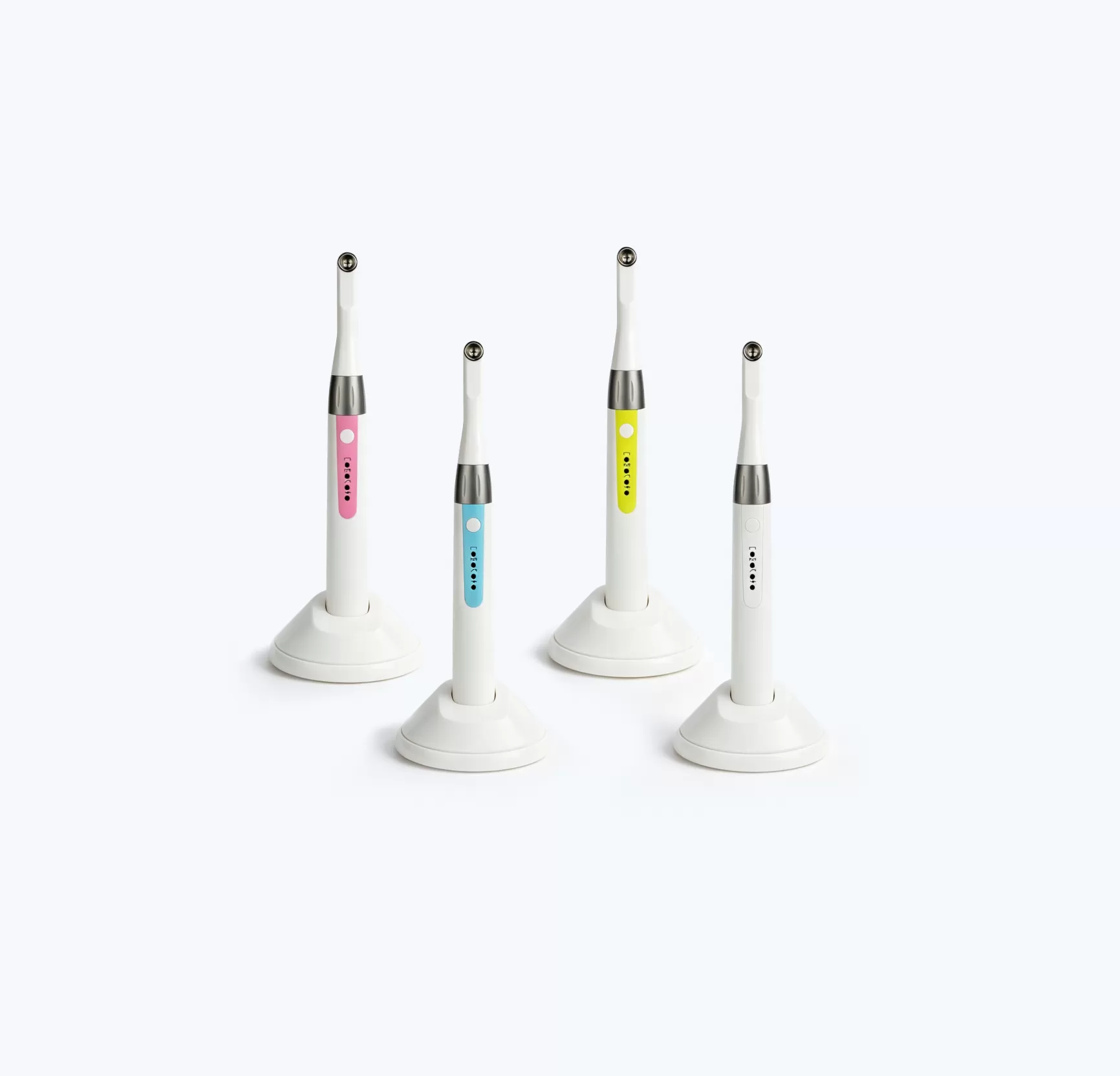
The ATBIO 1-Second Dental Curing Light cures at 2 mm depth in 1 second, powered by a 10W LED with a 360° rotational irradiation head. A faster cure means less time with a wet field, fewer patient-movement artifacts, and shorter appointments — provided the composite supports the recommended exposure. Always confirm depth-of-cure with your composite's instructions for use.
| Specification | ATBIO 1-Second Dental Curing Light |
|---|---|
| Light source | 10W LED with uniform beam profile* |
| Irradiation head | 360° rotational irradiation |
| Cure time | 1 second at 2 mm depth (documented)** |
| Modes | High-intensity, pulse, ramp |
| Available colors | Blue, White, Green, Pink |
| Compliance | CE (MDR 2017/745), ISO 10650:2018 aligned |
* High irradiance combined with uniform beam profile drives statistically significant higher DC% gains (p<0.001) across 42 pooled clinical studies (Alqaderi et al. 2021, PMID 34771794).
** Benchmark evaluation of 36 contemporary LED curing lights: only 39% simultaneously meet ≥1000 mW/cm² irradiance and uniform beam delivery (Durner et al. 2020, PMID 31685395).
A dental curing light is only half the system — the composite is the other. ATBIO's light-cured NANOFIL® Flowable Composite Resin (shrinkage below 2.4%) and NANOFIL® Z250 Universal Restorative (19 shades, high strength) are formulated to cure reliably under blue-light LED curing lights — matching resin and light removes a workflow variable. The light joins our dental equipment range, alongside the Compules Capsule Delivery Device for pressurized, contamination-free composite placement.
Interested in evaluating the 1-Second Dental Curing Light for your clinic or distributorship? Request a free evaluation sample →
Take a look inside our EN ISO 13485-certified production facility, where the 1-Second Dental Curing Light and the full ATBIO materials range are manufactured.
07 — FAQ: Best Curing Light Questions We Hear Most
What is the best dental curing light for daily use?
The right light combines adequate irradiance, blue-spectrum wavelength coverage, ergonomic rotational access, and reliable cordless operation — verified with a radiometer over time. Pairing it with ATBIO's internally tested light-cured composites simplifies compatibility further.
What wavelength is best for a dental curing light?
Look for emission covering the blue spectrum, roughly 400–500 nm, which matches standard camphorquinone-based light cure dentistry materials. Price RBT 2019 PMID 31693646 identifies emission spectrum match as the single most underrated compatibility driver for routine daily cure outcome.
How powerful should an LED curing light be?
Compare delivered irradiance (mW/cm²), not raw wattage. A 10W LED with a uniform beam and a documented 1-second cure at 2 mm depth meets routine restorative needs.
Is a curing light cordless model dependable?
Yes, when you dock it after use, follow the battery service schedule, and check output monthly with a radiometer. Modern LiPo cordless units match corded performance when maintained per the manufacturer's protocol.
What does pulse mode curing light mean?
Pulse mode alternates on/off light cycles to slow early polymerization and potentially reduce shrinkage stress; ramp mode gradually increases intensity. They are tools for sensitive cases, never a substitute for total energy dose.
How often should I check my curing light's output?
Monthly radiometer checks are a reasonable baseline; log readings and service the unit when output falls below clinically adequate levels. The Durner et al. 2020 PMID 31685395 survey confirms that output declines with use and only a written log catches the drift before restorations do.
Can I use one curing light with all my composite brands?
If their photoinitiators fall in the blue spectrum, generally yes — but pairing the light with ATBIO's own light-cured materials removes the compatibility question entirely, because ATBIO performs cross-material validation so you don't have to.
08 — References
Price RBT, et al. Light output from seven types of LED curing light measured using five laboratory parameters. 2019. pubmed.ncbi.nlm.nih.gov/31693646
Durner J, et al. Irradiance and beam profile of 36 contemporary LED light-curing units. 2020. pubmed.ncbi.nlm.nih.gov/31685395 / doi.org/10.1016/j.dental.2019.09.011
Alqaderi H, et al. Influence of irradiance on the degree of conversion and depth of cure of resin-based composites: a systematic review and meta-analysis. 2021. pubmed.ncbi.nlm.nih.gov/34771794 / doi.org/10.3390/ma14216525
Leprince JG, et al. Key principles of successful light curing in restorative dentistry. 2019. pubmed.ncbi.nlm.nih.gov/31002192
Price RB, Ferracane JL, Shortall AC. Light-curing units: a review of what we need to know. J Dent Res. 2015;94(9):1179-86. pubmed.ncbi.nlm.nih.gov/26156516 / doi.org/10.1177/0022034515594786
ISO 10650:2018. Dentistry — Powered polymerization activators. International Organization for Standardization. iso.org/standard/73302
ATBIO. 1-Second Dental Curing Light — Product page.
ATBIO. Compules Capsule Delivery Device — Product page.
About the Manufacturer
ATBIO (AT&M Biomaterials Co., Ltd.), headquartered in Beijing, is a 38-year dental materials manufacturer certified to CE (MDR 2017/745) and EN ISO 13485. Our products reach dental professionals in more than 100 countries. For inquiries, contact info@atmbio.com or +86-10-69778208, or visit atmbio.com.
Related Products
Do you prefer online learning?
Live webinars and professional tips — learn when, where and how.
Access our online learning opportunities