Composite Bonding Material Science | ATBIO
Composite bonding material science is best understood as a chain of interfaces. A resin matrix must convert into a stable polymer network; inorganic fillers must reinforce that network; a coupling layer must connect the two phases; and an adhesive must join the restorative material to enamel and dentin. A weakness at any link can affect handling, wear, polish, marginal integrity, or repairability.
That does not mean chemistry alone predicts how long a restoration will last. Case selection, isolation, preparation design, curing access, finishing, occlusion, patient risk, and compliance with each product's instructions for use remain decisive. This guide explains what the main material terms mean and how clinicians and buyers can evaluate them without turning a laboratory value into a clinical promise.
For a clinical overview, see the complete composite bonding guide. For a protocol comparison, review total-etch, self-etch, and universal bonding strategies.
01 — Resin Matrix Chemistry: Bis-GMA, UDMA, and TEGDMA
The organic matrix controls much of the uncured paste's flow and becomes a cross-linked polymer after activation. Most light-cured restorative composites combine dimethacrylate monomers to balance viscosity, filler incorporation and the resulting network. Naming a monomer does not disclose its proportion or prove the performance of the complete composite.
Bis-GMA has a rigid molecular structure and high viscosity. It can help provide a relatively stiff network, but its viscosity generally requires other monomers to make a workable, filler-rich paste.
UDMA is less viscous than Bis-GMA in many formulations and can be used to adjust conversion, toughness, and handling. Its effect depends on the complete monomer and filler system.
TEGDMA is a lower-viscosity reactive diluent. It improves flow and facilitates filler incorporation, but increasing its proportion can also alter shrinkage, water sorption, and network structure. Results from an experimental blend should not be projected directly onto every commercial composite.
| Matrix component | Typical formulation role | What the label cannot tell you alone |
|---|---|---|
| Bis-GMA | Rigid, high-viscosity base monomer | Final strength, shrinkage, or biological performance |
| UDMA | Lower-viscosity dimethacrylate used to tune handling and network properties | Whether the cured composite is tougher than another brand |
| TEGDMA | Reactive diluent that reduces viscosity | The net shrinkage stress of the full formulation |
| Photoinitiator system | Converts suitable light energy into initiating radicals | Adequate cure without wavelength, exposure, shade, and depth information |
For clinical use, ask how the complete formulation polymerizes under the intended curing conditions and how its properties change after water storage, temperature cycling and loading. A conversion value from a thin, directly illuminated specimen does not establish adequate cure at the bottom of a deeper or more opaque increment.
02 — Dental Composite Fillers: More Than a Loading Percentage
Inorganic fillers can increase stiffness, strength, wear resistance, radiopacity, and dimensional stability while also shaping viscosity, translucency, opacity, and polishability. Common filler families include silica and radiopaque glasses containing elements such as barium, strontium, or zirconium. Their composition, size, shape, surface treatment, and distribution all matter.
Terms such as microhybrid, nanohybrid, and nanofilled describe aspects of particle architecture, but they are not universal performance grades. A nanohybrid formulation can combine smaller particles with other filler fractions to balance sculptability, surface finish, and load-bearing properties. Performance still depends on the matrix, total filler system, silanization, degree of conversion, and test method.
Filler loading also needs context. Weight percentage and volume percentage are not interchangeable because resin and mineral fillers have different densities. Two materials with the same wt% may not have the same vol%, viscosity, flexural behavior, or wear. For purchasing comparisons, use the same unit and the same standardized test method—and request shade-specific or product-specific data when relevant.
03 — The Silane Interphase: Connecting Glass to Resin
Mineral filler and methacrylate resin do not form an effective reinforcing system merely by being mixed together. Manufacturers commonly treat silica-containing filler surfaces with an organosilane coupling agent. One part of the coupling molecule interacts with the hydroxylated filler surface, while its polymerizable group participates in the resin network.
This interphase helps transfer stress between the softer polymer and the stiffer filler. It also influences viscosity, water uptake, wear, and the way a surface ages. Silane coverage and condensation are formulation and manufacturing variables; more silane is not automatically better. The siloxane-rich connection can be susceptible to hydrolysis, so accelerated water-aging results are useful when comparing experimental materials.
Chairside silane has a related but distinct role in repair and indirect bonding. For etchable glass ceramic, use the specified hydrofluoric-acid (HF) and silane sequence or an explicitly validated alternative; MDP is not a substitute for that treatment. Do not HF-etch zirconia, which needs its own surface protocol. Follow the substrate and bonding-system instructions, including chemical handling precautions, rather than assume a universal adhesive replaces every primer.
04 — Polymerization: What the Curing Light Must Accomplish
During light curing, photons absorbed by the photoinitiator system generate reactive species that convert carbon–carbon double bonds into a cross-linked network. Conversion is never described adequately by exposure time alone. The following factors work together:
spectral match between the curing unit and the material's photoinitiators;
irradiance and exposure time, which together contribute to radiant exposure;
distance, angle, light-tip diameter, and beam uniformity;
increment thickness, shade, opacity, and filler-related light scattering;
contamination and the condition of the curing-light tip.
A high number on a radiometer cannot compensate for poor positioning or an incompatible spectrum. Nor should a laboratory “depth of cure” result be treated as permission to exceed the manufacturer's increment thickness. Use the material IFU, keep the light tip close and correctly oriented where access permits, verify output routinely, and extend exposure only within a validated clinical protocol.
Polymerization shrinkage is the dimensional change associated with network formation; shrinkage stress is the stress that develops when that change is constrained by bonded cavity walls. The two are related but not identical. Elastic modulus development, reaction rate, cavity geometry, bonded surface configuration, adhesive compliance, and placement technique all influence the stress transferred to the tooth–restoration interface.
05 — Enamel Retention and the Dentin Hybrid Layer
Enamel bonding is primarily micromechanical: acid conditioning creates surface microporosities that resin can infiltrate and polymerize within. Dentin is more complex because it is hydrated, contains a collagen-rich organic matrix, and is traversed by tubules. The smear layer created during preparation also changes how an adhesive reaches the underlying substrate.
In etch-and-rinse bonding, phosphoric acid removes the smear layer and demineralizes superficial dentin before the adhesive infiltrates the exposed collagen scaffold. Self-etch systems condition and infiltrate at the same time through acidic monomers. Universal adhesives may be designed for more than one mode. The resin-infiltrated zone created in conditioned dentin is the hybrid layer.
Functional monomers such as 10-MDP can interact with calcium in hydroxyapatite as well as participate in polymerization. This is an additional adhesion mechanism, not a guarantee of durable bonding by itself. Monomer concentration and purity, water and solvent balance, active application, evaporation, film thickness, curing, and the amount of residual hydroxyapatite all influence the resulting interface.
Hybrid-layer degradation involves both resin and collagen. Water can plasticize or hydrolyze resin components, while incompletely infiltrated collagen is vulnerable to mechanical fatigue and host-derived proteases, including matrix metalloproteinases and cysteine cathepsins. Frassetto and colleagues review these interacting mechanisms. They support careful infiltration, solvent removal and curing, not routine addition of unapproved disinfectants, enzyme inhibitors or extra primers.
06 — Bioactive Glass in Adhesive Research: Promise and Evidence Limits
Bioactive glasses can release ions and form calcium-phosphate-rich deposits under suitable laboratory conditions. Mesoporous bioactive glass (MBG) has a high internal surface area and is being investigated as a functional filler or carrier in restorative and adhesive materials. Laboratory studies have explored mineral deposition, acid buffering, and bond preservation, but the evidence depends on glass chemistry, particle loading, resin formulation, test medium, and aging design.
The important distinction is between a mechanism, a laboratory outcome, and a patient outcome. Evidence that one experimental bioactive-glass formulation forms apatite cannot establish reduced sensitivity, secondary-caries prevention, or longer clinical service for every MBG-containing product. A systematic review of bioactive glass for dentin remineralization found encouraging apatite formation but insufficient evidence to equate that with recovery of dentin's mechanical properties.
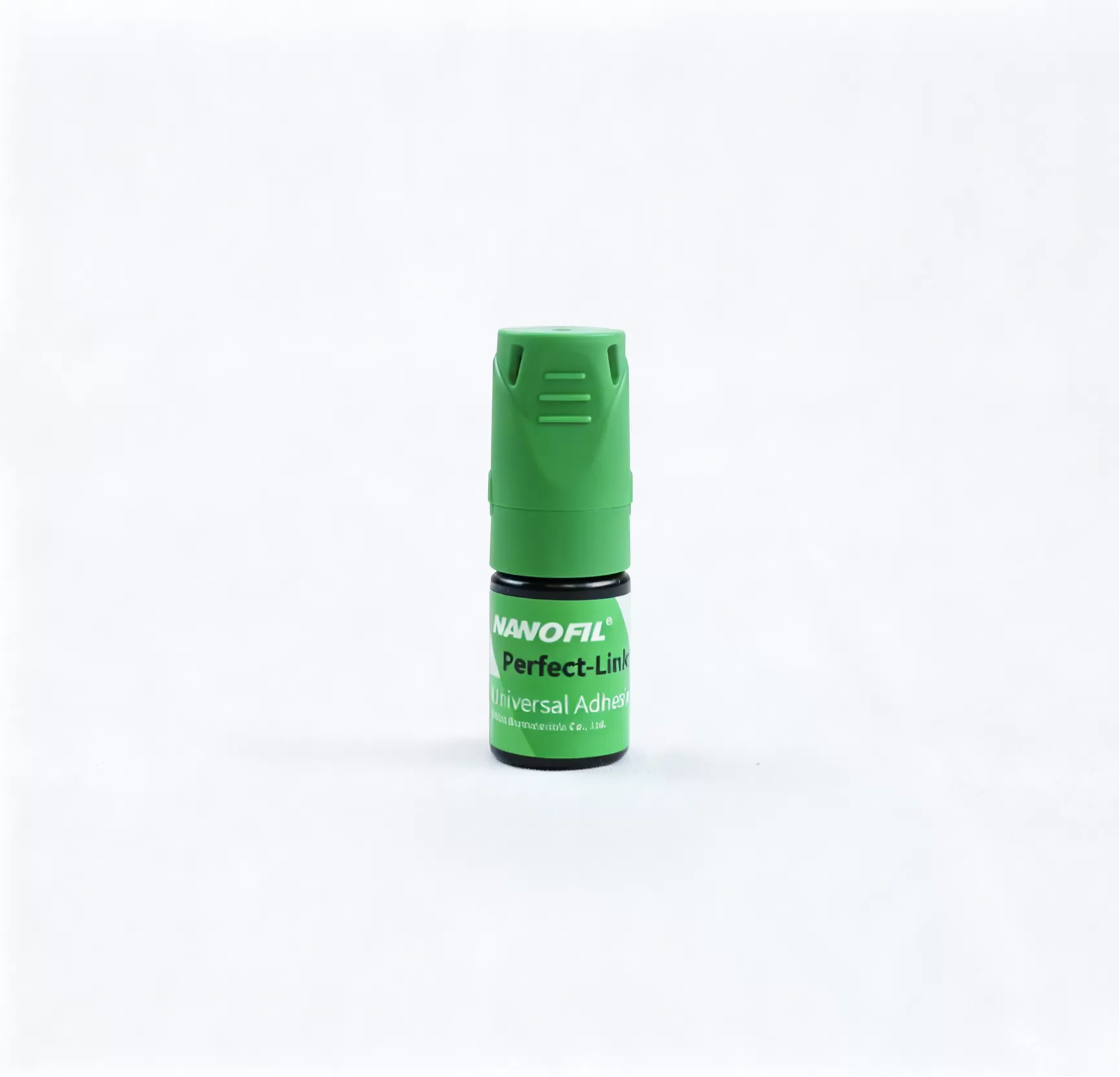
ATBIO's NANOFIL® Perfect-Link Universal Adhesive page identifies MDP and MBG and lists multiple etching approaches. This establishes the manufacturer's stated formulation features, not independent proof of remineralization or reduced sensitivity in patients. Request product-specific validation and the applicable instructions before making those claims; evidence from another experimental glass or adhesive cannot be transferred to Perfect-Link.
07 — How to Evaluate Composite and Adhesive Evidence
| Question | Useful evidence | Common interpretation error |
|---|---|---|
| Is the composite adequately cured? | Shade- and thickness-specific conversion or hardness data under a stated spectrum and radiant exposure | Comparing exposure time without checking irradiance, wavelength, or distance |
| Does filler architecture support the indication? | Filler type, wt% and vol%, particle distribution, radiopacity, wear and flexural data | Treating “nano” as a stand-alone guarantee of strength or polish |
| Is the filler–matrix interface stable? | Silane process controls plus water-aging and thermocycling data | Judging only an immediate dry specimen |
| Is bonding evidence clinically relevant? | Substrate, etching mode, application time, aging method, failure mode, and clinical follow-up | Using one immediate bond-strength value to predict restoration survival |
| Is a bioactive claim proportionate? | Product-specific ion-release, mineralization, mechanical, safety, and preferably clinical data | Applying results from a different glass concentration or resin system |
Buyers should also confirm lot traceability, shelf life and storage requirements, IFU availability, curing compatibility, shade and delivery format, complaint handling, and documentation for the intended market. A technically attractive formulation is only useful when manufacturing controls and clinical instructions make its performance reproducible.
08 — From Materials Science to a Coherent Workflow
Translate the science into a compatible sequence: select the composite for the indication and optical plan, match the adhesive strategy to enamel and dentin, and verify curing at the actual working distance. Follow the adhesive's own curing step rather than assume later composite curing will compensate. With self- or dual-cure materials, confirm chemical compatibility and any activator requirement. Isolation, specified increments, contouring, finishing and occlusal review still determine the result.
ATBIO's dental composite resin portfolio includes restorative formats for different clinical workflows. For example, the official page describes NANOFIL® Z250 Universal Restorative as a nanohybrid composite for anterior and posterior restorations, while NANOFIL® P60 Posterior Restorative is positioned for posterior use. Indications, increments, exposure, shades, and finishing steps should always follow the product-specific IFU.
09 — Frequently Asked Questions
Is Bis-GMA always better than UDMA in a dental composite?
No. They have different viscosity and network characteristics, and commercial materials normally use a coordinated matrix–filler system. Clinical suitability cannot be inferred from one named monomer.
Does a higher filler percentage always mean a stronger composite?
No. The unit (wt% or vol%), filler composition and distribution, silane treatment, resin matrix, porosity, and degree of conversion all affect performance. Compare like with like under the same test method.
What is the difference between the hybrid layer and resin tags?
The hybrid layer is resin-infiltrated conditioned dentin, including the collagen-rich interfacial zone. Resin tags are extensions of cured resin into tubules or enamel microporosities. Their appearance alone does not prove a durable bond.
Can longer curing compensate for placing an increment that is too thick?
Not as a general rule. Light attenuation is material- and shade-specific, and spectral compatibility still matters. Use the maximum increment thickness and exposure stated in the current IFU.
Does MBG in an adhesive prove remineralization in patients?
No. MBG provides a scientifically plausible platform for ion-mediated effects, and laboratory evidence is developing. Clinical conclusions require product-specific evidence under relevant use conditions.
10 — References
Ferracane JL. Resin composite—state of the art. Dental Materials. 2011. https://pubmed.ncbi.nlm.nih.gov/21093034/
Ilie N, Hickel R. Resin composite restorative materials. Australian Dental Journal. 2011. https://pubmed.ncbi.nlm.nih.gov/21564116/
Antonucci JM, Dickens SH, Fowler BO, Xu HHK, McDonough WG. Chemistry of Silanes: Interfaces in Dental Polymers and Composites. https://pmc.ncbi.nlm.nih.gov/articles/PMC4847576/
Frassetto A, et al. Mechanisms of degradation of the hybrid layer in adhesive dentistry and therapeutic agents to improve bond durability—A literature review. Dental Materials. 2016. https://pubmed.ncbi.nlm.nih.gov/26743967/
Carrilho E, et al. 10-MDP Based Dental Adhesives: Adhesive Interface Characterization and Adhesive Stability—A Systematic Review. https://pmc.ncbi.nlm.nih.gov/articles/PMC6427605/
Watts DC. Light-curing dental resin-based composites: How it works and how you can make it work. https://pubmed.ncbi.nlm.nih.gov/39916906/
Fernando D, et al. Bioactive glass for dentin remineralization: A systematic review. https://pubmed.ncbi.nlm.nih.gov/28482504/
ATBIO. NANOFIL® Perfect-Link Universal Adhesive product page. /dental-adhesives/perfect-link-universal-dental-adhesive
11 — About the Manufacturer
This article is published by ATBIO, the dental-materials brand of AT&M Biomaterials Co., Ltd.
ATBIO is the dental-materials brand of AT&M Biomaterials Co., Ltd. Product selection and supply discussions should be based on the intended indication, local regulatory requirements, the current IFU, and product-specific technical documentation. This page does not claim unconditional sale authorization in every country.
For a formulation and documentation review matched to your restorative portfolio, request a quote.
12 — Related Products
Clinical decisions must follow the applicable product instructions and professional judgment. Literature on a material class does not replace product-specific evidence.
Do you prefer online learning?
Live webinars and professional tips — learn when, where and how.
Access our online learning opportunities