Meilleur adhésif dentaire : quelle colle est sûre pour les dents | ATBIO
At ATBIO, we have spent 38 years manufacturing dental materials at our ISO 13485-certified facility in Beijing, and no question reaches us more often from clinicians and distributors than this: which tooth adhesive should I stock, and what glue is safe for teeth? A dependable tooth adhesive is the difference between a restoration that serves a patient for a decade and one that fails within months. This article explains what glue dentists actually use, what makes an enamel adhesive strong and biocompatible, and how to choose the best dental adhesive for your practice — with the verified specifications of two adhesives we manufacture, so you can benchmark them against any material on the market.
01 — What Glue Is Safe for Teeth? A Direct Answer
Only materials designed and regulated for intraoral use are safe for teeth. Household superglue, craft adhesives, and denture repair kits contain solvents and monomers that can irritate the pulp and oral soft tissues — none of them are tested for long-term contact with the oral environment. If you are asking "what glue can I use on my teeth" at home, the answer is: none. See a dentist instead.
What Makes a Tooth Adhesive Safe: ISO 13485 and CE Marking
A safe tooth adhesive is manufactured under a quality management system such as EN ISO 13485 and, where applicable, carries CE marking under the EU MDR 2017/745. At our Beijing plant, every batch of dental bonding agent we ship is produced under this framework. That gives distributors and clinicians documented traceability, not marketing claims. Two documents matter when you evaluate an adhesive: the CE certificate and the instructions for use. Polymer-based restorative materials are further covered by standards such as ISO 10477:2018, which anchors the performance and biocompatibility expectations for this class of material.
Non-Toxic Glue for Teeth: What Is Available
For temporary situations at home, only products explicitly labelled for oral use — such as temporary crown cements or denture adhesives — are considered safe, and even these are for short-term, non-restorative situations. Durable dental repair belongs exclusively to professional dental adhesives and resin cements applied in the dental office.
02 — What Is a Tooth Adhesive? The Role of the Dental Bonding Agent
A tooth adhesive is a dental bonding agent that creates a mechanical and chemical link between resin composite and the tooth structure, both enamel and dentin. Without this bond, even a well-contoured filling can leak at the margins — the result is recurrent caries, postoperative sensitivity, and eventual debonding.
Etch-and-Rinse vs. Self-Etch: The Two Documented Routes
Adhesive systems follow one of two clinical approaches. Etch-and-rinse systems apply phosphoric acid gel first, then primer and adhesive. Self-etch systems use an acidic primer that conditions and bonds in one step. Both routes are well documented: the classification and long-term behavior of these systems are reviewed in depth by Van Meerbeek and colleagues (PMID 32485234) and by Giannini and colleagues, who trace two decades of self-etch development (PMID 31348985). Total-etch delivers the strongest enamel bond; self-etch cuts steps and lowers technique sensitivity.
03 — What Type of Glue Do Dentists Use?
Dentists do not use "glue" — they use medical-grade adhesives, each built for a specific clinical job:
Universal adhesives — the standard today; one bottle works with total-etch, selective-etch, or self-etch protocols across direct and indirect restorations.
Total-etch adhesives — maximum enamel bond strength after 35–37% phosphoric acid etching; ideal for enamel-rich cases with predictable isolation.
Self-etch adhesives — simplified steps and lower postoperative sensitivity; suited to sensitivity-prone patients and faster workflows.
Resin cements — for crowns, bridges, and posts; cementation materials rather than adhesives for direct restorations, including dual-cure and self-adhesive resin cements such as NANOFIL NanoCem Ultimate.
04 — Enamel Adhesive Performance: The Specifications That Matter
Bond Strength to Enamel and Dentin
When clinicians evaluate an enamel adhesive, the first figure they ask about is bond strength. Our NANOFIL® Dental Bonding Agent delivers >28 MPa adhesion to enamel and dentin. It is a single-component, light-cured material with instant adhesion and good elasticity — properties that help the interface absorb masticatory stress instead of transmitting it to the tooth.
Moisture Tolerance and Sensitivity Control
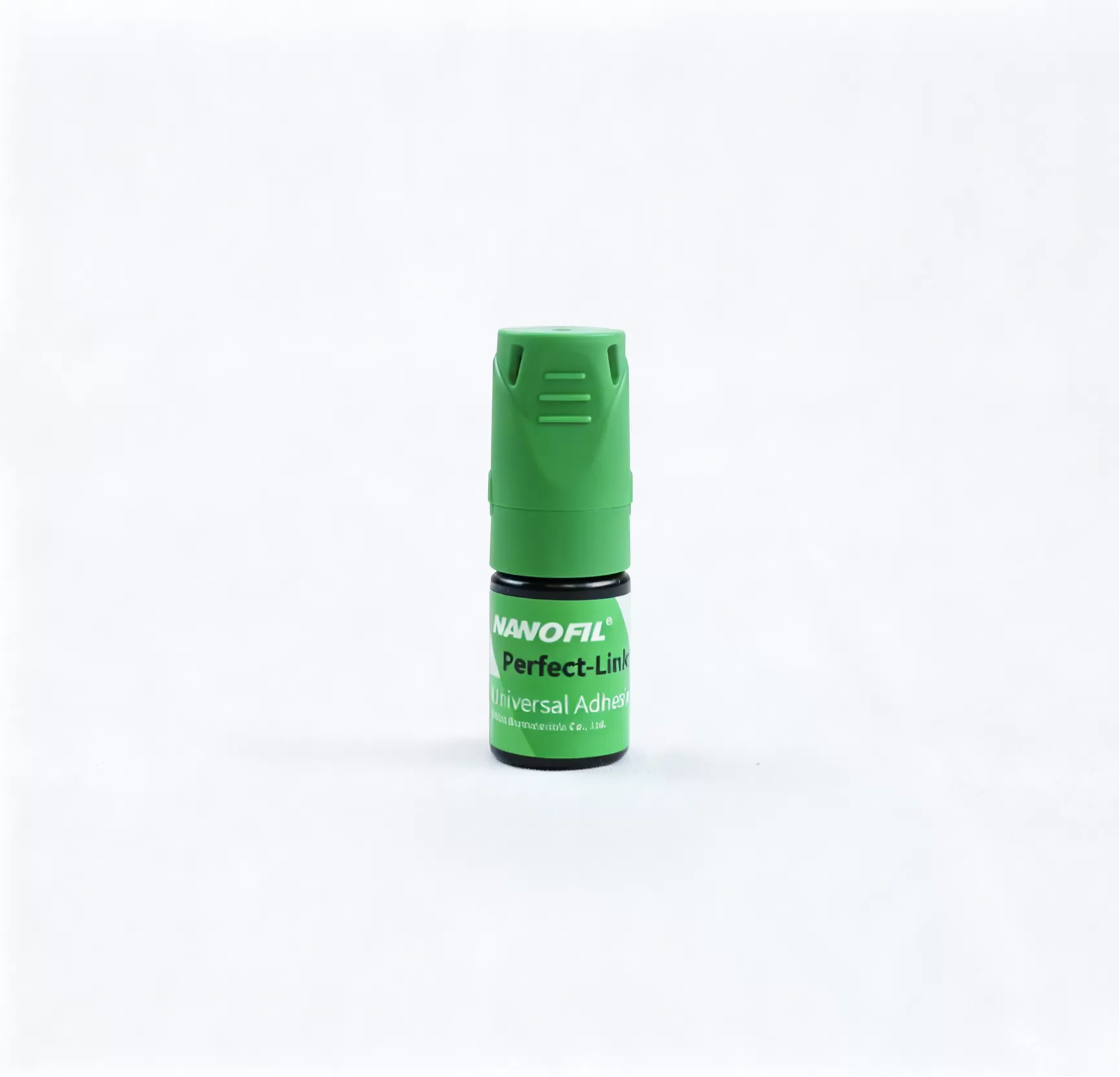
For wet bonding, the Perfect-Link Universal Adhesive combines MBG, a bioactive glass technology, with MDP, the functional monomer widely studied for its chemical affinity to hydroxyapatite. This combination provides strong adhesion on both wet and dry dentin, promotes remineralization at the adhesive interface, and reduces postoperative sensitivity — an outcome patients notice immediately after treatment.
05 — Best Dental Adhesive: Professional Comparison
| Feature | NANOFIL® Dental Bonding Agent | Perfect-Link Universal Adhesive |
|---|---|---|
| Best for | Fast everyday direct bonding | Universal wet/dry bonding, sensitivity-prone cases |
| Adhesion to enamel and dentin | >28 MPa | Strong wet and dry adhesion |
| Chemistry | Single-component, light-cured | MBG + MDP technology |
| Clinical benefits | Instant adhesion, good elasticity | Promotes remineralization, reduces sensitivity |
| Packaging | 5 ml/bottle | 5 ml/bottle |
Both products belong to our dental adhesives range, alongside etchants such as the NANOFIL® Etchant Gel (35%/37% phosphoric acid) for total-etch workflows.
Total-Etch vs. Self-Etch: When Each Wins
| Criterion | Total-Etch (Etch-and-Rinse) | Self-Etch |
|---|---|---|
| Enamel conditioning | 35–37% H₃PO₄ gel, 15–30 s, then rinse | Acidic primer inside the bonding step |
| Enamel bond strength | High, well documented | Good; improving with newer formulas |
| Steps at the chairside | Etch, rinse, dry, prime, bond | One or two simplified steps |
| Postoperative sensitivity | Manageable with careful technique | Reduced with simplified steps* |
| 10-year clinical retention | Strong track record** | Slightly lower on dentin in simplified forms** |
| Best suited for | Enamel-rich cases, predictable isolation | Sensitivity-prone patients, faster workflows |
* Simplified self-etch steps lower immediate postoperative sensitivity by avoiding the moisture-control pitfalls of rinse-and-dry techniques (Van Meerbeek et al. 2020, PMID 32485234).
** A 10-year meta-analysis found that etch-and-rinse systems retained significantly better dentin bonds over a decade than one-step self-etch systems, with a hazard ratio of about 0.84 (De Munck et al. 2020, PMID 32620664).
For most clinicians, a pragmatic route is to keep both families available: use a reliable etch-and-rinse adhesive for routine enamel-rich cases, and a universal or self-etch system for wet dentin, tricky isolation, or sensitive patients. That is exactly why ATBIO produces both the NANOFIL® Bonding Agent and the Perfect-Link Universal Adhesive within one dental adhesives range.
06 — Best Dental Adhesive for Bridges
Bridges place special demands on the luting interface: full-coverage margins, minimal cement-line thickness, and long-term retention under occlusal load. For well-fitting metal and PFM bridges, a fluoride-releasing glass ionomer such as GK® Glass Ionomer Luting Cement (Type I) provides chemical adhesion with a film thickness below 18 µm. For all-ceramic and high-strength zirconia bridges, a dual-cure self-adhesive resin cement such as NANOFIL NanoCem Ultimate delivers superior bond strength to the restoration material. Always follow the cement's instructions for use for mixing ratios, working time, and curing.
07 — Clinical Application Points for Reliable Bonding
Etch enamel selectively with 35–37% phosphoric acid gel according to the manufacturer's instructions, rinse thoroughly, and keep dentin slightly moist before applying a wet-bonding adhesive.
Apply the tooth adhesive in a thin, uniform layer, air-thin gently to evaporate the solvent, and light-cure at the wavelength recommended by your curing unit.
When placing composite, use incremental layering to keep the bond interface stable and limit polymerization stress.
For patients with a history of sensitivity, consider a universal adhesive with MDP, such as Perfect-Link, before composite placement.
Interested in testing ATBIO adhesive systems in your clinic or adding them to your catalog? Request a free evaluation sample →
08 — FAQ: Tooth Adhesive Questions We Hear Most
What glue is safe for teeth at home?
No household glue is safe for teeth. Only a dental bonding agent formulated for intraoral use, ideally CE-marked and produced under ISO 13485, should ever touch tooth structure.
What type of glue do dentists use?
Dentists use professional dental adhesives (universal, total-etch, or self-etch bonding agents) for direct restorations and resin cements or glass ionomer luting cements for crowns and bridges — never household adhesives.
What is the best dental adhesive for everyday restorations?
For routine direct composite restorations, a single-component, light-cured bonding agent such as the NANOFIL® Dental Bonding Agent offers >28 MPa adhesion with fast, predictable application. Ten-year clinical data show that etch-and-rinse adhesives keep their bond at high rates over a decade of service (De Munck et al. 2020, PMID 32620664).
Can a dental bonding agent be used on wet dentin?
Yes, if it is designed for wet bonding. Perfect-Link Universal Adhesive provides strong adhesion on wet and dry dentin thanks to its MBG and MDP technology. How simplified and universal systems behave on moist dentin is a core theme in the adhesive literature (Van Meerbeek et al. 2020, PMID 32485234).
What is the best dental adhesive for bridges?
For well-fitting metal and PFM bridges, a glass ionomer luting cement provides chemical adhesion and fluoride release; for all-ceramic and zirconia bridges, a dual-cure self-adhesive resin cement is preferred. Both are available from ATBIO — see our cements portfolio.
Can the bonding agent itself cause sensitivity?
Correct application reduces sensitivity. The MDP-containing Perfect-Link is specifically formulated to reduce postoperative sensitivity while promoting remineralization at the interface. Research confirms that simplified self-etch steps lower the incidence of immediate postoperative sensitivity, while careful total-etch technique remains fully viable (Van Meerbeek et al. 2020, PMID 32485234).
Which adhesive approach lasts longer: total-etch or self-etch?
On enamel, both approaches perform well. On dentin, a 10-year meta-analysis reports that etch-and-rinse systems retained significantly more bond strength than one-step self-etch systems, with a hazard ratio near 0.84 (De Munck et al. 2020, PMID 32620664). Two decades of self-etch research have narrowed the gap, but simplified systems still deserve careful selection for load-bearing posterior restorations (Giannini et al. 2019, PMID 31348985).
09 — References
Van Meerbeek B, et al. State of the art of self-etch adhesives. Dent Mater. 2020. pubmed.ncbi.nlm.nih.gov/32485234 / doi.org/10.2341/19-382-L
De Munck J, et al. Ten-year bond strength retention of adhesive systems: a meta-analysis. Dent Mater. 2020. pubmed.ncbi.nlm.nih.gov/32620664 / doi.org/10.1016/j.dental.2020.06.006
Giannini M, et al. Self-etch adhesives: a 20-year perspective. J Dent. 2019. pubmed.ncbi.nlm.nih.gov/31348985 / doi.org/10.1016/j.jdent.2019.07.013
Perdigão J, et al. Dental adhesives: a comprehensive literature review. 2018. pubmed.ncbi.nlm.nih.gov/29243244
ISO 10477:2018. Dentistry — Polymer-based restorative materials. International Organization for Standardization.
ATBIO. Dental Adhesives Product Range — Overview.
ATBIO. Contact and partnership.
About the Manufacturer
ATBIO (AT&M Biomaterials Co., Ltd.) is a Beijing-based dental materials manufacturer with 38 years of production experience. Our products are CE (MDR 2017/745) certified and manufactured under EN ISO 13485, and they are trusted by dental professionals in more than 100 countries. Visit www.atmbio.com or contact us at info@atmbio.com or +86-10-69778208.
Related Products
Préférez-vous l’apprentissage en ligne ?
Webinaires en direct et conseils professionnels : apprenez quand, où et comment.
Accédez à nos possibilités d’apprentissage en ligne