Single-Shade Composite: Where Matching Can Fail | ATBIO
Single-shade composite offers distributors a practical way to simplify the shade assortment they present to dental customers. The purchasing decision is broader than choosing one syringe: it includes the intended restorations, handling preferences, evaluation method and product information the sales team will use. This guide connects those decisions with ATBIO's ONELUX and ONELUX CHROME documentation.
Inside this guide: ONELUX and CHROME specifications, a six-step sample evaluation and a purchasing checklist for distributors and OEM teams.
1. Where single-shade composite fits in a product portfolio
A one-shade line can make product selection and replenishment easier to organize for suitable applications. Instead of maintaining the same depth of stock across many shade codes, a distributor can allocate stock to the applications and presentation formats its customers actually request. The commercial benefit depends on the existing shade mix, turnover and customers' restorative workflows; it should be assessed using your own order history.
Single-shade and multi-shade products can serve complementary roles. A useful assortment can offer a single-shade option for streamlined workflows alongside materials chosen for specific aesthetic or opacity requirements. Define the role of each SKU before deciding which stock it replaces. For a broader product comparison, see the ATBIO composite selection matrix.
2. Understand the appearance you are evaluating
The visible result is a combination of the cured material, surrounding tooth, background and surface finish. Translucency describes how light passes through the material; opacity describes its ability to limit the background's influence. Shade blending concerns the appearance of the restoration within its surroundings. These are related properties, but they answer different selection questions.
In a 2025 laboratory study, researchers assessed three single-shade products using different specimen thicknesses and backgrounds. Their findings support considering material, thickness and background together during optical evaluation. The study concerns the named materials in its experimental setup. Research source
A 2015 multicenter study on dental ceramics reported CIEDE2000 (ΔE00) 50:50 perceptibility and acceptability thresholds of 0.8 and 1.8, respectively. These describe different observer judgments. Paravina et al., 2015
Set the evaluation question before comparing samples. Record separately whether an observer notices a color difference and whether the finished appearance is acceptable for the defined application. If instrument readings are included, record the color-difference formula and viewing conditions. The ceramic-study thresholds provide methodological context; they are not ONELUX or CHROME test results, masking-thickness requirements or product acceptance limits. Agree the sample criteria with qualified evaluators for your own setup.
For procurement, turn this knowledge into a comparison plan: identify the typical background and restoration geometry your customers work with, then evaluate finished samples under consistent viewing conditions. A product photograph is useful for identifying packaging; a controlled sample is more informative for comparing the optical result.
| Selection question | What to compare | How to use the result |
|---|---|---|
| Routine shade simplification | Representative tooth shades and surrounding walls in a suitable model | Define the applications covered by your introduction kit |
| Background influence | Comparable specimens on documented light and darker backgrounds | Decide which additional shade or masking information the team needs |
| Aesthetic characterization | Shade, translucency, surface finish and intended restoration | Position complementary products within the assortment |
| Handling preference | Placement, adaptation, contour retention and finishing | Match the evaluation to the customer's workflow |
3. ONELUX and ONELUX CHROME: keep the product records distinct
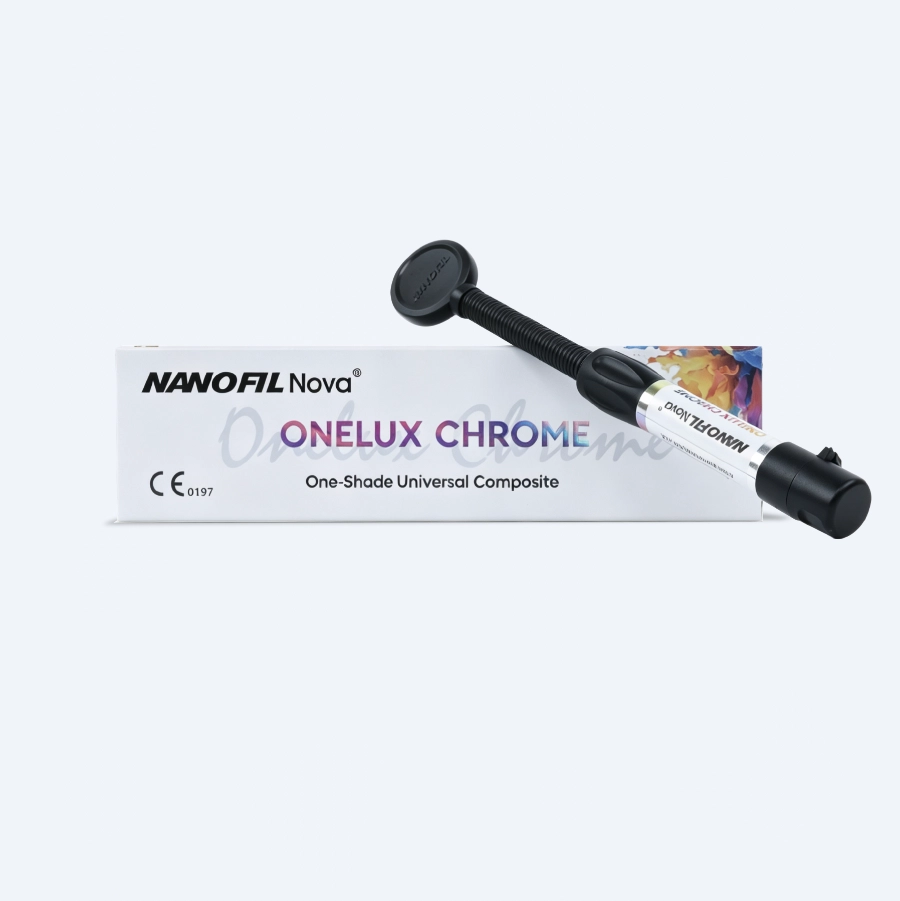
The reviewed V2601 instructions describe both ONELUX and ONELUX CHROME as light-cured, radiopaque composites for anterior and posterior restorations. Both list restorations of all cavity classes. The CHROME instructions additionally list direct veneers, diastema closure and repair of ceramic restorations. Use the exact product’s instructions when selecting a procedure.
| Documentation field | ONELUX | ONELUX CHROME |
|---|---|---|
| Filler content stated in the IFU | 81% by weight; 65% by volume | 80% by weight; 75% by volume |
| Filler size stated in the IFU | 0.05–1.5 µm | Less than 0.2 µm |
| Radiopacity stated in the IFU | 180% aluminium | 200% aluminium |
| Increment and light-curing instructions | Maximum 2 mm; each increment 20 seconds; 400–500 nm; at least 1000 mW/cm² | Maximum 2 mm; each increment 20 seconds; 400–500 nm; at least 1000 mW/cm² |
These are product-documentation values, not a head-to-head clinical ranking. Keep weight and volume percentages in separate columns. The curing conditions form one instruction set: a higher device output is not permission to shorten the stated exposure by arithmetic. Confirm that the supplied SKU and instructions match the product being evaluated.
For darker or discolored backgrounds, the CHROME instructions include a blocker step and name NANOFIL Nova LC UNIVERSAL COMPOSITE BW as an example. Include this part of the system in a relevant evaluation and confirm the current shade designation and supply configuration with ATBIO. Do not transfer that material combination to another product without its supporting instructions.
4. A repeatable sample evaluation in six steps
Define the purchasing question. State whether the aim is shade simplification, a new aesthetic line or a private-label project. Identify the reference material and the result your team needs to decide.
Identify the samples. Record exact product, lot, expiry, presentation and IFU revision. Evaluate ONELUX and CHROME on separate records.
Prepare comparable models. Use a documented background and geometry with final specimen thickness recorded. Keep the preparation method consistent while following each material's own placement limits. Model evaluation should precede any clinical evaluation organized by qualified professionals.
Control curing and finishing. Record light model, mode, exposure, tip position and finishing system. Use the conditions prescribed for each product; identical specimen geometry does not mean identical instructions for every candidate.
Evaluate the finished result. Compare appearance under the same lighting and viewing arrangement. Record handling and optical observations separately. If photography is used, retain camera settings and an unedited reference image.
Agree the next step. Decide which product and application proceed to a broader evaluation, which documentation is still needed and what to include in the initial assortment. A purchasing screen establishes the scope of the next assessment; clinical claims need appropriate clinical evidence.
5. Copy this sample record into your evaluation file
The following is an ATBIO-proposed purchasing template, not a published test standard or a completed clinical study. Agree acceptance criteria with the qualified evaluators before starting.
| Record field | Entry to complete |
|---|---|
| Project and intended market | Company / country / distributor or OEM project |
| Product identification | Exact name / lot / expiry / presentation / IFU version |
| Application and reference | Intended use / model / current reference material |
| Optical setup | Background / surrounding material / final thickness / lighting |
| Processing | Increment / light and mode / exposure / finishing sequence |
| Observations | Appearance / handling / adaptation / polish, recorded separately |
| Decision | Suitable for the defined evaluation goal / further evaluation needed / additional information requested |
| Traceability | Evaluator / date / specimen IDs / photographs / follow-up owner |
Illustrative decision example: a distributor wants to introduce a single-shade option while retaining an established aesthetic line. It prepares representative models, records the chosen material and evaluates appearance and handling separately. The purchasing decision is then a defined sample assortment and training plan, rather than replacing every existing shade at once. This is a planning example, not an ATBIO customer case or performance result.
6. Turn the evaluation into a distributor or OEM brief
A useful brief contains your target market, customer group, intended applications, preferred presentation, estimated quantity and whether the project uses the ATBIO brand or private labeling. Attach the evaluation record and list the exact documents needed: current IFU, available packaging options, label information, shelf-life and storage details, and market-specific supply documentation.
For OEM discussions, separate the approved reference sample from artwork and packaging approval. Record the product identity associated with each approval so a translated label, a demonstration sample and a later order all refer to the same specification. Commercial conditions and available customization should be confirmed for the project.
Request ATBIO product and sample information with your selection brief. Include ONELUX or ONELUX CHROME by name so the response can address the correct product and documentation.
Frequently asked questions
What is the main purchasing value of a single-shade composite?
It can simplify the shade assortment for suitable workflows. Assess that value alongside actual customer demand, sample evaluation and replenishment needs rather than counting shade codes alone.
How should a distributor compare shade blending?
Use cured, finished specimens with documented background, geometry and viewing conditions. Keep a reference material in the comparison and evaluate handling separately from appearance.
What should be evaluated for a darker background?
Review the optical requirements and the exact product's masking guidance. CHROME's V2601 instructions include a blocker step for dark or discolored teeth; obtain the current supporting material information for your project.
Can ONELUX and CHROME be presented as one specification?
They should have separate product records. Their stated filler and radiopacity values differ, and customers should receive the instructions corresponding to the exact product supplied.
What should an OEM sample request contain?
The intended market, applications, presentation, quantity estimate, labeling needs and evaluation criteria. State which formulation or named reference product is being considered before discussing packaging.
References and product documentation
Technical sources checked: 13 October 2026. The studies inform the optical discussion and interpretation of color differences; ATBIO product specifications come from the corresponding V2601 instructions. The purchasing template and planning example are editorial tools, not experimental data.
Additional product documentation
About the manufacturer
ATBIO is the dental-materials brand of AT&M Biomaterials Co., Ltd. Explore ONELUX, ONELUX CHROME and NANOFIL Universal Aesthetic when planning your composite assortment. Product selection and supply documentation depend on the exact SKU and destination. Dental materials are for professional use according to their applicable instructions.
Préférez-vous l’apprentissage en ligne ?
Webinaires en direct et conseils professionnels : apprenez quand, où et comment.
Accédez à nos possibilités d’apprentissage en ligne