Dental Composite Resin Selection Matrix | NANOFIL® Guide
Choosing the right dental composite is a selection matrix, not a popularity contest. Every composite on the market is a compromise between strength, polish, flow, and optics — and the material that wins in a Class II posterior box is rarely the same one that wins in a smile-zone veneer. After 38 years of manufacturing composite resins in our EN ISO 13485-certified facility in Beijing, we have learned that the best dental composite for a practice is the portfolio that matches its case mix. This guide gives you a complete composite resin selection matrix: material classes, the universal vs flowable question, the three numbers that decide performance, and a practical table mapping clinical scenarios to the right NANOFIL® material.
01 — What Is a Dental Composite?
A dental composite is a tooth-colored, light-cured restorative material made of three essential components: a resin matrix, inorganic fillers, and a coupling agent that bonds the two together. When you place a composite and cure it with a curing light, the matrix polymerizes and locks the fillers into a hard, wear-resistant solid that mimics the optical behavior of natural tooth structure (Ferracane, 2011; PMID 21093034).
Composite Resin Composition: The Resin Matrix
The resin matrix — typically methacrylate monomers such as Bis-GMA, UDMA, or TEGDMA — determines handling, curing, and shrinkage behavior. Monomer chemistry sets the polymerization kinetics, the working time, and the volumetric change that stresses the adhesive interface.
Composite Resin Composition: Inorganic Fillers & Silanes
Inorganic fillers (silica, zirconia, or glass particles) provide strength, hardness, and wear resistance — and reduce polymerization shrinkage by lowering the organic content per volume. Coupling agents (silanes) create a stable chemical bridge between filler and matrix, protecting the material from water degradation over time. Filler size, shape, and loading are the variables that differentiate one composite from another.
02 — From Hybrid to Nanohybrid: Why Filler Technology Decides Performance
The term hybrid refers to a filler system that combines particles of different sizes. Understanding the generations that led to today's nanohybrids explains why they perform as they do (Ferracane, 2011; PMID 21093034):
Macrofill and microfill: early systems; microfills polish beautifully but are weaker and wear faster in stress-bearing areas.
Hybrid and microhybrid: mixed large and small particles improved strength at the cost of some polishability; microhybrids narrowed the optical gap.
Nanohybrid: adds nanoparticles (roughly 20–75 nm) into a hybrid framework — the workhorse technology of modern universal composites, combining high strength, low shrinkage, and a high-gloss surface.
Composite Resin Strength: The Nanohybrid Advantage
Comparative mechanical evaluations of nanofilled composites report higher flexural strength and better wear resistance than conventional microfills (Ilie, Hickel & Watts, 2009; PMID 19124150). Higher filler loading also means less organic matrix per volume, which lowers polymerization shrinkage and reduces interfacial stress in high-C-factor cavities.
Composite Polishability: The Aesthetic Payoff
Smaller filler particles leave a finer surface texture that scatters less light and appears more natural, and a well-coupled nanofiller system resists the pull-out that roughens conventional hybrids — so the polish survives chewing and brushing longer. Long-term randomized clinical evaluation confirms that well-selected nanohybrid composites sustain excellent esthetics when material choice and adhesive technique are disciplined (van Dijken & Pallesen, 2015; PMID 25359327).
03 — Composite Filling Types: The Selection Categories
| Composite type | Characteristics | Typical use |
|---|---|---|
| Universal (nanohybrid) | Balanced strength, polish, and shade range | Most anterior and posterior direct restorations |
| Posterior-specific | Higher hardness and wear resistance | Class I/II, cusp reconstruction, stress-bearing areas |
| Flowable | Low viscosity, high flow, low shrinkage | Liners, small defects, Class V, pit and fissure sealing |
| One-shade universal | Shade-adaptive optics | Single-shade inventory for mixed cases |
| Aesthetic / veneer | Opalescence, layered translucency | Cosmetic anterior and veneer cases |
04 — Universal Composite vs Flowable: Where Each Excels
One of the most common purchasing debates is universal composite vs flowable. The two are not competitors — they are complementary layers of the same restoration.
When a Universal Composite Earns Its Place
A universal composite is a higher-viscosity, higher-filler material used for the bulk of the restoration, where strength and wear resistance matter most. It is the workhorse of Class II restorations, cusp reconstruction, and stress-bearing posterior sites, where flexural strength and fracture resistance decide longevity. ISO 4049:2019 requires polymer-based restorative materials to reach a flexural strength of at least 80 MPa for clinical use, and high-filler nanohybrids routinely exceed that threshold by a wide margin.
When a Flowable Earns Its Place
A flowable composite has lower viscosity and lower filler load, which lets it penetrate deep into fissures and irregular cavity floors, but it is generally reserved for liners, small Class V lesions, and repair work rather than load-bearing surfaces. As a cavity liner, a flowable also reduces voids at the adhesive interface — one of the most common technical causes of postoperative sensitivity. The same "type" logic applies to posterior-specific materials (higher hardness, less aesthetic flexibility) and one-shade universals (fewer inventory SKUs, self-adaptive color).
05 — The Three Numbers That Decide Dental Filling Material Performance
1. Shrinkage Percentage
Lower is better for marginal integrity. Flowable materials with <2.4% shrinkage minimize interfacial stress in high-C-factor cavities, where the bonded surface area is large relative to the free surface. The clinical consequence of shrinkage stress is well documented: it is a primary driver of marginal gaps and postoperative sensitivity.
2. Filler Load
Higher filler loading generally improves mechanical properties and wear resistance, while reducing shrinkage and improving handling. As a benchmark, ISO 4049:2019 sets a minimum flexural strength of 80 MPa for polymer-based restorative materials — and high-filler nanohybrids routinely exceed this threshold, which is exactly what stress-bearing posterior sites need.
3. Shade Count and System
A broad shade range (for example, 19 shades in the Z250 system, or dedicated A/B shade series) simplifies chairside matching and reduces the number of "no-match" re-dos. Shade strategy is a workflow decision as much as an esthetic one: the fewer chairside mixing steps your team performs, the faster and more consistent your restorations become.
06 — Composite Resin Selection by Clinical Scenario
| Clinical scenario | Recommended material | Key published specifications |
|---|---|---|
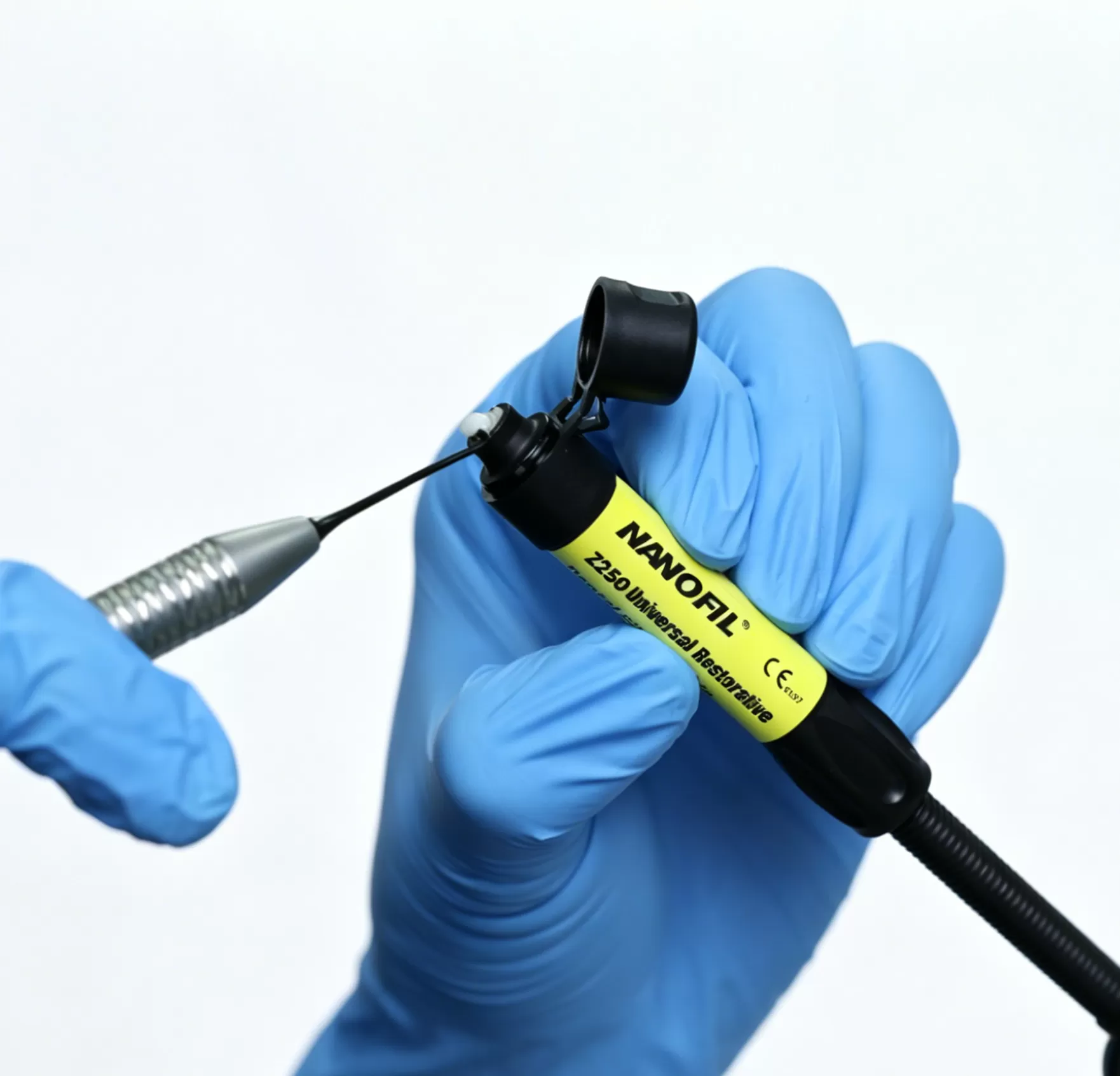
| Anterior restorations (Class III/IV) | NANOFIL® Z250 or Universal Aesthetic | 19 shades; high strength; low shrinkage; opalescent depth with VITA shade matching |
| Posterior restorations (Class I/II, cusp reconstruction) | NANOFIL® P60 | High hardness; exceptional wear resistance; withstands masticatory forces; shades A3, B2, C2; 4.5 g/syringe |
| Universal anterior + posterior in one system | NANOFIL Nova® or ONELUX One-Shade | Nova: 81.5 wt% filler load, dual-series design. ONELUX: self-adaptive shade covering A1–D3, high gloss |
| Liners, Class V, small defects, pit and fissure | NANOFIL® Flowable | Low viscosity; ultra-low shrinkage (<2.4%); deep penetration; shades A1–A3.5, B1–B2; 3 g/syringe |
| Veneers and cosmetic cases | NANOFIL® Universal Aesthetic | Opalescent depth; VITA shade matching; undetectable anterior restorations |
Interested in testing ATBIO composite resins in your clinic or adding them to your catalog? Request a free evaluation sample →
07 — Clinical Application Points
Start with a clean, well-isolated field and a reliable dental adhesive before placing any composite.
Place posterior materials in increments to limit polymerization stress, and use a flowable liner where deep, irregular cavity floors require penetration.
Match material to site: reserve high-filler posterior composites for load-bearing areas and use aesthetic veneer resins where translucency and shade blending dominate.
Finish and polish to protect both the restoration and the adjacent tooth; a nanohybrid's gloss depends as much on finishing technique as on formulation.
A decade of clinical observation supports the practical conclusion: composites chosen by indication, placed with disciplined technique, and finished properly deliver long service in both anterior and posterior sites (Demarco et al., 2012; PMID 22192253). For bulk-fill workflows, a 5-year randomized controlled clinical study found no significant difference in clinical performance between posterior restorations placed with a bulk-filled resin composite and those placed with conventional layering (van Dijken & Pallesen, 2016; PMID 27238052).
08 — FAQ: Composite Resin Selection
What is the best dental composite for anterior teeth?
For the smile zone, prioritize shade range, translucency, and polishability. Z250's 19 shades cover most patients, while a dedicated veneer resin like Universal Aesthetic adds opalescent depth for demanding cosmetic cases; long-term randomized clinical evaluation confirms that well-selected nanohybrid composites retain their esthetics over years of service (van Dijken & Pallesen, 2015; PMID 25359327).
What is the best composite for posterior teeth?
Look for high filler loading, high hardness, and wear resistance. P60 is engineered for posterior restorations, and Nova Universal's 81.5 wt% filler load provides another strong option for stress-bearing sites — the mechanical profile that comparative studies associate with nanofilled materials (Ilie, Hickel & Watts, 2009; PMID 19124150).
How do I choose between a flowable and a packable composite resin?
Use flowable material where adaptation matters — liners, small defects, Class V. Use packable or universal material where contour must be built, such as Class II boxes and cusps.
What is a one-shade composite?
A one-shade composite uses self-adaptive shade technology to match a range of tooth colors from a single syringe. ONELUX covers A1–D3 with high gloss and stain resistance, simplifying inventory and chair time.
How many composite shades does a practice need?
Start with the common A shades and add B/C series as needed. Wide systems like Z250's 19 shades reduce re-dos; one-shade composites are an alternative for simplified inventory.
What is a nanohybrid dental composite?
A nanohybrid composite combines nanoparticles (roughly 20–75 nm) with larger particles in one filler system, delivering the strength of a hybrid and the polishability of a microfill in a single material — the technology behind our Z250 and P60 restoratives.
Can one universal composite cover anterior and posterior teeth?
A true universal can handle both zones. Nova Universal's dual-series design explicitly targets anterior aesthetics and posterior durability in a single system.
09 — References
Ferracane JL. Resin composite—state of the art. Dental Materials. 2011;27(1):29-38. pubmed.ncbi.nlm.nih.gov/21093034 / doi.org/10.1016/j.dental.2010.10.020
Ilie N, Hickel R, Watts DC. Spatial and cure-time distribution of dynamic-mechanical properties of a dimethacrylate nano-composite. Dental Materials. 2009;25(3):411-418. pubmed.ncbi.nlm.nih.gov/19124150 / doi.org/10.1016/j.dental.2008.11.008
Demarco FF, Corrêa MB, Cenci MS, et al. Longevity of posterior composite restorations: not only a matter of materials. Dental Materials. 2012;28(1):87-101. pubmed.ncbi.nlm.nih.gov/22192253 / doi.org/10.1016/j.dental.2011.09.003
van Dijken JW, Pallesen U. Eight-year randomized clinical evaluation of Class II nanohybrid resin composite restorations bonded with a one-step self-etch or a two-step etch-and-rinse adhesive. Clinical Oral Investigations. 2015;19(6):1371-1379. pubmed.ncbi.nlm.nih.gov/25359327 / doi.org/10.1007/s00784-014-1345-8
van Dijken JW, Pallesen U. Posterior bulk-filled resin composite restorations: A 5-year randomized controlled clinical study. Journal of Dentistry. 2016;51:29-35. pubmed.ncbi.nlm.nih.gov/27238052 / doi.org/10.1016/j.jdent.2016.05.008
ISO 4049:2019. Dentistry — Polymer-based restorative materials (flexural strength ≥ 80 MPa). International Organization for Standardization. iso.org/standard/67596
ATBIO. Dental Composite Resins Product Range — Overview.
ATBIO. Contact and partnership.
About the Manufacturer
ATBIO (AT&M Biomaterials Co., Ltd.) is a Beijing-based dental materials manufacturer with 38 years of experience in restorative dentistry products. NANOFIL® composites are manufactured under CE (MDR 2017/745) certification and an EN ISO 13485 quality management system, and are trusted by dental professionals in more than 100 countries. Visit www.atmbio.com or contact us at info@atmbio.com or +86-10-69778208.
Related Products
Do you prefer online learning?
Live webinars and professional tips — learn when, where and how.
Access our online learning opportunities