Flowable Composite: Uses & Buying Guide | ATBIO
Flowable composite is a handling category, not a single indication or strength class. Two products that both pass through a fine delivery tip may differ in viscosity, filler system, radiopacity, shade, increment limit, curing conditions and authorized uses. The safest buying and clinical decisions therefore begin with the exact product and its current instructions for use (IFU).
This guide explains how to select, place and procure flowable resin composite without turning familiar rules of thumb into universal claims.
01 — What Makes a Composite Flowable?
A flowable resin composite is formulated to express and adapt more readily than a conventional sculptable paste. Manufacturers can obtain that handling through several formulation choices; it is inaccurate to assume that every flowable simply contains less filler or is mechanically weaker. “Low-flow,” “high-flow,” “injectable,” “bulk-fill” and “self-adhesive” are not interchangeable labels.
Viscosity also describes behaviour only under defined conditions. A thixotropic material may flow under pressure yet resist slumping after placement. Temperature, tip geometry and delivery force can change the handling the operator experiences. Evaluate the supplied presentation rather than the product name alone.
Four “flowable” categories should not be compared as one
The label “flowable” describes handling, not one standardized clinical indication. Separate conventional low-viscosity flowables, highly filled or injectable flowables, flowable bulk-fill bases and products making a self-adhesive claim. Compare each only within its IFU-supported role.
Conventional flowable: adaptation and small, product-approved indications; do not infer bulk-fill depth.
Highly filled/injectable: may have broader restorative positioning, but formulation-specific evidence controls.
Flowable bulk-fill: depth and need for an occlusal capping layer are product-specific.
Self-adhesive flowable: an adhesion claim must come from that product's IFU; it cannot be transferred to the class.
A 2025 systematic review of highly filled flowables found promising clinical uses but emphasized limitations and heterogeneous evidence. The ADA overview of direct restorative materials also notes that lower-viscosity materials can improve adaptation while wear and shrinkage concerns differ from higher-density composites. The defensible buying question is therefore “which formulation for which verified indication?”, not “is flowable better?”
02 — Match the Product to the Task
| Possible task | What to verify | Do not assume |
|---|---|---|
| Small direct restoration | Cavity class, tooth type, stress-bearing limits and required adhesive | Every flowable is suitable for all posterior surfaces |
| Liner or base | IFU indication, layer limit, curing and compatibility | A flowable liner improves every posterior restoration |
| Pit-and-fissure application | Explicit preventive or sealant indication and isolation protocol | Any restorative flowable substitutes for a sealant |
| Repair or auxiliary use | Approved substrate, surface treatment and load | Wettability alone creates durable adhesion |
03 — Direct Restorations Require Product-Specific Indications
Flowable composites are often selected for small preparations, cervical lesions or other areas where delivery and adaptation are useful. That does not create a class-wide indication. A highly filled restorative flowable and a low-viscosity liner may have different permitted cavity classes and load limits. Small occlusal preparations, incisal repairs, splinting and core build-ups therefore require an explicit indication; delivery convenience does not establish suitability. Conversely, do not impose a blanket non-load-bearing restriction on every modern highly filled flowable.
Clinical evidence is similarly product- and case-specific. A three-year randomized trial in non-carious cervical lesions reported similar clinical performance for one highly filled flowable and one conventional paste composite, with better marginal adaptation for the tested flowable. The result supports the tested protocol; it does not prove equivalence for every flowable product.
04 — A Flowable Liner Is an Option, Not a Requirement
A thin first layer can help an operator place material in line angles or irregular geometry when the product is indicated as a liner. Thickness, curing and the overlying restorative must follow the respective IFUs. Avoid an uncontrolled pool that reduces space for the material selected to carry the main occlusal load.
Do not promise that a liner automatically prevents sensitivity, eliminates voids or absorbs polymerization stress. In a 2024 randomized split-mouth trial of Class I and II posterior restorations, the liner group had four failures at three years, compared with none in the no-liner group. Both groups used the same self-etch adhesive. The result does not show that all liners are harmful, but it does not support a routine clinical benefit for the tested liner. Choose according to the material system and case, not habit alone.
05 — Posterior Use: Distinguish Conventional and Bulk-Fill Products
A conventional flowable is not automatically a bulk-fill composite. Maximum increment, exposure time, light irradiance, distance, shade and whether an occlusal capping layer is required are product-specific. Never infer a deep-curing claim from low viscosity.
For a conventional posterior workflow, place the adhesive and restorative materials according to their own IFUs, maintain anatomy and proximal contact, and verify cure access. The posterior composite workflow guide provides the broader sequence.
06 — Adhesion and Contamination Control
Most flowable composites still require a separate adhesive. “Flows well” does not mean “self-adhesive.” Identify enamel, dentin, existing resin, ceramic, metal or temporary material before selecting surface treatment. Follow both the adhesive and restorative IFUs and do not infer cross-brand compatibility from a distributor bundle.
Control saliva, blood and other contaminants during bonding. If contamination occurs, use the recovery procedure supported by the adhesive manufacturer rather than improvising. In cervical areas, moisture control and access to the margin may determine whether a resin workflow is appropriate.
07 — Placement and Light Curing
Select shade and isolate before dispensing. Shade selection may be less reliable after prolonged dehydration.
Attach the correct tip securely. Confirm unobstructed flow away from the patient and avoid excessive force.
Deliver with the tip close to the target. Express steadily and observe adaptation; a tip does not guarantee a void-free result.
Respect the stated increment. Use the material's IFU for thickness, shade-specific limits and exposure.
Cure with a suitable light. Check wavelength compatibility, output, distance and access; protect eyes as instructed.
Finish and inspect. Remove excess, establish contour and contacts, polish, check occlusion and confirm margins.
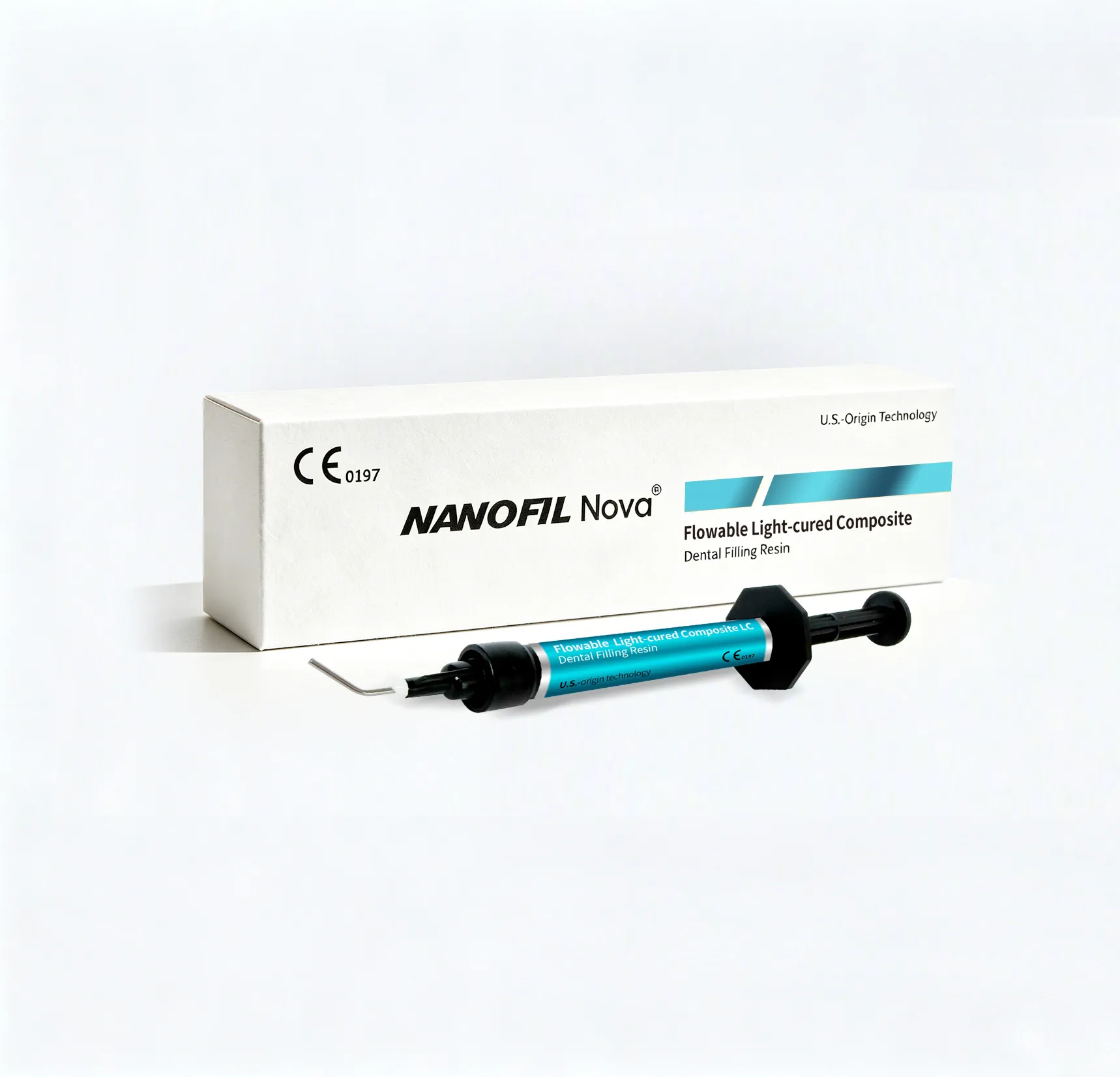
The NANOFIL Nova® Flowable V2601 IFU, for example, specifies 1–2 mm increments, 1 mm for Opaque White, and a curing instruction of 20 s at 500 mW/cm2. This is a product-specific example, not a universal dose or permission to trade exposure time against irradiance. Confirm the shade designation and light compatibility against the supplied IFU before use; do not transfer these settings to another product.
08 — Syringe Hygiene and Storage
Prevent the reusable syringe from becoming contaminated. Use the protective barrier, disposable tip and cleaning or disinfection method specified by the manufacturer; do not reuse a single-use tip. Recap after use and prevent material from remaining in the tip or cap interface.
Storage limits also vary. Record lot and expiry, protect the product as labelled and allow any required temperature equilibration before use. If transport or storage falls outside the allowed range, quarantine the stock and obtain a documented disposition instead of judging it by appearance.
09 — How Buyers Should Compare Flowable Composites
exact intended purpose, cavity classes, patient or tooth restrictions and compatible substrates;
viscosity variants, tip gauge, syringe control, net content and material left as unusable waste;
shade range, opacity, radiopacity, polish and compatibility with the clinic's aesthetic workflow;
increment and curing table, including supported lights and shade-specific conditions;
controlled test data for relevant properties instead of adjectives such as “strongest” or “zero shrinkage”;
current IFU, label, shelf life, storage, market registration and quality-system evidence.
ISO 4049:2019 covers polymer-based restorative materials within its stated scope and remains current after confirmation in 2024. Compliance evidence should identify the exact product and test report. ISO 13485 certification addresses the manufacturer's quality-management system within its certified scope; it is not unconditional product authorization.
10 — Evaluate Samples With a Defined Protocol
Qualified users should evaluate dispensing, slump resistance, adaptation, visibility, shade, curing, finishing and polish using the intended adhesive and curing light. Record product, lot, tip, operator, conditions and deviations. Use the same cavity model and scoring form for each candidate.
Separate handling feedback from clinical claims. A bench or model evaluation cannot establish long-term survival, sensitivity reduction or caries prevention. For a distributor, add packaging integrity, tip supply, traceability, remaining shelf life, complaint support and reorder economics.
11 — ATBIO Flowable Options
The current NANOFIL Nova® Flowable product page distinguishes standard-viscosity shades from an A2(LV) low-viscosity variant. Its V2601 IFU lists Class III, Class V, small non-stress-bearing Class IV, deciduous Class I/II, and specified auxiliary uses, including lining and pit-and-fissure sealing. The product-page table also lists Class I/II without that dentition qualifier.
The separate NANOFIL® Flowable product page lists a 3 g syringe and its own shade and application range. Do not merge the specifications of the two lines. Browse the composite resin portfolio, then send the exact product, shade mix, quantity and destination through request a quote.
12 — Frequently Asked Questions
Can flowable composite be used as the full posterior restoration?
Only when the exact product's indication covers the cavity and load. Some highly filled restorative flowables are indicated for stress-bearing restorations; other products have narrower uses or serve as liners. A conventional flowable should not be treated as bulk-fill without an explicit instruction.
How thick should a flowable liner be?
There is no class-wide number. Use the liner and overlying composite IFUs. The layer should serve the planned purpose without exceeding the product's supported increment.
Does every flowable composite need an adhesive?
No class-wide answer is safe, but most conventional flowables use a separate adhesive. Products marketed as self-adhesive have a different protocol and should not be generalized to other materials.
Is a flowable composite the same as a fissure sealant?
No. ISO 4049 excludes materials intended specifically to prevent caries from its restorative-material scope and points to a separate standard. Use a flowable for sealing only if its IFU explicitly includes that indication.
What matters most when buying a flowable composite?
Start with the authorized indication and full IFU. Then compare viscosity, delivery control, shades, radiopacity, curing requirements, evidence, net content, shelf life and market documentation.
13 — References
International Organization for Standardization. ISO 4049:2019 — Dentistry — Polymer-based restorative materials.
ATBIO. NANOFIL Nova® Flowable Light-cured Composite — Instructions for Use.
Nguyen AD, et al. Influence of Cavity Lining on the 3-Year Clinical Outcome of Posterior Composite Restorations: A Randomized Controlled Clinical Trial. Dent J (Basel). 2024.
Zhang H, et al. Randomized controlled clinical trial of a highly filled flowable composite in non-carious cervical lesions: 3-year results. Clin Oral Investig. 2021.
14 — About the Manufacturer
This article is published by ATBIO, the dental-materials brand of AT&M Biomaterials Co., Ltd.
ATBIO is the dental-materials brand of AT&M Biomaterials Co., Ltd. Its official site lists composite resins, adhesives, cements, impression materials and other dental categories. Exact indications, packaging, availability and documentation depend on the SKU and market. This page does not claim unconditional sale authorization in every country.
This article is general professional education, not patient-specific clinical or regulatory advice. Use authorized products according to their current IFUs and applicable requirements.
15 — Related Products and Resources
Do you prefer online learning?
Live webinars and professional tips — learn when, where and how.
Access our online learning opportunities