Glass Ionomer Cement: 7 Benefits & Clinical Uses | ATBIO
Glass ionomer cement (GIC) is one of the most versatile dental materials in modern restorative dentistry—bonding chemically to tooth structure, releasing fluoride for years, and protecting pulp. This guide covers the glass ionomer cement benefits, clinical GIC indications, and the clinical uses of GIC in luting, restorative, pediatric, and preventive dentistry, so you can choose the right material for every case. ATBIO has manufactured GK glass ionomer cements for 38 years under CE and EN ISO 13485 certification.
Quick answer: Glass ionomer cement is a water-based dental cement formed by the acid–base reaction between fluoroaluminosilicate glass powder and polyacrylic acid liquid. Its three core advantages are chemical bonding to enamel and dentin, sustained fluoride release, and good biocompatibility—making it the first-choice material for luting crowns, Class V restorations, and pediatric fillings.
01 — What Is Glass Ionomer Cement?
Glass ionomer cement is a tooth-colored, water-based material introduced in the early 1970s. It is formed by an acid–base reaction between a fluoroaluminosilicate glass powder and a polyalkenoic acid liquid (commonly polyacrylic acid). Unlike resin composites, GIC bonds chemically to both enamel and dentin without requiring a separate etching and bonding step, and it releases fluoride ions continuously over time.
Chemical Composition: Fluoroaluminosilicate Glass + Polyacrylic Acid
Per the official GK IFU, the powder contains fluoroaluminosilicate glass and polyacrylic acid; the liquid contains polyacrylic acid, purified water, and tartaric acid. The set material is chemically bonded to enamel and dentin, releases fluoride ions, and is radio-opaque—visible on dental radiographs.
The Acid–Base Setting Reaction
When the glass powder is mixed with the acid liquid, the polyalkenoic acid attacks the glass particles, releasing calcium, aluminum, sodium, and fluoride ions. As the pH rises, calcium and aluminum polyacrylate salts cross-link and the cement hardens. This is a classic acid–base setting reaction, not a photopolymerization—which is why GIC needs no curing light.
The Role of Water in GIC Setting
Water is not an inert component in GIC: it acts as both the reaction medium and the plasticizer during the early setting phase. A clean but slightly moist dentin surface actually improves chemical adhesion, because water participates in the acid–base reaction. This is also why freshly placed restorative GIC must be protected from dehydration with a protective coating during the first hours—premature drying interrupts the maturation of the cement matrix and weakens the surface.
Types of GIC: Type I (Luting) vs Type II (Restorative) vs Type III (Lining)
Conventional GIC is classified by clinical function:
Type I (luting) — low film thickness and high flow, for cementing crowns, bridges, inlays, and orthodontic bands. ISO 9917-1:2007 requires a film thickness ≤ 25 µm for Type I water-based cements.
Type II (restorative) — higher powder loading and wear resistance for direct restorations, primary teeth, bases, and liners.
Type III (lining/base) — low-viscosity formulations for pulp protection and dentin replacement beneath composite.
02 — 7 Key Advantages of Glass Ionomer Cement
Glass ionomer cement benefits explain why the material remains clinically irreplaceable even in the composite era:
1. Chemical Bonding to Tooth Structure
GIC bonds ionically to the hydroxyapatite of enamel and dentin via carboxylate groups on the polyalkenoic acid chain. This direct chemical bond seals the margin without a separate bonding system—a decisive advantage in cervical and root-surface sites where isolation for adhesive resin is difficult.
2. Sustained Fluoride Release & Recharge
GIC is the classic fluoride-releasing cement. Its fluoride release follows a biphasic pattern: an early burst during the first days, then slow, sustained elution for months and years (Nicholson 2023, PMID 37615013). The material can also be "recharged" by topical fluoride applications, extending its anticariogenic effect over the life of the restoration.
3. Biocompatibility & Low Post-Operative Sensitivity
GIC's neutral, non-resinous chemistry and low release of free monomers make it well tolerated by pulp and gingival tissues, with low post-operative sensitivity. It is a common choice for liner/base use close to the pulp.
4. Coefficient of Thermal Expansion Matches Tooth Structure
GIC's thermal expansion coefficient is close to that of natural tooth structure, which minimizes microleakage at the restoration margin under temperature cycling in the mouth.
5. Moisture Tolerance
GIC behaves predictably in slightly humid conditions where resin-based systems fail. This moisture tolerance makes it dependable for gingival margins, orthodontic bands, and pediatric cases where isolation is imperfect.
6. Caries Inhibition
A 2023 systematic review found GIC restorations showed a superior preventive effect against secondary caries compared with amalgam restorations (PubMed 2023). The sustained fluoride release at the marginal gap is the mechanism behind this clinical benefit.
7. Ease of Use
Predictable powder–liquid mixing, generous working and setting times, and no curing light requirement reduce the learning curve and fit busy daily schedules.
03 — Clinical Uses of Glass Ionomer Cement
Glass ionomer cement applications span luting, restorative, preventive, and pediatric dentistry:
Type I — Luting for Crowns & Bridges
GK Type I luting cement cements metal, PFM, and zirconia crowns, bridges, inlays, posts, and orthodontic bands. With a film thickness below 18 µm—well under the 25 µm ISO 9917-1 limit—it allows full seating of indirect restorations with minimal cement-line gaps.
Type II — Restorative (Class III/V, Primary Teeth, ART)
GK Type II restorative cement is used for Class III and Class V restorations, root caries, and deciduous teeth fillings, and as a base or liner beneath composite. A 2025 randomized controlled trial of 140 Class V cervical restorations confirmed GIC showed statistically non-inferior marginal integrity vs nanohybrid composite (p = 0.38) and significantly lower secondary caries at the gingival margin (p = 0.02) (Shah 2025, PMID 40291201).
Pediatric Dentistry — The Material of Choice
For pediatric patients and ART (atraumatic restorative treatment) in primary teeth, Type II restorative GIC is preferred. A 2026 review of 18 clinical studies reported 88–92% 24-month survival for GIC restorations placed under ART protocol in primary molars of high-caries-risk children (Bahammam 2026, DOI 10.22514/jocpd.2026.059).
Core Build-Up, Bases & Liners
GIC protects the pulp and replaces lost dentin beneath composite restorations. In deep cavities, place a hard-setting calcium hydroxide liner near the pulp horns before the GIC layer, per the material's IFU.
Geriatric & High-Caries-Risk Patients
Aging patients with gingival recession and exposed root surfaces, and patients with xerostomia (reduced saliva), benefit from GIC's root adhesion and fluoride release at the cemento-enamel junction. A 2025 retrospective cohort of 620 pediatric restorations found GIC under ART protocol had significantly lower re-intervention rates than composite in primary first molars at 36 months (Arbildo-Vega 2025, DOI 10.3389/fdmed.2025.1651696).
04 — Limitations of Conventional GIC
Lower Compressive Strength vs Composite
Conventional GIC achieves compressive strengths of roughly 100–150 MPa—above the 70 MPa minimum in ISO 9917 for water-based cements, but below resin composite. For high-stress posterior Class I and Class II restorations, use the sandwich technique: GIC base for fluoride release, composite surface for wear resistance.
Aesthetics (Opacity)
Conventional GIC has a limited shade range and opaque appearance compared with nanohybrid composite. When aesthetics are the priority, composite is the better surface material.
Early Moisture Sensitivity
Freshly placed GIC must be protected from saliva and moisture during the setting phase with petroleum jelly, bonding resin, or a commercial GIC coating; premature water contamination can cause surface erosion and fluoride washout.
05 — GIC vs Composite vs RMGI: Quick Selection Table
| Criterion | Glass Ionomer Cement | Nanohybrid Composite |
|---|---|---|
| Bonding mechanism | Ionic / chemical bond to hydroxyapatite | Micromechanical (etch + adhesive) |
| Fluoride release | Yes, sustained + rechargeable | No (unless specialized filler) |
| Isolation required | Minimal; moisture-tolerant | Strict isolation required |
| Tooth structure removed | Minimal — no etch cavity prep needed | Moderate — micromechanical retention prep |
| Marginal adaptation (Class V, 24 mo) | 91.4% intact margins* | 88.6% intact margins* |
| Aesthetics | Limited shade range | Excellent; 16+ shades + translucency |
| Posterior load-bearing | Limited (base + composite overlay recommended) | Excellent (direct Class I / II) |
| Post-op sensitivity | Low | Moderate (technique-dependent) |
*Marginal adaptation data from a 2025 randomized controlled trial of 140 Class V cervical restorations: GIC showed statistically non-inferior marginal integrity vs nanohybrid composite (p = 0.38, 95% CI −0.05 to +0.13) and significantly lower secondary caries incidence at the gingival margin (p = 0.02) (Shah 2025, PMID 40291201, DOI 10.7759/cureus.81265).
06 — GK Glass Ionomer Series from ATBIO
ATBIO offers two GK glass ionomer formulations engineered for the two dominant glass ionomer cement applications:
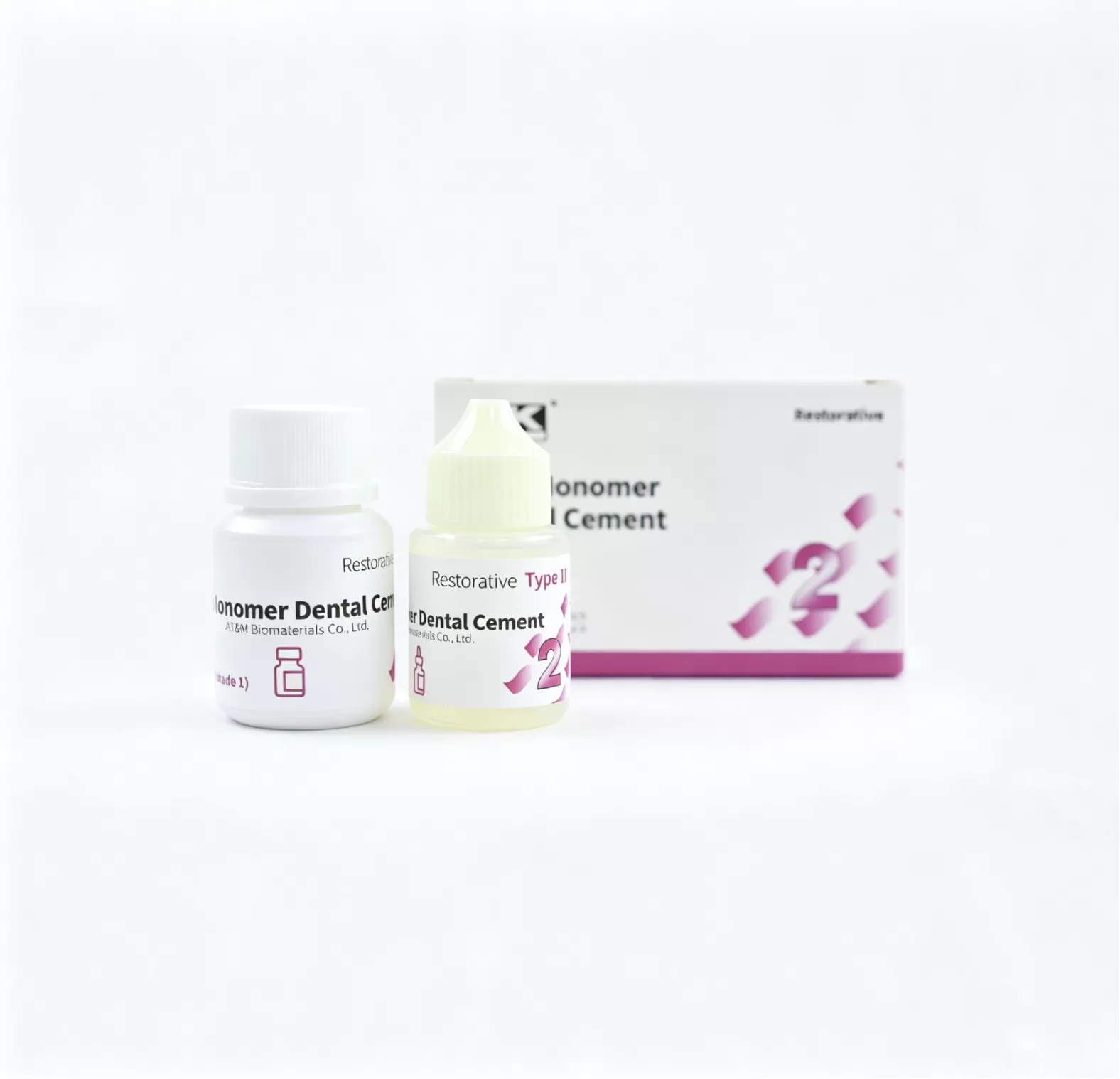
GK Glass Ionomer Luting Cement (Type I) — for crowns, bridges, inlays, posts, and orthodontic bands. Film thickness < 18 µm, sustained fluoride release, powder 16 g + liquid 8 g.
GK Glass Ionomer Restorative Cement (Type II) — self-adhesive, for Class III/V, deciduous teeth, and liner/base use. Shades 1–3, powder (20 g)×3 + liquid (16 ml)×3.
Both materials are manufactured in our ISO 13485-certified facility in Beijing and supplied through authorized ATBIO distributors worldwide, alongside our full cements portfolio.
For step-by-step mixing parameters, working and setting times, and IFU-based application steps, see our companion guide: Glass Ionomer Cement: What It Is, How It Works, and When to Use GK Type I vs Type II.
Interested in testing GK Glass Ionomer for your clinic or distribution network? Request a free evaluation sample →
07 — FAQ
What are the main glass ionomer cement benefits?
The main glass ionomer cement benefits are chemical adhesion to enamel and dentin, sustained fluoride release and recharge capacity, good biocompatibility with low post-op sensitivity, minimal tooth preparation, moisture tolerance, and simple handling. A 2025 trial of 140 restorations confirmed GIC's superior secondary-caries protection at cervical margins vs composite resin (p = 0.02) (Shah 2025, PMID 40291201).
What is glass ionomer cement used for?
Glass ionomer cement is used for luting crowns, bridges, inlays, and orthodontic bands (Type I); direct Class III and V restorations and primary teeth fillings (Type II); and bases and liners beneath composite (Type III). It is also the material of choice for ART and for high-caries-risk patients.
What are the uses of GIC cement in dentistry?
Common uses of GIC cement include cementation of metal and PFM restorations, orthodontic band cementation, Class V cervical and root-caries restorations, pediatric restorations, ART, core build-ups, and pulp-protective bases. Its fluoride release also supports preventive restorations in xerostomic and geriatric patients.
How long does glass ionomer cement last?
Clinical studies report 88–92% survival at 24 months for GIC restorations in primary molars under ART protocol (Bahammam 2026, DOI 10.22514/jocpd.2026.059). Longevity depends on cavity site, patient caries risk, and protection of the fresh surface during the initial setting phase.
Is glass ionomer cement self-adhesive?
Yes. Restorative-type glass ionomer cement is self-adhesive and requires minimal preparation because it bonds chemically to both enamel and dentin. Luting-type formulations provide the same chemical adhesion for cementing crowns, bridges, and orthodontic bands.
Do you offer OEM or ODM services for glass ionomer cement?
Yes. ATBIO provides OEM and ODM solutions for dental brands, laboratories, clinics, and distributors, with customized packaging and specifications based on target market requirements. Contact our team to discuss territory availability, pricing, and CE-certified documentation.
08 — References
Shah M, et al. Clinical performance of glass ionomer cement versus nanohybrid composite resin in Class V cervical restorations: a 24-month randomized controlled trial. Cureus. 2025. pubmed.ncbi.nlm.nih.gov/40291201
Nicholson JW, Sidhu SK, Czarnecka B. Fluoride release from glass-ionomer cements and their clinical implications. Biomater Investig Dent. 2023. pubmed.ncbi.nlm.nih.gov/37615013
Cabral MFC, et al. Fluoride release from conventional and resin-modified glass ionomer cements. Restor Dent Endod. 2015. pubmed.ncbi.nlm.nih.gov/26295024
Bahammam HA. Efficacy of ion-releasing smart restoratives compared to resin composite in primary teeth: systematic review. J Clin Pediatr Dent. 2026. doi.org/10.22514/jocpd.2026.059
Arbildo-Vega HI, et al. Clinical performance of ion-releasing restorative materials vs resin composite in pediatric dentistry: systematic review. Front Dent Med. 2025. doi.org/10.3389/fdmed.2025.1651696
The preventive effect of glass ionomer cement restorations on secondary caries: a systematic review. PubMed. 2023. pubmed.ncbi.nlm.nih.gov/37838608
ISO 9917-1:2007. Dentistry — Water-based cements — Part 1: Powder/liquid acid-base cements. International Organization for Standardization. iso.org/standard/45818.html
About the Manufacturer
This guide is published by AT&M Biomaterials Co., Ltd. (ATBIO), a dental materials manufacturer with 38 years of industry experience, headquartered in Beijing, China. GK glass ionomer cement is produced under CE marking and EN ISO 13485 certified quality management. Product parameters cited on this page are taken from the official IFU; clinical claims are referenced to peer-reviewed literature listed above. This page does not claim unconditional sale authorization in every country.
Related Products
Do you prefer online learning?
Live webinars and professional tips — learn when, where and how.
Access our online learning opportunities