Glass Ionomer Cement: What It Is, How It Works, and When to Use GK® Type I vs Type II
Glass ionomer cement (GIC) is one of the most widely used dental luting and restorative materials worldwide, valued for its chemical adhesion to tooth structure and long-term fluoride release. This guide explains what glass ionomer cement is, how GK® glass ionomer cement compares to resin cement, step-by-step mixing guidance, and clinical indications — based on ATBIO's 38 years of manufacturing experience and CE / EN ISO 13485 certified production.
01 — What Is Glass Ionomer Cement?
Glass ionomer cement is a tooth-colored dental material formed by the acid-base reaction between fluoroaluminosilicate glass powder and polyacrylic acid liquid. Unlike resin-based cements, it bonds chemically to both enamel and dentin without requiring a separate bonding agent, and releases fluoride continuously over time.
A sustained fluoride release in the marginal gap between restoration and tooth helps prevent secondary caries (StatPearls, NCBI Bookshelf). A 2023 systematic review found GIC restorations showed a superior preventive effect against secondary caries compared with amalgam restorations (PubMed). Conventional GIC luting cements typically achieve compressive strengths of 100–150 MPa — well above the 70 MPa minimum in ISO 9917 for water-based dental cements (ScienceDirect).
GK® glass ionomer luting cement, manufactured by ATBIO, combines this chemistry with enhanced adhesive properties and a thermal expansion coefficient close to natural tooth structure — which helps minimize microleakage and postoperative sensitivity.
Composition of GK® Glass Ionomer Cement (per IFU)
Powder: fluoroaluminosilicate glass and polyacrylic acid
Liquid: polyacrylic acid, purified water and tartaric acid
The set material is chemically bonded to enamel and dentin, releases fluoride ions, and is radio-opaque — visible on dental radiographs.
02 — Key Properties of GK® Glass Ionomer Cement
GK® Type I is engineered for clinical ease and reliable performance across common cementation workflows:
Fine powder and excellent fluidity — smooth, easy to mix, with reliable flow once combined with the liquid
Ultra-thin film thickness (<18 μm) — allows precise, fully-seated restoration placement
Superior adhesion and marginal sealing — strong bond to both tooth tissue and restorative material
Biocompatibility and reduced sensitivity — thermal expansion coefficient close to natural tooth structure
Ample working time, fast intraoral cure — low solubility; working time 1.5–2.5 min; hardening in 3–5 min
Long-term fluoride release — sustained anti-caries effect around the restoration margin
03 — Glass Ionomer Cement vs. Resin Cement: Which One to Choose?
Both cement types are routinely used in indirect restorations. The right choice depends on the restoration material, fit precision, and clinical priorities:
| Criteria | GK® Glass Ionomer (Type I) | Dual-Cure Resin Cement |
|---|---|---|
| Adhesion | Chemical bond to enamel and dentin; no bonding agent needed | Self-adhesive; no separate etching or priming |
| Delivery | Powder + liquid, manual mixing (2.0–2.5:1 w/w) | Automix paste syringe |
| Fluoride release | Long-term; anti-caries benefit | Limited to none |
| Bond strength | Good for metal and alloys; 100–150 MPa compressive (above ISO 9917 minimum) | Higher strength for ceramics, zirconia, and high-stress areas |
| Film thickness | <18 μm | Low; varies by formulation |
| Best for | Metal, PFM, zirconia crowns and bridges; orthodontic bands; base/liner | All-ceramic, inlays/onlays, high-load indirect restorations |
Clinical guidance from the ADA notes that the higher strength and adhesive bonding of resin cements allow them to tolerate larger cement spaces — relevant when a crown does not fit the preparation precisely (ADA Professional Product Review). Glass ionomer remains the economical, fluoride-releasing choice for well-fitting metal and PFM restorations.
In practice, many clinics stock both: GK® Type I for routine metal and PFM cementation, and a dual-cure resin cement such as NanoCem Ultimate for higher-strength all-ceramic cases.
04 — GK® Type I (Luting) vs Type II (Restorative)
ATBIO's GK® line follows the conventional GIC classification. The two types differ in viscosity and intended clinical use:
| GK® Type I — Luting | GK® Type II — Restorative | |
|---|---|---|
| Primary use | Cementing crowns, bridges, inlays, posts, orthodontic bands | Direct restorations; Class III/V; primary teeth |
| Consistency | Lower viscosity; film thickness <18 μm for full seating | Higher filler content; viscosity suited to bulk placement |
Choose Type I for cementing indirect restorations; for direct fillings see GK® Type II Restorative.
05 — Clinical Indications
Cementation of stainless steel or metal-porcelain crowns, bridges, inlays, posts and screws
Cementation of all-ceramic (zirconia-based) crowns and bridges
Cementation of orthodontic parts to metal crowns, and orthodontic bands
Use as a base and bottom liner
06 — How to Mix and Apply Glass Ionomer Cement
The following parameters are taken from the official GK® Type I Instructions for Use (IFU), measured at 23–26°C / 50% relative humidity:
| Parameter | Value |
|---|---|
| Powder-to-liquid ratio (w/w) | 2.0–2.5 : 1 (≈ 1 level spoonful of powder to 1 drop of liquid) |
| Mixing time | 30–40 seconds |
| Working time | 1 min 30 s – 2 min 30 s |
| Hardening time | 3–5 minutes |
| Recommended mixing temperature | 20–25°C / 68–77°F |
Step-by-Step Clinical Workflow
Preparation: Thoroughly clean and dry the tooth and restoration surfaces. Dry with oil-free air or cotton pellets — do not over-dry.
Pulp protection: Cover areas close to the pulp with a hard-setting calcium hydroxide liner before cementation. Glass ionomer cement must not be applied directly to the exposed pulp.
Dosage: Shake the bottle to loosen the powder. Dispense at the 2.0–2.5:1 ratio without compressing the powder — an overly thin mix may cause pulpitis symptoms.
Mixing: Add the powder to the liquid in one portion using a plastic spatula and smooth until homogeneous (30–40 seconds).
Application: Keep the working area free of water and saliva. Apply a thin coat of cement to both the restoration and the preparation, then seat the restoration.
Excess removal: Remove excess cement and any residues remaining in the sulcus and surrounding areas.
Temperature note: higher temperatures and higher powder ratios shorten working time; lower temperatures extend it. Exceeding the working time causes loss of adhesion. Always follow the IFU supplied with each batch — parameters may be updated between versions.
07 — Specifications & Packaging
| Product | Contents | Unit |
|---|---|---|
| GK I Luting (standard) | Powder 16 g + Liquid 8 g; 1 mixing pad; 1 spatula | Set |
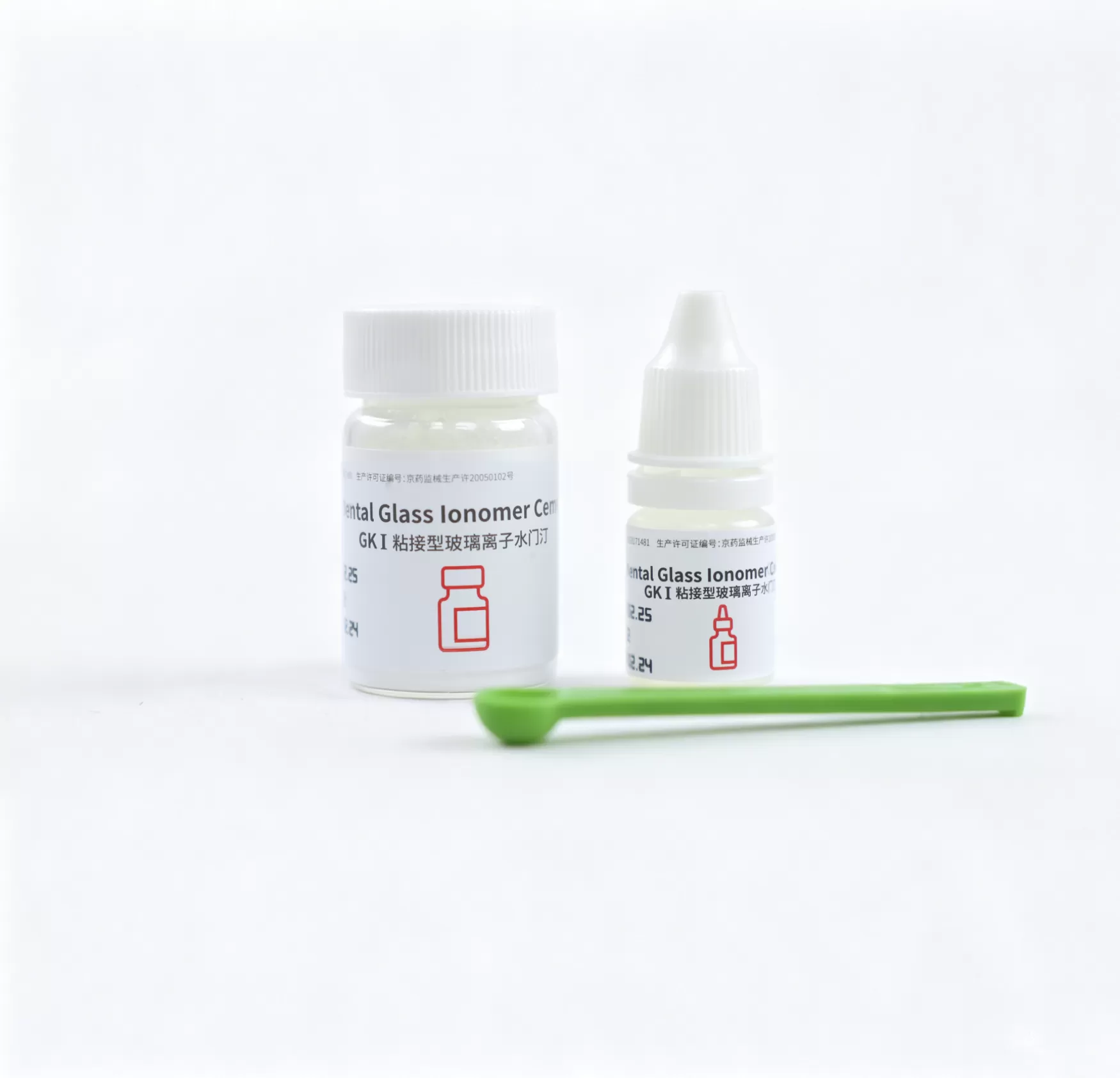
| GK I Luting (compact) | Powder 8 g + Liquid 4 g; plastic spoon; mixing pad | Set |
What's in the GK® Glass Ionomer Cement Set
A 46-second physical overview of the GK® glass ionomer luting cement powder/liquid set — packaging contents, material presentation, and key properties.
Storage Conditions (per IFU)
Store at 4–25°C / 39.2–77°F
Keep the powder in a dry place away from moisture
Do not use after the expiry date
Precautions
Must not be applied directly to the exposed pulp — use a hard-setting calcium hydroxide liner near the pulp
Contains polyacrylic acid and tartaric acid; do not use in patients with known hypersensitivity to these ingredients
In case of eye contact, rinse immediately with clean water and seek medical treatment
08 — Frequently Asked Questions
What is glass ionomer cement used for in dentistry?
Glass ionomer cement is used for luting crowns, bridges, inlays, posts, and orthodontic bands, and as a base or liner under restorations. Type II variants are used for direct restorations in Class III/V cavities and primary teeth.
How long does glass ionomer cement take to set?
GK® Type I has a working time of 1 min 30 s – 2 min 30 s and a hardening time of 3–5 minutes at 23–26°C. Higher temperatures and higher powder ratios shorten working time.
Does glass ionomer cement release fluoride?
Yes. Glass ionomer cement releases fluoride ions continuously after setting. A 2023 systematic review found GIC restorations showed a superior preventive effect against secondary caries compared with amalgam restorations (PubMed).
Do you offer OEM or ODM services for glass ionomer cement?
Yes. ATBIO provides OEM and ODM solutions for dental brands, laboratories, clinics, and distributors, with customized packaging and specifications based on target market requirements.
Can I request product samples?
Yes. Samples are available for product evaluation, market testing, and clinical trial purposes. Contact ATBIO with the products of interest, target market, and estimated purchasing needs.
ATBIO manufactures GK® glass ionomer cement under CE and EN ISO 13485 certification, with 38 years of experience in dental materials production. For questions about specifications, IFU details, or to request samples for evaluation, contact our technical team.
Regulatory note: CE marking and EN ISO 13485 certification support market entry in the EU/EEA. For the UK, Switzerland, Turkey, and markets outside the EU/EEA, additional local registration or an authorized representative may be required. This page does not claim unconditional sale authorization in every country.
References
Sikka N, et al. Glass Ionomer Cement. StatPearls, NCBI Bookshelf. ncbi.nlm.nih.gov/books/NBK582145
The preventive effect of glass ionomer cement restorations on secondary caries: a systematic review. PubMed, 2023. pubmed.ncbi.nlm.nih.gov/37838608
Updates on the clinical application of glass ionomer cement. PMC. pmc.ncbi.nlm.nih.gov/articles/PMC11725089
Glass Ionomer Cement — mechanical properties and ISO 9917. ScienceDirect Topics. sciencedirect.com/topics/medicine-and-dentistry/glass-ionomer-cement
Luting cements comparison. ADA Professional Product Review. ada.org/en/member-center/oral-health-topics/dental-cements
GK® Glass Ionomer Dental Cement (GK I Luting) — IFU EN V2601. AT&M Biomaterials Co., Ltd. atmbio.com — Official IFU (PDF)
About the Manufacturer
This guide is published by AT&M Biomaterials Co., Ltd. (ATBIO), a dental materials manufacturer with 38 years of industry experience, headquartered in Beijing, China, with EU representation through Lotus NL B.V. (The Hague, Netherlands). GK® glass ionomer cement is produced under CE marking and EN ISO 13485 certified quality management. Product parameters cited on this page are taken from the official IFU (version EN V2601); clinical claims are referenced to peer-reviewed literature listed above.
Related Products
Do you prefer online learning?
Live webinars and professional tips — learn when, where and how.
Access our online learning opportunities