Glass Ionomer vs Composite: Which to Choose | ATBIO
Glass ionomer cement (GIC) and composite resin are two important restorative materials in direct dentistry. They are sometimes presented as competing alternatives, but their clinical strengths are different and, in selected cases, complementary. Choosing between them is therefore not simply a question of which material is "better." The more useful question is: which material best matches the clinical indication, tooth substrate, caries risk, moisture-control conditions, functional demands and aesthetic requirements?
This guide compares glass ionomer and composite resin across their chemistry, fluoride release, adhesion, mechanical properties, moisture sensitivity, handling and aesthetics. It then provides a practical case-based decision framework covering paediatric restorations, root-surface lesions, ART, posterior restorations and high-caries-risk patients, followed by an overview of the sandwich technique, which combines GIC and composite in selected restorative situations.
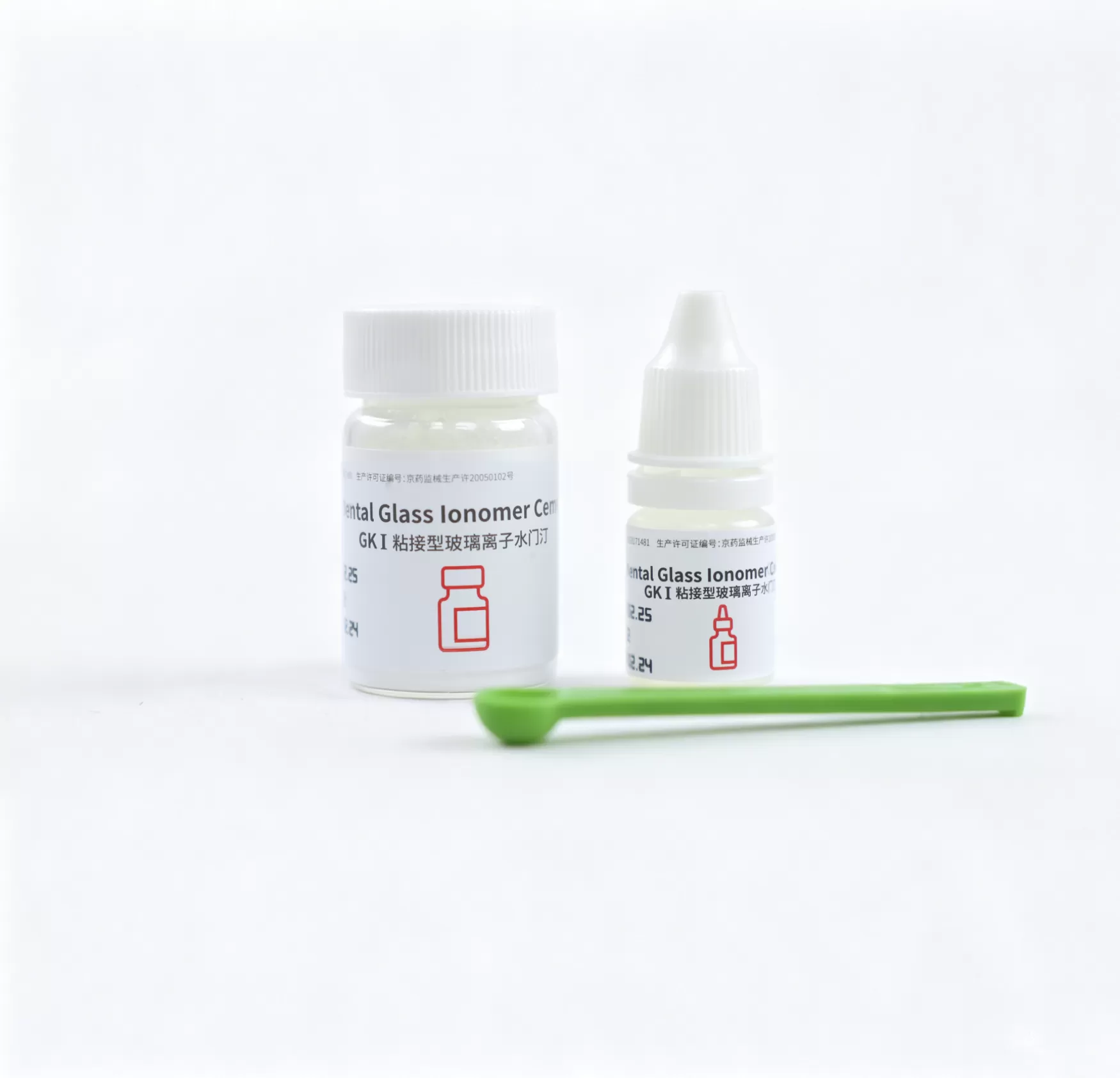
GK® glass ionomer cement — fluoride-releasing restorative and luting material
01 — How They Differ Chemically
The two materials set through fundamentally different mechanisms, and these differences help explain many of their clinical characteristics.
Glass ionomer cement is an acid-base material. A fluoroaluminosilicate glass powder reacts with a water-soluble polyalkenoic acid, commonly polyacrylic acid, to form a cross-linked ionic matrix. The setting process occurs progressively through an initial setting stage followed by maturation. During and after setting, fluoride can be released from the glass phase and may subsequently participate in fluoride exchange with the surrounding oral environment.
The setting reaction is therefore chemically different from polymer-based restorative materials. Conventional GIC does not depend on light activation, although resin-modified glass ionomer cement (RMGI) incorporates resin components and a light-activated polymerization component in addition to its acid-base reaction.
Composite resin is a polymer-based restorative material consisting primarily of an organic resin matrix, inorganic filler particles and other components such as coupling agents and photoinitiators. Many contemporary composites use resin systems based on monomers such as Bis-GMA, UDMA and/or related dimethacrylate chemistry, with the exact formulation varying by product. Filler loading and particle characteristics also vary substantially between composite formulations.
Most direct light-cured composites set through free-radical polymerization initiated by light. This provides a practical command set: the clinician can shape and manipulate the material before curing and then polymerize it when the desired anatomy has been established. However, polymerization is accompanied by volumetric shrinkage and associated stress, making adhesive protocol, increment thickness and curing conditions important clinical considerations.
The practical distinction is therefore not simply "chemical versus light-cured." GIC and composite represent different material systems with different setting mechanisms, bonding strategies, moisture requirements, mechanical profiles and clinical indications. RMGI occupies an intermediate position in some of these characteristics because it combines the acid-base GIC reaction with a resin component.
02 — Fluoride Release and Remineralization
Fluoride release is one of the most characteristic properties of conventional glass ionomer cement. Fluoride can be released from the glass phase during and after setting, with release generally higher during the early period and decreasing over time. GICs can also participate in fluoride exchange with the surrounding environment when exposed to external fluoride sources.
Laboratory and clinical research has investigated the relationship between fluoride release from glass ionomers and effects on adjacent tooth structure and caries-related outcomes. However, fluoride release should be distinguished from a guaranteed clinical anticaries effect: the magnitude of any clinical benefit depends on the material, restoration, patient caries risk, oral environment and other preventive measures.
Conventional composite resins generally do not provide the same sustained fluoride-release profile as glass ionomers. Some resin-based restorative materials contain fluoride-releasing components, but their release behaviour and clinical significance depend on the specific formulation and should not automatically be equated with conventional GIC.
The clinical implication is that fluoride release can be an important consideration when treating patients or sites with elevated caries risk, including selected root-surface lesions, some paediatric restorations and situations where a fluoride-releasing restorative material is clinically desirable. Conversely, when the principal requirements are high mechanical performance, wear resistance, detailed shade matching and surface polish, composite may provide advantages that fluoride release does not address.
For a fuller treatment of the material and its mechanism, see our guides on what glass ionomer cement is and how it works and GIC's benefits in modern dentistry.
03 — Adhesion to Tooth Structure
Both glass ionomer and composite can be used in adhesive restorative dentistry, but their interactions with tooth structure are fundamentally different.
GIC can chemically interact with tooth structure. The carboxylate groups of the polyalkenoic acid can interact with calcium-containing mineral in enamel and dentin, contributing to adhesion without requiring the separate etch-and-adhesive sequence used for conventional resin composite bonding. However, surface conditioning, cleaning and moisture management may still be important depending on the specific GIC and manufacturer's instructions.
One practical advantage of conventional GIC is that its placement is generally less dependent on the highly controlled adhesive interface required by resin composite. This can be useful in selected situations where isolation is difficult, although GIC is not completely insensitive to moisture. During the early setting period, excessive water contamination or dehydration can adversely affect the developing cement.
Composite resin relies primarily on micromechanical retention through an adhesive interface. Depending on the adhesive system and technique, this may involve enamel etching, dentin conditioning, primer application, adhesive infiltration and polymerization. When performed correctly, resin bonding can provide high bond strength and support conservative restorative approaches. However, the procedure remains sensitive to contamination, substrate condition, adhesive selection, curing and operator technique.
The distinction is therefore better expressed as different bonding strategies rather than simply "strong bond versus weak bond." Composite can achieve high adhesive bond strength under appropriate conditions, while GIC offers chemical interaction with tooth structure and a comparatively less technique-sensitive placement strategy in selected clinical environments.
04 — Mechanical and Aesthetic Trade-offs
When mechanical loading, wear resistance, detailed anatomy and high aesthetic demands dominate the case, resin composite generally has important advantages over conventional GIC. However, the magnitude of these differences depends on the specific formulation, restoration design and clinical indication.
| Property | Glass Ionomer Cement | Composite Resin |
|---|---|---|
| Setting mechanism | Acid-base reaction; conventional GIC matures progressively | Usually light-activated free-radical polymerization for direct restorative composites |
| Fluoride release | Characteristic fluoride release; may participate in fluoride exchange | Generally limited or absent in conventional formulations; product-dependent |
| Adhesion | Chemical interaction with tooth mineral; separate resin bonding agent is generally not required | Primarily micromechanical adhesion through an adhesive interface |
| Strength & wear | Generally lower than composite; conventional GIC has limitations in high-stress load-bearing situations | Generally higher mechanical performance and wear resistance; formulation-dependent |
| Aesthetics | Tooth-coloured; generally more limited in shade range, translucency and surface gloss | Broad shade options, sculptability, translucency and polishability depending on formulation |
| Moisture tolerance during placement | Generally more forgiving than resin adhesive procedures, but early contamination and dehydration should still be avoided | Adhesive interface is sensitive to moisture contamination and isolation quality |
| Command set | Conventional GIC is chemically setting; RMGI adds a light-activated resin component | Light-cured formulations provide clinician-controlled polymerization |
Strength and wear: Modern resin composites can provide substantially higher mechanical strength and wear resistance than conventional GIC, making them appropriate for many restorative situations involving functional loading when case selection and restorative technique are appropriate. Conventional GIC has lower fracture resistance and wear resistance and therefore has more limited indications in high-stress load-bearing areas. High-viscosity GIC and resin-modified GIC may extend the range of selected indications, but the specific product's validated indications should always be followed.
Aesthetics: Composite resin generally offers greater flexibility for shade selection, anatomical sculpting, translucency and surface polishing. These characteristics make it particularly useful when detailed anterior aesthetics or highly polished visible surfaces are important. GIC can provide a tooth-coloured restoration, but conventional formulations generally offer less control over translucency, shade effects and final surface gloss.
Handling: Light-cured composite provides a clinician-controlled setting reaction and allows immediate finishing after adequate polymerization. Conventional GIC has a chemical setting process and requires appropriate protection during its early setting period. RMGI combines an acid-base reaction with a resin component and light activation, which can improve handling and early mechanical performance compared with conventional GIC, while retaining several characteristic GIC properties.
05 — Decision Tree by Case
Paediatric restorations (primary teeth). GIC or RMGI can be advantageous in selected paediatric cases because of their chemical interaction with tooth structure, fluoride release and comparatively forgiving moisture requirements. However, composite remains an important option when adequate isolation, cooperation and restorative conditions are available and when the clinical indication calls for its mechanical or aesthetic advantages. The choice should be based on tooth type, lesion size, caries risk, occlusion, cooperation and the expected service period.
Elderly patients (root caries, xerostomia). Root-surface lesions can present challenging bonding and moisture-control conditions, particularly when salivary flow is reduced. GIC or RMGI may be useful options in selected cases because of their interaction with tooth structure and fluoride release. The clinician should also consider lesion activity, accessibility, periodontal status, plaque control, caries risk and whether the restoration will be subjected to significant functional loading.
ART / minimally invasive and community settings. Atraumatic restorative treatment (ART) is strongly associated with high-viscosity glass ionomer cement because the approach can be performed with hand instruments and does not require conventional rotary cavity preparation. Conventional self-curing GIC also does not depend on a curing light. Its adhesion and fluoride-release characteristics can be useful in the clinical environments for which ART was developed. Product selection should follow the requirements of the specific ART protocol and the manufacturer's instructions.
Posterior aesthetic restorations (adult permanent teeth). When a permanent posterior restoration must withstand substantial functional loading and also meet aesthetic requirements, resin composite is often the more appropriate direct restorative material because of its mechanical properties, wear resistance, shade range and polishability. Conventional GIC has more limited indications in high-stress Class I and Class II restorations in permanent adult teeth. For composite-based restorative applications, a universal material such as NANOFIL® Z250 may be considered according to its intended indications and product documentation. For the wider material landscape, see the teeth filling types comparison on the ATBIO blog.
High-caries-risk patients. Caries risk should be considered alongside mechanical and aesthetic requirements. GIC or RMGI may be useful when fluoride release and chemical interaction with tooth structure are desirable. In selected deep or cervical restorative situations, a GIC-based material may also be incorporated as part of a layered restorative approach beneath composite. However, fluoride release does not replace plaque control, fluoride exposure, dietary management, recall care or other preventive strategies.
06 — Using Both Together: The Sandwich Technique
The most appropriate answer to "GIC or composite?" is sometimes "both." The sandwich technique combines a glass ionomer-based internal layer with a resin composite external layer. Depending on the specific design, the GIC may contribute chemical interaction with tooth structure and fluoride release, while the composite provides the external surface's mechanical and aesthetic characteristics.
The open-sandwich technique leaves a portion of the GIC exposed at the cervical margin, while the closed-sandwich technique completely covers the GIC with composite. The choice between these approaches depends on the cavity design, margin location, material selection and clinical objective.
The GIC-composite interface requires careful attention. The GIC should be handled and protected according to the manufacturer's instructions, including appropriate control of water exposure and dehydration during setting. When composite is placed over GIC, the clinician should follow the validated surface-conditioning and adhesive protocol recommended for the materials being used. The precise protocol can vary between conventional GIC, RMGI and different adhesive/composite systems.
The value of the sandwich technique is therefore not that it automatically produces a "best of both worlds" restoration. Rather, it allows the clinician to position different restorative materials where their respective properties may be most useful. GIC and composite are complementary materials in selected clinical situations, not universally interchangeable alternatives.
ATBIO supplies both sides of this decision: the GK® series of glass ionomer cements and restorative materials, and the NANOFIL® composite system with related cements for lining and luting applications. Contact ATBIO for details or request a quote, or learn about becoming a distributor.
07 — FAQ
1. Is glass ionomer stronger than composite?
Generally, no. Conventional composite resin typically provides higher mechanical strength and wear resistance than conventional GIC. GIC's principal advantages are different and include chemical interaction with tooth structure, fluoride release and a comparatively forgiving placement protocol. RMGI can improve some mechanical and handling characteristics compared with conventional GIC, but its properties remain formulation-dependent.
2. When should I choose glass ionomer over composite?
GIC may be preferable in selected situations involving high caries risk, root-surface lesions, some paediatric restorations, ART or minimally invasive treatment, and clinical environments where achieving the isolation required for a resin adhesive procedure is difficult. The decision should also consider restoration size, functional loading, aesthetics and the specific product's indications.
3. Can composite be placed over glass ionomer?
Yes. This is the basic principle of the sandwich technique. GIC can form the internal layer while composite forms the external restorative surface. The GIC must be handled appropriately during setting, and the interface between the two materials should be treated according to the validated instructions for the materials and adhesive system being used.
4. Can GIC be used in load-bearing adult posterior restorations?
Conventional GIC has important mechanical limitations in high-stress load-bearing situations and is generally not the first choice for many Class I and Class II restorations in permanent adult posterior teeth. High-viscosity GIC and RMGI have different indications and may be appropriate in selected situations, but the specific material's intended use and clinical evidence should be considered. Composite remains an important option when posterior mechanical performance and aesthetics are required.
5. What is the difference between GIC and RMGI?
Conventional GIC sets primarily through an acid-base reaction. Resin-modified glass ionomer cement (RMGI) retains the glass ionomer acid-base reaction but also contains resin components and a light-activated polymerization mechanism. RMGI can therefore offer different handling and early-setting characteristics compared with conventional GIC. It should be evaluated as a distinct material category rather than treated as identical to conventional GIC.
6. Which is better for root caries: GIC or composite?
GIC or RMGI may be advantageous in selected root-caries cases because they can chemically interact with tooth structure and provide fluoride release. However, lesion activity, accessibility, moisture control, caries risk, periodontal condition and functional loading should all be considered. Composite may be appropriate when the lesion can be predictably isolated and the clinical indication favors its mechanical or aesthetic properties.
7. Which is better for children: GIC or composite?
Neither material is universally better for every child. GIC or RMGI can be advantageous when moisture control or treatment time is challenging and when fluoride release is desirable. Composite may be preferable when isolation and cooperation are adequate and the restoration requires greater mechanical performance or aesthetic control.
8. Does glass ionomer release fluoride?
Yes. Fluoride release is a characteristic property of conventional glass ionomer cement. The amount and rate of release vary with formulation, setting stage, surface area, environmental conditions and other factors. Some GICs can also exchange fluoride with the surrounding environment when exposed to external fluoride sources.
9. Is composite completely moisture-sensitive?
Composite itself is not simply "water-sensitive," but the adhesive interface used to bond resin composite to tooth structure is technique-sensitive. Saliva, blood and other contamination can compromise bonding. This is why effective isolation and strict adherence to the adhesive manufacturer's protocol are important for predictable results.
10. Can GIC and composite be used in the same restoration?
Yes. Selected restorations can use GIC or RMGI as an internal material with composite as the external restorative layer. This approach is commonly described as the sandwich technique. The indication, cavity design and material-specific bonding protocol should determine whether the technique is appropriate.
08 — References
Sidhu SK, Nicholson JW. A Review of Glass-Ionomer Cements for Clinical Dentistry. Journal of Functional Biomaterials. pmc.ncbi.nlm.nih.gov/articles/PMC5040989
Clinical Performance of Glass Ionomer Cement in Load-Bearing Restorations: A Systematic Review. pubmed.ncbi.nlm.nih.gov/38351604
Clinical Effectiveness of High-Viscosity Glass Ionomer Cement and Composite Resin as a Restorative Material in Primary Teeth: A Systematic Review of Clinical Trials. pubmed.ncbi.nlm.nih.gov/39184894
09 — About the Manufacturer
ATBIO (AT&M Biomaterials Co., Ltd.) is a dental materials manufacturer with CE certification and EN ISO 13485-compliant quality management, supplying dental markets in more than 100 countries under the NANOFIL®, NANOFIL Nova®, GK® and ONELUX® brands. The portfolio spans glass ionomer cements, composite resins, adhesives, cements, etchant gels, impression materials and related dental consumables, with OEM and private-label support for distributors worldwide. This page does not claim unconditional sale authorization in every country.
10 — Related Products
GK® Series Glass Ionomer Cements & Restoratives — ATBIO's glass ionomer range for selected luting, lining and direct restorative applications, with fluoride release characteristic of glass ionomer materials.
NANOFIL® Z250 Universal Restorative Composite — a nanohybrid universal composite designed for restorative applications where mechanical performance, handling and aesthetic control are required.
NANOFIL® Flowable Light-Cured Composite Resin — a flowable composite for selected liners, cavity bases and small Class I/III/V restorative applications according to its intended indications.
Choose the restorative material according to the clinical indication, not a single material specification. Request a quote or contact ATBIO for samples and technical support.
Do you prefer online learning?
Live webinars and professional tips — learn when, where and how.
Access our online learning opportunities