Orthodontic Adhesives: Distributor Guide | ATBIO
An orthodontic adhesive may occupy little warehouse space, yet it carries substantial clinical and commercial risk. It must support accurate bracket placement, remain compatible with the prescribed enamel and bracket workflow, and allow controlled removal at the end of treatment. For a distributor, repeat demand is attractive only when product documentation, training, batch consistency, storage and complaint support are equally dependable.
This guide shows how to compare orthodontic bonding adhesives without turning a brochure claim or one laboratory number into a clinical promise. The correct choice depends on the complete system, the product's instructions for use, the brackets and curing equipment used locally, the target-market authorization route, and evidence generated with clearly described methods.
01 — Buy a Bonding System, Not an Isolated Syringe
An orthodontic adhesive must be evaluated as a complete bonding system. Use its current instructions for use (IFU) to map tooth cleaning, isolation, substrate preparation, any etchant or primer, adhesive placement, bracket seating, excess removal and curing. This is a document checklist, not a universal clinical sequence: a separate phosphoric-acid etch, a self-etch primer and their timing cannot be inferred from the words “light-cure” or “orthodontic.” Define what the quotation includes and which additional components the IFU requires.
| System question | Evidence to request | Commercial consequence |
|---|---|---|
| Bracket and substrate scope | IFU indications for metal or ceramic brackets, enamel condition and any exclusions | Prevents the sales team from extending claims to unlisted combinations |
| Surface-treatment sequence | Required etchant, primer or bonding agent and their application steps | Determines the true kit cost and training burden |
| Curing compatibility | Specified curing-light wavelength, exposure time, position and minimum output | Identifies clinics that need equipment checks before evaluation |
| Presentation | Paste, primer, etchant, applicators, syringe size and replacement SKUs | Allows cost-per-case and replenishment planning |
Do not combine components from different systems unless the relevant manufacturers explicitly support that configuration. Product familiarity cannot replace the current IFU.
02 — Compare Bond Strength With the Test Method Attached
Shear bond strength is useful only when the test context travels with the result. Enamel source and preparation, bracket base and area, adhesive layer, curing conditions, storage, thermocycling, crosshead speed and calculation method can all change the reported value. ISO 29022 describes a notched-edge shear test for adhesion of direct restorative materials to tooth structure; it is not an orthodontic-bracket acceptance standard. For bracket procurement, ask for the actual bracket-and-adhesive protocol and its relevance to the proposed indication.
A universal MPa purchasing threshold is misleading. An unusually high result is not automatically preferable because bracket retention must be balanced with the intended debonding procedure and protection of enamel. Ask for a report that identifies samples, protocol, descriptive statistics and failure analysis rather than a single headline number.
Request results for bracket materials and base designs commonly sold in your market.
Distinguish initial values from results after water storage, thermocycling or another defined aging protocol.
Record where failure occurred using a stated assessment method; the number alone does not describe cleanup or enamel outcome.
Treat laboratory data as comparative evidence, not a guarantee of individual clinical performance.
03 — Evaluate Placement, Working Time and Cure Mode
Light-cured adhesives let the clinician position the bracket and remove excess before initiating polymerization. Self-cured systems begin setting after components are combined and may suit particular techniques or equipment situations. Neither format is universally superior; the portfolio decision should follow local workflow, IFU indications and demand.
Handling needs an evaluation protocol, not adjectives such as “ideal viscosity.” Ask pilot users to score extrusion force, transfer to the bracket base, bracket drift before curing, flash visibility, ease of excess removal and cleanup after debonding. Check working time under representative operatory lighting and curing performance with the clinic's actual light. A lamp that powers on is not proof that its output and spectral range satisfy the IFU.
04 — Understand What Color-Change Technology Can and Cannot Claim
A color-change orthodontic adhesive uses a visible contrast before or during curing to help the operator identify material around the bracket. This can make placement and flash inspection easier to demonstrate. The manufacturer should define the starting color, the trigger for change, the expected final appearance and whether lighting or adhesive thickness affects the transition.
Visibility is a workflow aid, not proof that all excess will be removed. Armstrong and colleagues found no significant difference in excess adhesive between the two systems tested on a typodont; that result is not a test of every color-change formulation. Daraqel and colleagues' review of flash-free ceramic bracket systems found faster bonding but no significant difference in several other assessed outcomes. Flash-free bracket design and a color indicator are different interventions and must not be treated as interchangeable evidence. Promotional copy should therefore say that color contrast helps identify uncured material, not that it guarantees plaque control, prevents gingival irritation or eliminates cleanup.
During a sample evaluation, document whether the indicator is easy to see on the tooth shades and under the lights commonly used by target clinics, whether the final shade is acceptable, and whether the change is repeatable across several units and lots.
05 — Treat Fluoride Release as a Defined Product Claim
White spot lesions are a recognized concern during fixed-appliance treatment, but the presence of a fluoride-releasing ingredient should not be converted into a promise that lesions will be prevented. Nascimento and colleagues' systematic review suggested a reduced risk of new white spot lesions with the fluoride-releasing materials studied, but found no evidence of reduced lesion extent once lesions had occurred. That class-level finding does not establish the effect of an untested formulation. Interpret it alongside the release profile, study design, oral hygiene and other preventive measures.
If fluoride release is part of the value proposition, ask the supplier for the test method, units, sampling intervals, medium, specimen geometry and full release curve. Clarify whether a quoted value is an initial burst, a cumulative result or sustained release over a stated period. Keep sales language within the product's authorized claims and remind clinics that material selection does not replace patient-specific prevention and hygiene protocols.
06 — Calculate Usable Value per Case
Kit price alone does not show procurement value. Compare the total system needed for the labelled workflow and measure actual consumption in a controlled pilot.
| Cost driver | What to record | Risk to control |
|---|---|---|
| Consumable content | Net paste, primer and etchant quantities plus applicators | Quotations with similar kit names but different contents |
| Yield | Cases or brackets completed under the approved workflow | Unsupported theoretical yield that ignores waste |
| Shelf-life exposure | Remaining life on receipt, storage condition and monthly rotation | Savings lost through expiry or temperature excursions |
| Service | Training, replacement components, complaint response and reorder lead time | Low invoice price offset by poor continuity |
Ask whether paste, primer, etchant and applicators can be replenished separately. A kit can become unusable commercially if one component is consumed early and no matching replacement is available.
07 — Qualify the Supplier and the Exact SKU
ISO 13485 is a quality-management-system standard, not a blanket product approval. Verify the certificate's issuer, validity, legal entity, manufacturing site, activities and scope. Then connect the exact orthodontic adhesive SKU to its declaration, market-specific certificate or registration where applicable, label, IFU, test reports and current specification.
Use the broader dental materials supplier evaluation guide to review document control, change notification, batch release, traceability, complaints and recall cooperation. For a private-label project, establish who is the legal manufacturer, who approves artwork and translations, who maintains the technical file, and which changes require notice before implementation.
Verify storage and transport conditions from the current label and IFU; do not assume one temperature for all orthodontic resins.
Agree minimum remaining shelf life at dispatch or receipt.
Require lot-level receipt and customer-dispatch records and a named complaint contact. For bond-failure reports, capture the affected lot, bracket and substrate, IFU sequence, contamination or deviations, curing-light details and time to failure; assess stock hold and regulatory escalation without assuming operator error.
Record formulation, raw-material, site, process, packaging and label changes in a written notification agreement.
Confirm market access separately for every destination. CE marking, where applicable, is not universal permission to sell.
08 — Run a Controlled Sample Evaluation
Samples should answer a prewritten question, not simply create enthusiasm. Use qualified clinical evaluators and follow the supplied IFU. If extracted teeth or laboratory fixtures are used, comply with ethical, biosafety and local handling requirements; do not present the result as a clinical trial.
Document the setup. Record adhesive and component lots, bracket type, substrate condition, curing light, operator and protocol.
Assess handling. Score dispensing, bracket stability, working time, flash visibility and cleanup using the same criteria for each candidate.
Check the package. Inspect closure, syringe control, labelling, component identification and storage information.
Capture exceptions. Record contamination, deviations, bond failures or atypical appearance rather than repeating until a preferred outcome appears.
Decide by gate. Proceed only when regulatory documents, evaluation evidence, landed cost and support meet the pre-agreed threshold.
A distributor-led evaluation supports product selection and training; it does not amend the intended purpose or prove a new medical claim.
09 — Position ATBIO Orthodontic Adhesives Accurately
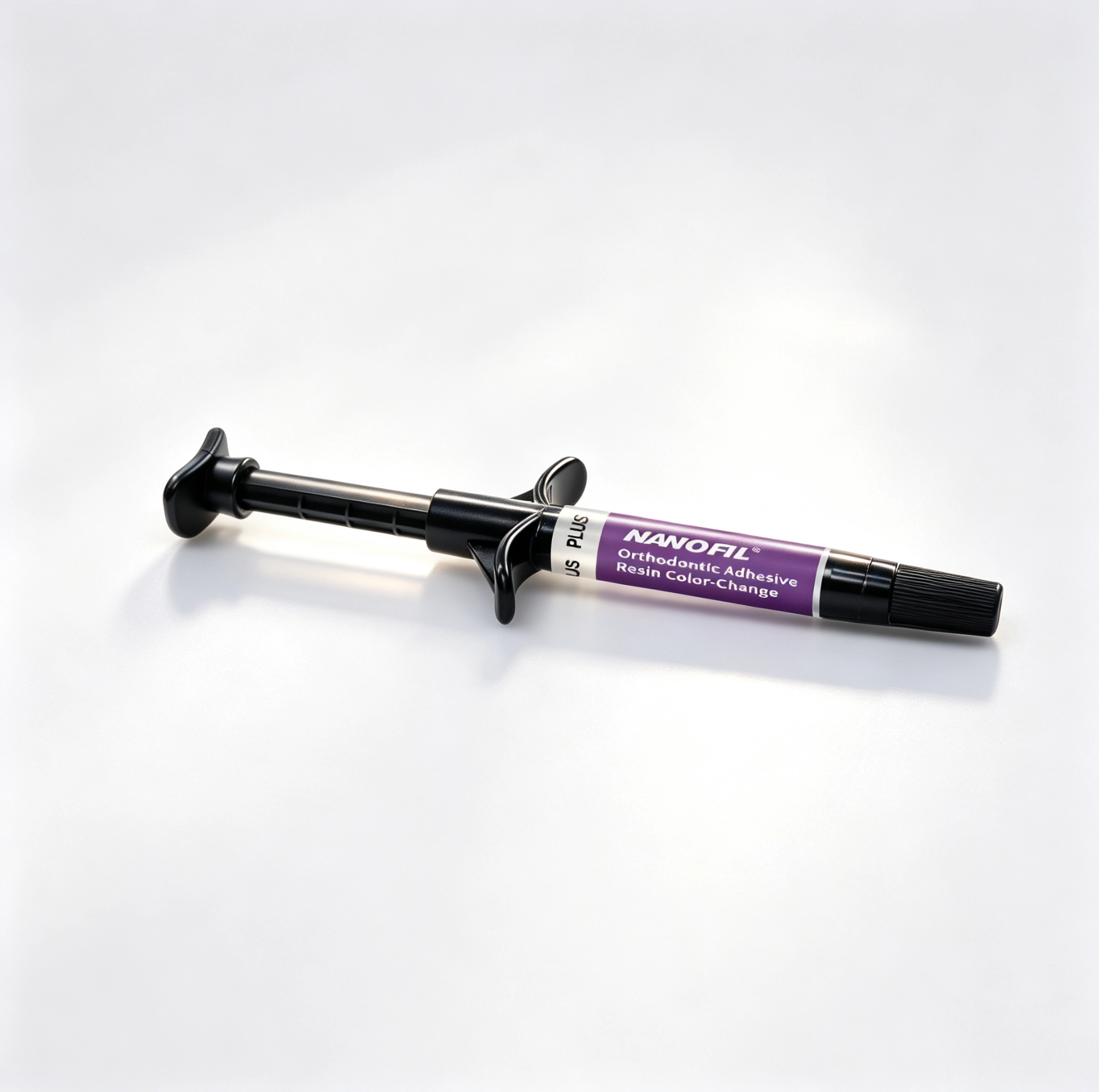
ATBIO's official orthodontics portfolio lists light-cured NANOFIL® adhesive options for bonding metal and ceramic brackets to enamel. The standard resin page describes a high-viscosity, light-cured material intended to support positioning, while the Color-Change Plus listing describes color-change technology and continuous fluoride release.
These are manufacturer descriptions, not independently verified clinical outcomes or permission to generalize beyond the current product documentation. Do not infer a curing exposure, etch duration, primer requirement or debonding method from the category page; obtain the current IFU for the exact adhesive and bracket application. Before listing the product, request the exact SKU's IFU, composition and performance evidence relevant to your claims, packaging specification, shelf life, storage conditions and destination-market documents. Confirm whether a standalone syringe or a complete kit better matches local purchasing habits.
For current availability, samples, documentation and distributor pricing, submit the target market, estimated quantity and intended configuration through request a quote.
10 — Frequently Asked Questions
What bond strength should an orthodontic adhesive have?
There is no single purchasing number that applies to every bracket, substrate and method. Compare results generated with a fully described, relevant protocol and review aging and failure mode alongside the measured strength. The clinician must use the product within its IFU.
Does a color-change adhesive automatically leave less flash?
No. Contrast can help the operator see material, but published research shows that a coloring agent alone does not guarantee less excess. Technique, bracket design, viscosity, placement and removal remain important.
Does fluoride release prevent white spot lesions?
It should not be marketed as a guaranteed preventive result. Ask for the release method and profile, remain within authorized claims, and treat the material as one element of a broader, patient-specific preventive program.
Should a distributor stock complete kits or individual syringes?
Stock both only when demand and the IFU-supported system justify them. Kits simplify adoption; individual replacement components can reduce waste and improve reorder continuity. Model consumption and expiry by component.
Can an orthodontic adhesive be sold under a private label?
Potentially, but the regulatory consequences depend on the market and role arrangement. Confirm legal-manufacturer responsibility, product evidence, artwork approval, translations, registrations, change control and post-market duties before using your own brand.
11 — References
International Organization for Standardization. ISO 29022:2013 — Dentistry — Adhesion — Notched-edge shear bond strength test.
Daraqel B, Yingying T, Zheng L. Flash-free and conventional adhesive ceramic brackets in patients undergoing orthodontic treatment: a systematic review and meta-analysis. Orthod Craniofac Res. 2023.
Armstrong D, Shen G, Petocz P, Darendeliler MA. Excess adhesive flash upon bracket placement: a typodont study. Angle Orthod. 2007.
Nascimento PLMM, Fernandes MTG, Figueiredo FED, Faria-E-Silva AL. Fluoride-releasing materials to prevent white spot lesions around orthodontic brackets: a systematic review. Brazilian Dental Journal. 2016;27(1):101–107.
International Organization for Standardization. ISO 13485:2016 — Medical devices — Quality management systems.
European Union. Regulation (EU) 2017/745 on medical devices.
ATBIO. Orthodontics product portfolio.
12 — About the Manufacturer
This article is published by ATBIO, the dental-materials brand of AT&M Biomaterials Co., Ltd.
ATBIO is the dental-materials brand of AT&M Biomaterials Co., Ltd. Its official portfolio includes restorative, adhesive, cement, impression, endodontic and orthodontic materials. Product availability, claims, instructions, documentation and packaging depend on the exact SKU and destination market. This page does not claim unconditional sale authorization in every country.
This article provides general procurement and educational information, not clinical, legal or regulatory advice. Dental professionals must follow the current IFU and exercise independent clinical judgment; distributors must verify market-specific requirements before import, registration or sale.
13 — Related Products and Resources
Do you prefer online learning?
Live webinars and professional tips — learn when, where and how.
Access our online learning opportunities