Composite Bonding Cost: 8 Fee Factors | ATBIO
Composite bonding cost depends on what is being treated and what the quotation includes. Repairing a small chip, closing a gap and covering the front of a tooth are different tasks, even when each is described as bonding and priced per tooth.
This guide helps patients compare treatment quotations and dental teams explain their scope. It covers eight fee factors and a practical comparison checklist. It does not provide country-specific prices or a universal price range; an individual treatment estimate requires a dental examination.
Quick answer: what changes the cost?
The main variables are the teeth and surfaces involved, preparatory treatment, aesthetic complexity, clinical time, materials, practice overhead, included services and aftercare. Start by asking for a written description of the work, the total treatment fee and any separately charged items. A higher fee alone does not establish better quality.
01 — Eight Factors That Affect Composite Bonding Cost
The factors below are a framework for discussing a quote, not a formula for setting fees. They overlap: for example, a complex tooth shape can affect both planning and chair time. For the treatment process, see our complete composite bonding guide.
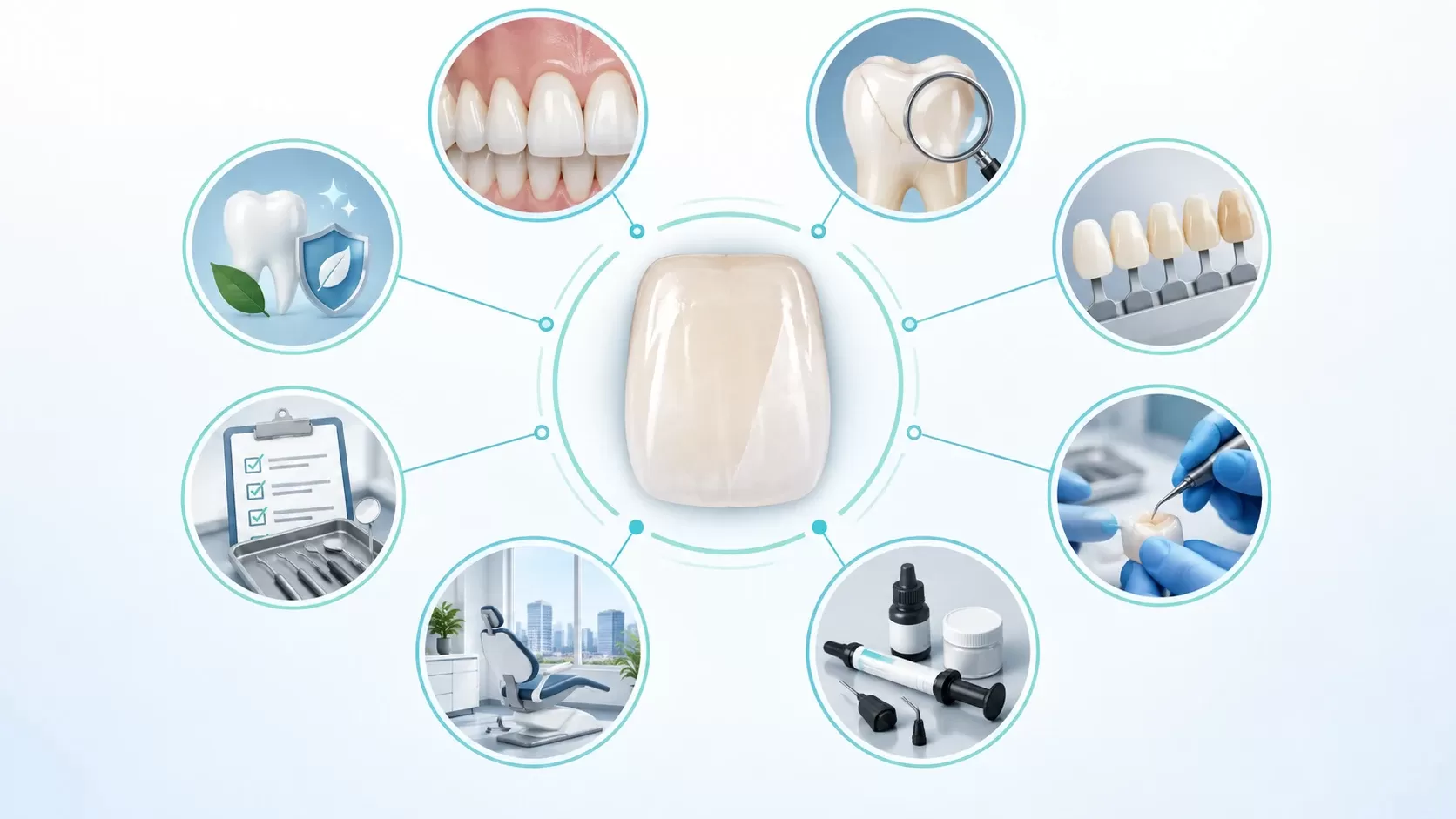
Eight visual factors behind a composite bonding quote. The illustration shows categories for comparison, not fixed price shares.
1. Number of teeth and surfaces
A price per tooth is meaningful only when the planned coverage is clear. A small incisal-edge repair differs from rebuilding several surfaces or placing a direct composite veneer. Ask the clinic to identify each tooth and describe the planned change. Do not assume that a multi-tooth package gives every tooth the same treatment or a discounted unit fee.
2. Tooth condition and preparatory care
Existing restorations, decay and gum health may change the plan. The dentist should explain whether examination, removal of old material or other necessary care is included or billed separately. Where additional treatment is needed, compare the complete plan, not just the bonding line on the estimate. Patient information on preparatory care [6].
3. Aesthetic planning and complexity
Matching a small defect can differ from coordinating tooth proportions, contacts and colour across several teeth. Photographs, a diagnostic mock-up or a detailed shade plan may be proposed for some cases. Ask what each planning step contributes and whether it is required, optional or unnecessary for your situation.
4. Clinical time and technique
Isolation, adhesive application, placement, curing, finishing and bite checks all form part of the clinical work. The appropriate protocol depends on the case and the materials' instructions for use. Ask how the appointment is organised, but do not use longer appointment time as proof of better treatment or shorter time as proof of shortcuts.
5. Composite and other consumables
The material system can include composite, adhesive, etchant, matrices, isolation supplies and finishing instruments. The price of one syringe cannot explain the full treatment fee. Ask which materials are planned and why they fit the case; material price or a term such as “nanohybrid” alone cannot establish clinical superiority. Material background [1].
6. Practice location and operating costs
Staffing, premises, equipment and supplies contribute to practice costs. The ADA advises practices to review fees against expenses, including equipment, supplies and employee benefits. This supports considering overhead; it does not establish a universal bonding tariff. Compare local quotations for equivalent work. Practice-management source [2].
7. What the quoted service includes
One estimate may include consultation, records and a review; another may list these separately. A bundle can be convenient, but its headline total says little without a service list. Ask whether the quote is provisional, how long it remains valid and how the clinic will discuss any change in the treatment plan.
8. Aftercare and future maintenance
Initial finishing, an early adjustment and later repolishing may fall under different charging policies. Ask which visits are included, for how long, and how future repairs are assessed and charged. A maintenance policy should describe the service offered without implying that a restoration has a guaranteed lifespan.
02 — A Checklist for Comparing Bonding Quotes
ATBIO suggests completing the following checklist with each clinic. The purpose is to identify differences in scope before comparing totals.
| Item to confirm | Question to ask | What to record |
|---|---|---|
| Teeth and coverage | Which teeth and surfaces are being treated? | Tooth list; edge repair, reshaping or veneer coverage. |
| Preparation | Is any treatment needed before bonding? | Required preparatory care and whether it is included. |
| Planning | Are photographs, scans or a mock-up proposed? | Purpose of each item; included, separate or optional. |
| Placement and completion | What does the restoration appointment cover? | Planned restoration, finishing, polishing and bite assessment. |
| Aftercare | What is included after the placement visit? | Review period; adjustment, repolishing and repair policy. |
| Total and payment | What is the full amount for the agreed plan? | Written total, exclusions and any confirmed benefit contribution. |
03 — Why Two “Per-Tooth” Quotes May Differ
Illustrative example only: the following comparison is not a patient record or a survey of clinic prices.
| Scope | Proposal A | Proposal B |
|---|---|---|
| Same visible concern | Repair a small chip on one front tooth. | Remove an existing restoration and rebuild more of the same tooth. |
| Planning and coverage | A limited repair is planned after assessment. | A broader change in shape and colour is planned after assessment. |
| Items to clarify | Whether the review is included. | Whether removal, additional planning and review are included. |
Both proposals concern one tooth, but they describe different work. Before deciding which offers value, ask the dentist why that scope is appropriate and whether a more conservative option is suitable. This example does not predict which proposal will cost more.
A practical way to compare totals:
For each proposal, record the quoted treatment plus required separately charged items and any optional services you actually choose. Keep later maintenance estimates separate from the initial total. If benefits apply, distinguish the clinic's fee from your expected out-of-pocket amount using confirmed information from the relevant provider.
04 — Initial Fee and Long-Term Cost
A low fee does not necessarily mean poor value, and a high fee does not guarantee durability. Clinical studies report variation in anterior composite outcomes; a single lifespan cannot be promised for every restoration. Clinical longevity review [3]. Our bonding longevity guide explains the factors in more detail.
Localised defects may be suitable for repair after assessment. A systematic review found no significant difference in failure risk between repaired and replaced defective direct restorations, but the certainty of evidence was very low. It did not establish a universal lifetime-cost saving. Repair-versus-replacement review [4].
Ask what an early problem would mean under the clinic's policy and which later interventions would be separately charged. For treatment-risk context, see why composite bonding fails.
05 — Frequently Asked Questions
How much does composite bonding cost per tooth?
There is no single figure that applies across countries, clinics and treatment scopes. This page explains fee factors rather than publishing a price range. For a usable estimate, ask a local dentist to specify the tooth, planned coverage, preparatory care and included follow-up.
Does bonding several teeth reduce the price per tooth?
Some clinics offer packages, but a discount should not be assumed. Compare the total agreed plan and the work proposed for each tooth. A lower average per tooth is not a meaningful saving if the proposals cover different treatment.
Is composite bonding cheaper than porcelain veneers?
The ADA describes porcelain veneers as tending to be the more expensive veneer option. That is a broad comparison, not a quote for your case. Confirm the type of restoration, preparation, laboratory work where relevant and aftercare before comparing totals. ADA patient guidance [5].
Does dental insurance cover bonding?
Ask the clinic and your benefits provider whether the specific planned treatment is covered. Do not assume a contribution because a quotation describes treatment as restorative or cosmetic. Obtain plan-specific confirmation, and keep your estimated payment separate from the full clinic fee.
Are polishing and repairs included in the original fee?
Do not assume so. Ask whether the fee includes only finishing at placement, an early review, later repolishing or repair. Request the time limits and exclusions in writing.
Can ATBIO quote the cost of my dental treatment?
ATBIO supplies dental materials and provides product information for professional buyers. A patient's treatment fee must come from the treating clinic after assessment. The product-enquiry link below is for materials, not a clinical treatment quotation.
06 — References and Evidence
The clinical sources below support treatment and maintenance context. Source [2] supports the discussion of practice expenses; none provides a global bonding price or a validated cost calculator. The checklist and example are ATBIO's editorial tools, not research findings. Sources checked on 11 September 2026.
Ferracane JL. Resin composite—state of the art. Dental Materials. 2011;27(1):29–38. https://pubmed.ncbi.nlm.nih.gov/21093034/
American Dental Association. Measuring Success. Guidelines for Practice Success: Managing Finances. https://www.ada.org/resources/practice/practice-management/measuring-success20160428t155202
Shah YR, Shiraguppi VL, Deosarkar BA, Shelke UR. Long-term survival and reasons for failure in direct anterior composite restorations: A systematic review. Journal of Conservative Dentistry. 2021;24(5):415–420. https://pubmed.ncbi.nlm.nih.gov/35399771/
Mendes LT, Pedrotti D, Casagrande L, Lenzi TL. Risk of failure of repaired versus replaced defective direct restorations in permanent teeth: a systematic review and meta-analysis. Clinical Oral Investigations. 2022;26(7):4917–4927. https://pubmed.ncbi.nlm.nih.gov/35362754/
American Dental Association, MouthHealthy. Veneers. https://www.mouthhealthy.org/all-topics-a-z/veneers
Cleveland Clinic. Dental Bonding. Updated January 5, 2026. https://my.clevelandclinic.org/health/treatments/10922-dental-bonding
07 — About ATBIO and Materials for Dental Professionals
Published by ATBIO, the dental-materials brand of AT&M Biomaterials Co., Ltd. Editorial update: 11 September 2026.
ATBIO supplies composite resins, adhesives, cements, etchant gels and related dental materials. Dental professionals and distributors can review the following product information, using current instructions for use and documentation for the exact product and destination market:
Related Products
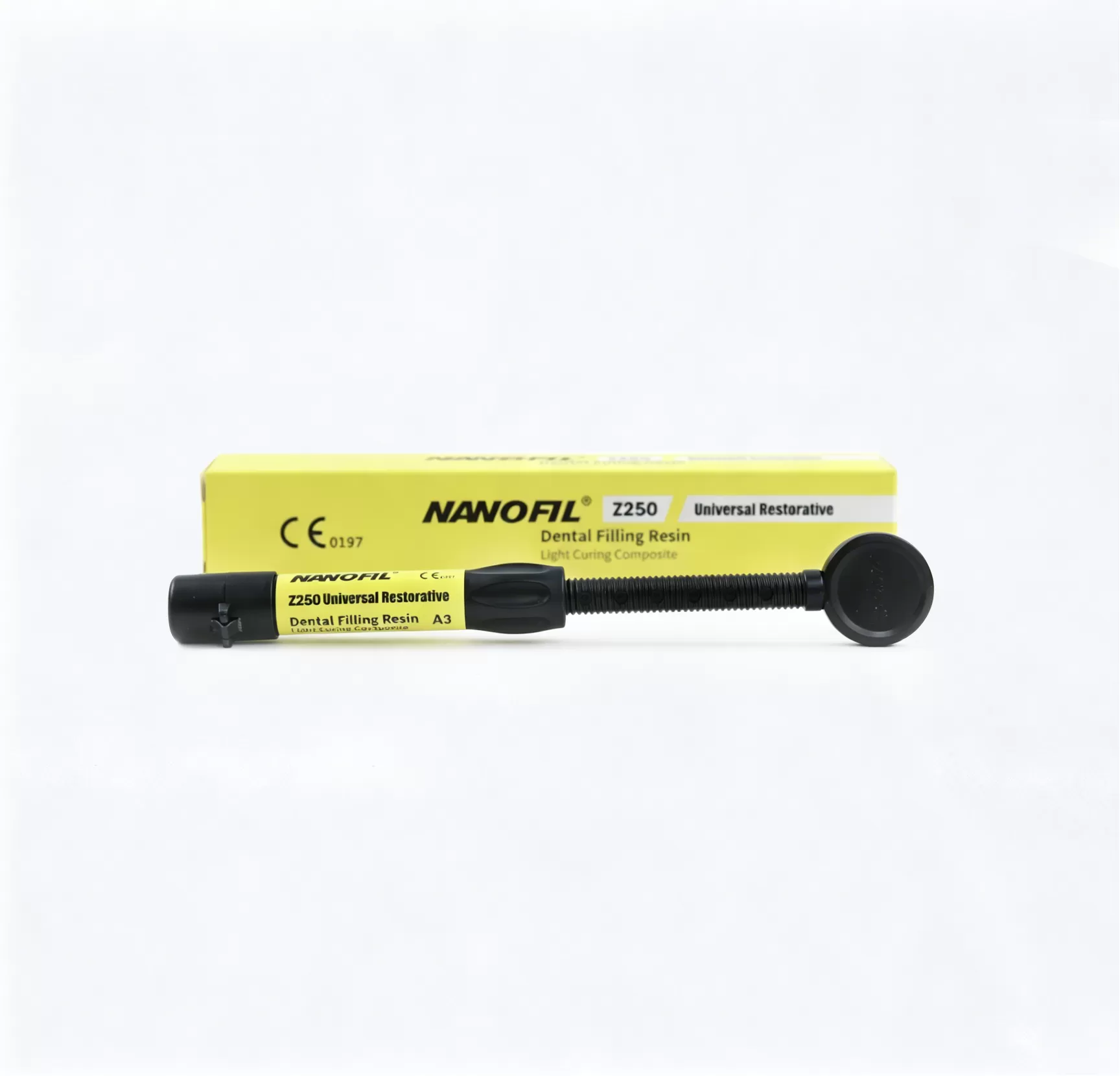
NANOFIL® Z250 product image. Material selection is one part of a clinical treatment plan.
Request product documentation or a materials quotation for professional purchasing and distributor enquiries.
This article provides general educational information and does not replace diagnosis, a case-specific treatment plan or product instructions for use. ISO 13485 concerns the quality management system, not clinical superiority. Product conformity and market requirements must be checked separately. This page does not claim unconditional sale authorization in every country.
Do you prefer online learning?
Live webinars and professional tips — learn when, where and how.
Access our online learning opportunities