Composite Bonding vs Veneers | Case Guide | ATBIO
Composite bonding is often considered for localized, additive changes that can be repaired chairside; ceramic veneers may suit a coordinated change in shape and colour across several teeth. Neither is the better choice for every case. Comparing composite bonding vs veneers requires an assessment of remaining enamel, the space needed for the restoration, occlusion, aesthetic expectations and willingness to maintain the result.
This guide compares direct composite bonding with ceramic veneers side by side. It is designed to support an informed clinical conversation rather than replace case-specific examination. Readers who need the bonding workflow first can consult the complete guide to composite bonding.
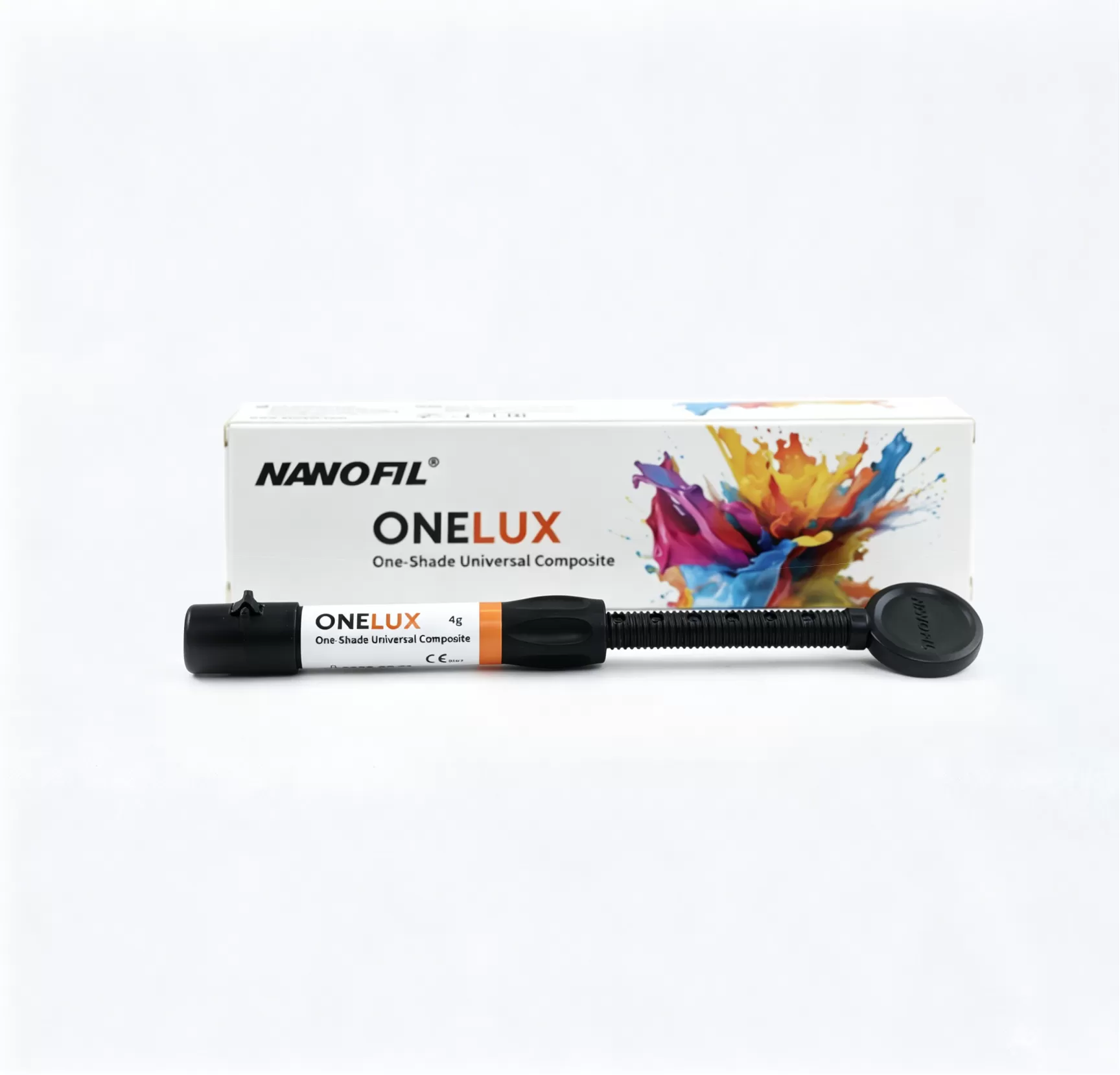
NANOFIL® ONELUX one-shade universal composite for professional restorative workflows.
01 — The Fundamental Difference Between Bonding and Veneers
Composite bonding is a direct technique. The clinician applies tooth-coloured composite to the prepared or minimally prepared tooth, shapes the material, light-cures it and finishes the restoration chairside. Laboratory fabrication is not required, and enamel removal may be minimal or unnecessary in selected additive cases.
Ceramic veneers are indirect restorations. Thin ceramic restorations are fabricated outside the mouth by a laboratory or a chairside digital workflow and then adhesively bonded to the tooth. Preparation can range from minimal to more extensive depending on alignment, colour, material thickness and restorative design. Some cases may remain largely in enamel; others cannot be treated predictably without preparation.
The direct-versus-indirect distinction determines who controls each stage. With bonding, the clinician designs, builds and finishes the restoration chairside. Veneers require coordination of diagnosis, preparation, interim protection when needed, fabrication, try-in and adhesive cementation. A digital chairside pathway may shorten the appointment sequence, but it does not remove the fitting and bonding requirements.
02 — Composite Bonding vs Veneers at a Glance
| Decision factor | Composite bonding | Ceramic veneers |
|---|---|---|
| Fabrication | Built directly on the tooth chairside | Fabricated indirectly, then bonded to the tooth |
| Tooth preparation | Often additive or minimally invasive in selected cases | Case-dependent; preparation may be required for space, contour and colour control |
| Treatment sequence | Frequently completed in a direct appointment after planning | Usually involves planning, fabrication and a separate bonding stage |
| Relative fee position | Generally lower because laboratory fabrication is avoided | Generally higher because fabrication and additional stages are involved |
| Maintenance | Can often be polished, refurbished or repaired locally | Review and margin care remain necessary; selected defects can be repaired, but major fracture may require replacement |
| Aesthetic control | Strong chairside control for localized and additive changes | Broad control of multi-unit shape, surface and ceramic optical effects |
| Common fit | Small chips, localized gaps, minor reshaping and conservative trials | Broader multi-tooth changes, selected intrinsic colour problems and cases requiring ceramic surface stability |
The table describes general tendencies, not an indication for an individual patient. Tooth structure, periodontal health, caries risk, parafunction, occlusion and patient expectations can change the decision.
03 — Tooth Preparation and Reversibility
Preserving sound enamel is a major advantage of additive composite bonding. If space and alignment permit, composite may be added with little or no preparation. Even then, the word "reversible" should be used cautiously: removing bonded material without altering the underlying enamel can be difficult, and the tooth may require continued maintenance after treatment.
Veneer preparation is determined by the planned ceramic thickness, existing tooth position, colour change and desired contour. Keeping the adhesive interface predominantly in enamel is generally favourable, but not every tooth position allows that design. A no-preparation veneer is not automatically more conservative if it creates overcontour, plaque retention or an unacceptable emergence profile.
The clinically relevant question is therefore not simply whether a bur is used. It is whether the final plan preserves healthy tissue while creating adequate material space, cleansable contours and a stable adhesive design.
04 — Aesthetics and Colour Management
Modern restorative composites can produce highly natural results when the clinician controls opacity, translucency, anatomy, texture and polish. Direct placement is especially useful for localized corrections because colour and contour can be adjusted immediately against adjacent teeth. Simplified shade systems can reduce inventory and support efficient workflows, while multilayer systems provide additional control for demanding cases.
Ceramic veneers can offer stable gloss, surface texture and broad optical control across several anterior teeth. They may be preferred when the treatment objective includes a coordinated multi-unit change or when severe intrinsic discolouration requires a carefully planned masking strategy. The final result still depends on preparation, ceramic selection, laboratory communication, try-in and resin cement shade.
Neither material can correct every colour problem without compromise. Opaque composite or ceramic used to mask a dark substrate may require thickness that affects contour or preparation. Diagnostic photographs, shade mapping and a mock-up can reveal these limitations before irreversible treatment begins.
05 — Longevity, Wear and Repairability
Both options can remain in service with appropriate selection and maintenance, but survival is not the same as remaining unchanged or needing no intervention. The veneer and anterior-composite reviews below include different designs and follow-up periods; their rates cannot be compared as if they came from a head-to-head trial. The older Cochrane review found insufficient reliable comparative evidence to establish a longevity advantage for direct or indirect veneers. Discuss likely maintenance and failure patterns rather than promise a fixed lifespan.
Composite commonly shows gradual changes such as gloss loss, marginal staining, surface wear or localized chipping. Many of these changes can be managed by polishing, refurbishment or repair when the remaining restoration and tooth are sound. That maintainability is an important advantage for conservative care.
Ceramic generally retains gloss and resists surface staining well, but it is not maintenance-free. Periodontal review, margin assessment and caries prevention still matter. A small chip may be polished or repaired; an intact debonded veneer may sometimes be rebonded after investigating the cause. Extensive fracture, poor fit or underlying disease may instead require replacement. Enamel support, preparation, surface treatment and occlusal loading affect this decision.
Patients considering direct treatment can review the article on how long composite bonding lasts, including maintenance and behavioural factors.
06 — Cost, Appointments and Chairside Economics
Composite bonding is generally positioned below ceramic veneers because it avoids laboratory fabrication and is often delivered in a direct workflow. Veneers usually include additional diagnostic, fabrication, try-in and cementation stages. The final fee in either category depends on case complexity and included services.
Initial fee should be considered alongside maintenance. Composite may need periodic polishing or localized repair; ceramic may retain its surface longer but can involve a larger replacement event when major failure occurs. The previous guide to composite bonding cost factors explains how material, clinician time, scope and region affect relative positioning without publishing universal prices.
For clinics, bonding consumes restorative materials, adhesive, finishing instruments and clinician time. Veneers add laboratory or digital fabrication, provisional materials when needed and resin cementation products. Distributors may therefore support both workflows: direct restorative consumables for recurring chairside demand and cementation materials for indirect restorations.
07 — Technique Sensitivity and Failure Modes
Composite bonding depends on clean isolation, substrate management, correct adhesive use, adequate curing, controlled placement and detailed finishing. Contamination, unsuitable case selection, weak unsupported material, occlusal overload and incomplete finishing can contribute to staining, chipping or debonding.
Veneers add preparation design, impression or scan accuracy, laboratory communication, treatment of the internal bonding surface and cement selection. Etchable glass ceramic generally requires the specified hydrofluoric-acid and silane protocol; MDP alone is not a substitute. Zirconia must not be hydrofluoric-acid etched and needs a different, validated surface treatment. Reconcile the ceramic, adhesive and cement instructions, including curing through the restoration, rather than use one sequence for all materials.
Bruxism, edge-to-edge contacts, unstable occlusion and habits such as biting hard objects can threaten both options. Occlusal assessment and patient counselling should occur before selecting the restorative material.
08 — Decision Guidance by Patient Priority
Consider composite bonding when the change is localized, an additive plan is feasible, same-stage direct treatment is valued, repairability matters or the patient wants a conservative provisional step before a future indirect option.
Consider ceramic veneers when several teeth require coordinated changes, ceramic optical and surface properties fit the objective, the patient accepts the preparation and fabrication pathway, and the clinician can create a predictable adhesive design.
Delay either treatment when active caries, periodontal inflammation, unstable occlusion, uncontrolled parafunction or unclear expectations would make the result unpredictable.
Combine approaches selectively when different teeth have different needs. A treatment plan can use ceramic on some teeth and direct composite on others, provided shade, contour, maintenance and future repair have been considered together.
A diagnostic wax-up, mock-up or digital simulation helps the patient compare contours and treatment scope, but does not establish clinical suitability. Where appropriate, discuss whitening, orthodontics, observation or a smaller restoration before covering sound tooth structure. Informed consent should document preparation, maintenance, alternatives and likely failure modes, including the limits of removing bonded material later.
09 — Material Planning for Clinics and Distributors
A direct bonding workflow typically requires a restorative composite, compatible adhesive, etchant when indicated, matrices, finishing and polishing instruments and a verified curing light. Clinics may choose a simplified one-shade approach for selected cases or a broader shade system for layered aesthetic work. NANOFIL® ONELUX One-Shade Universal Composite and NANOFIL® Z250 Universal Restorative Composite represent two portfolio options for professional evaluation.
An indirect veneer workflow requires cement selected for the ceramic, thickness and light transmission, with compatible tooth and internal-surface treatments. Before ordering, ask which indications the current instructions cover, whether separate silane or primer is required, how curing is validated through the planned ceramic and whether try-in materials and replacement mixing tips are available. Do not assume all adhesives and cements are interchangeable.
10 — FAQ
1. Is composite bonding better than veneers?
Not universally. Bonding may be preferable for conservative, localized and repairable treatment. Veneers may be preferable for selected multi-tooth changes or when ceramic surface and optical properties match the objective. Diagnosis determines the better fit.
2. Is composite bonding reversible?
It may require little or no tooth preparation in additive cases, but complete reversal cannot be guaranteed. Removing bonded composite without changing enamel can be difficult, and treated teeth still need clinical review and maintenance.
3. Do veneers always require enamel removal?
No. Preparation varies with tooth position, colour, planned contour and ceramic design. Some selected cases can be treated with minimal or no preparation, while others need space to avoid overcontour and achieve the intended result.
4. Which option is easier to repair?
Composite is generally easier to repair locally because new composite can be bonded to a properly prepared surface when clinically suitable. Significant ceramic veneer fracture more often requires replacement, although the decision is case-specific.
5. Which option resists staining better?
Glazed or polished ceramic generally offers greater surface stain resistance. Composite can still maintain good aesthetics but may require periodic polishing and attention to staining exposures and marginal condition.
6. Can bonding and veneers be used in the same smile?
Yes, when planned carefully. The clinician must coordinate shade, translucency, contour, contacts and maintenance across materials and explain that they may age and require repair differently.
11 — References
Alenezi A, Alsweed M, Alsidrani S, Chrcanovic BR. Long-Term Survival and Complication Rates of Porcelain Laminate Veneers in Clinical Studies: A Systematic Review. https://pubmed.ncbi.nlm.nih.gov/33807504/
Lim TW, Tan SK, Li KY, Burrow MF. Survival and complication rates of resin composite laminate veneers: a systematic review and meta-analysis. https://pubmed.ncbi.nlm.nih.gov/38035903/
Wakiaga J et al. Direct versus indirect veneer restorations for intrinsic dental stains. https://pubmed.ncbi.nlm.nih.gov/14974066/
Shah YR, Shiraguppi VL, Deosarkar BA, Shelke UR. Long-term survival and reasons for failure in direct anterior composite restorations: A systematic review. https://pubmed.ncbi.nlm.nih.gov/35399771/
12 — About ATBIO
This article is published by ATBIO, the dental-materials brand of AT&M Biomaterials Co., Ltd.
ATBIO (AT&M Biomaterials Co., Ltd.) supplies composite resins, adhesives, cements, etchant gels and related dental materials. For distributor or OEM enquiries, request the current instructions, lot-traceability information and documents applicable to the exact product and destination. Any CE documentation must cover the product concerned; ISO 13485 concerns the quality management system, not proof of clinical superiority or authorization in every market.
This article provides general educational information and does not replace diagnosis, a case-specific treatment plan, professional clinical judgment or the instructions for use of an individual product. This page does not claim unconditional sale authorization in every country.
13 — Related Products
NANOFIL® ONELUX One-Shade Universal Composite — a one-shade restorative option for simplified direct aesthetic workflows.
NANOFIL® Z250 Universal Restorative Composite — a universal restorative composite for professional evaluation according to its intended indications.
Perfect-Link Universal Dental Adhesive — a universal dental adhesive for compatible restorative workflows.
Match the material to the tooth, the treatment objective and the maintenance plan. Request a quote or contact ATBIO for product documentation, samples and distributor support.
Do you prefer online learning?
Live webinars and professional tips — learn when, where and how.
Access our online learning opportunities