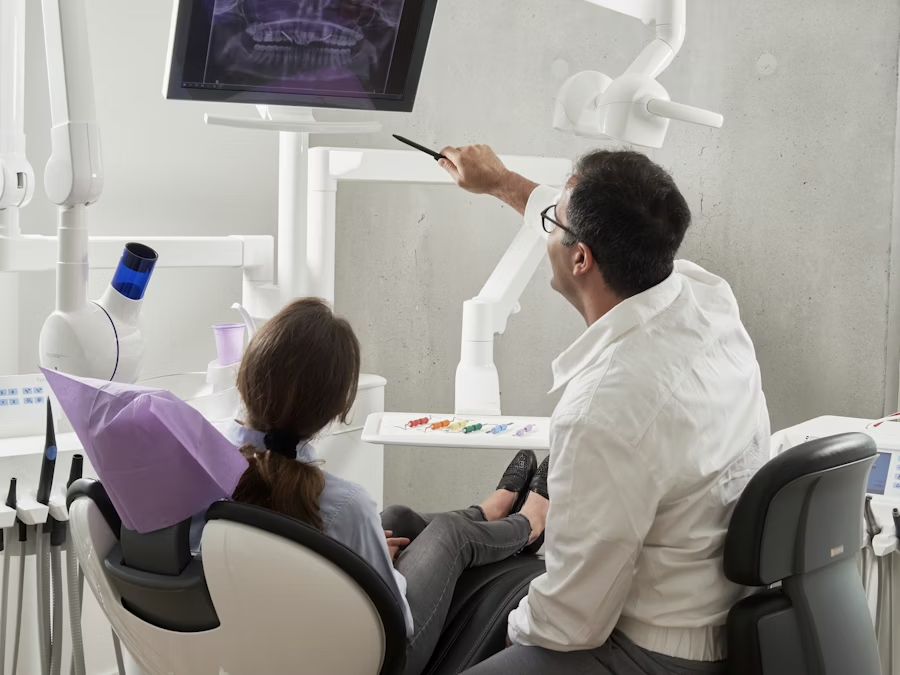
Total-Etch vs Self-Etch | Adhesive Guide | ATBIO
Total-etch vs self-etch vs universal adhesive compares two application approaches with a product category, not three interchangeable generations. Etch-and-rinse uses a separate acid-and-rinse step; self-etch uses acidic monomers without that rinse; a universal adhesive may permit either approach and selective enamel etching. Choose by enamel and dentin exposure, the restoration, isolation and the validated material protocol, not by the bottle's generation number.
Enamel is highly mineralized and responds predictably to phosphoric-acid etching. Dentin contains more water and organic matrix, so excessive demineralization, incomplete resin infiltration, poor solvent evaporation, or contamination can weaken the interface. Universal adhesives add flexibility by allowing more than one etching mode, but they do not remove these biological and technical differences.
This guide compares the three strategies, explains selective enamel etching, and provides a case-based checklist. Product-specific application times, etching sequences, substrate indications, and cure compatibility always take priority.
01 — Total-Etch, Self-Etch, and Universal Adhesives Defined
Total-etch, more precisely called etch-and-rinse, uses phosphoric acid as a separate conditioning step. Enamel and/or dentin are etched and then rinsed before primer and adhesive are applied. Systems may separate primer and bond into different bottles or combine steps.
Self-etch systems use acidic functional monomers to condition and prime without a separate phosphoric-acid rinse on the treated surface. They interact with the smear layer and underlying tooth structure while the adhesive infiltrates. They may be one-step or multi-step. Self-etch adhesive is not the same as self-adhesive resin cement: the former is still a separate bonding material.
Universal, or multi-mode, adhesives are designed for use in more than one etching mode: self-etch, etch-and-rinse, or selective enamel etch. Many contain functional monomers such as 10-MDP, but composition, acidity, water and solvent content, film thickness, silane behaviour, and compatibility with other materials vary by product.
A universal adhesive is therefore a product category, while etch-and-rinse, self-etch, and selective enamel etch are application strategies. A universal bottle can be used incorrectly, and a conventional multi-step system can perform well when its validated protocol is followed.
02 — How the Three Bonding Strategies Differ
| Decision factor | Etch-and-rinse | Self-etch | Universal adhesive |
|---|---|---|---|
| Separate phosphoric-acid step | Yes, on the substrates specified by the protocol | No in the basic self-etch sequence | Optional, depending on the selected mode |
| Smear-layer approach | Acid conditioning removes or modifies it before rinsing | Acidic monomers interact with and incorporate it | Depends on etching mode |
| Enamel conditioning | Strong phosphoric-acid etch when correctly performed | Varies with adhesive acidity; may be less pronounced | Can add selective phosphoric-acid enamel etching |
| Dentin technique | Requires controlled conditioning, moisture, infiltration, and solvent removal | Conditioning and infiltration occur together | Depends on selected mode and product instructions |
| Main workflow risk | Over- or under-conditioning, dentin moisture errors, extra steps | Weak enamel interaction with some systems, shortened application, poor evaporation | Assuming every mode, substrate, and cement combination is equivalent |
Read clinical and laboratory outcomes separately. Hong and colleagues found better retention and marginal outcomes with etch-and-rinse than self-etch in the included universal-adhesive clinical studies. Chen and colleagues, studying laboratory dentin bond strength, found no significant advantage from prior acid etching. These are different substrates and endpoints, not necessarily contradictory conclusions; neither establishes one protocol for every cavity or product.
03 — Etch-and-Rinse: Strengths, Risks, and Indications
Etch-and-rinse remains a well-established option when enamel margins are important. Phosphoric acid creates a microretentive enamel pattern that adhesive resin can penetrate. On dentin, however, the acid removes mineral from the surface and exposes a collagen-rich zone that must remain accessible to primer and adhesive.
Potential strengths:
Predictable conditioning of cut and uncut enamel when the acid is applied and rinsed correctly.
Useful for enamel-dominant restorations, bevels, and margins where phosphoric-acid enamel etching is specified.
Long clinical history across multi-step and simplified systems.
Technique risks:
Dentin contact time, rinsing, and residual moisture must match the adhesive instructions.
Over-drying can collapse an exposed collagen network in systems that depend on moist dentin; excessive water can dilute components or impair solvent removal.
More separate steps create more opportunities for contamination and timing errors.
Etch-and-rinse should not be described as automatically causing more postoperative sensitivity. A systematic review of posterior composite restorations did not find that adhesive strategy alone determined the risk or intensity of postoperative sensitivity. Diagnosis, depth, isolation, application, curing, and occlusion remain relevant.
04 — Self-Etch: Strengths, Risks, and Indications
Self-etch adhesives use acidic monomers to interact with the smear layer and tooth substrate without a separate rinse step. Because conditioning and infiltration are coupled, the approach avoids the same wet-bonding transition required by many etch-and-rinse systems.
Potential strengths:
Fewer separate clinical stages and no phosphoric-acid rinse on dentin in the basic protocol.
Controlled interaction with dentin according to the formulation's acidity and application method.
Useful when the selected product, substrate, and cavity design support a self-etch sequence.
Technique risks:
Some mild self-etch adhesives create less pronounced etching on uncut enamel than phosphoric acid.
Shortened rubbing time, inadequate solvent evaporation, and insufficient curing can impair performance.
One-step convenience does not guarantee long-term durability, and formulations cannot be treated as interchangeable.
Self-etch is also not automatically “sensitivity-free.” Pulpal status, lesion depth, dentin permeability, operative trauma, adhesive handling, polymerization, and occlusion can all contribute to postoperative symptoms.
05 — Universal Adhesives and Selective Enamel Etching
Universal adhesives allow the operator to choose how phosphoric acid is used. In selective enamel etching, phosphoric acid is applied to enamel margins while dentin is treated with the adhesive in self-etch mode. This seeks to combine stronger enamel conditioning with a less aggressive dentin sequence.
Josic and colleagues found a retention advantage for selective enamel etching over self-etch alone at some follow-up points in noncarious cervical lesions, but certainty was low or very low. Ma and colleagues' network meta-analysis found similar marginal and retention outcomes for etch-and-rinse and selective enamel etching, with poorer results for self-etch without enamel etching in the included trials. This supports evaluating selective enamel etching when enamel margins matter, not applying a cervical-lesion result uncritically to every restoration.
Many universal adhesives contain 10-MDP, which can interact with calcium in hydroxyapatite. That ingredient does not make formulations identical or replace every restoration primer. Etchable glass ceramic still needs its specified HF-and-silane sequence or validated alternative; MDP alone is not a substitute, and HF must not be used on zirconia. Monomer formulation, pH, solvent, initiators, film thickness, application and curing differ, so do not transfer one product's protocol to another.
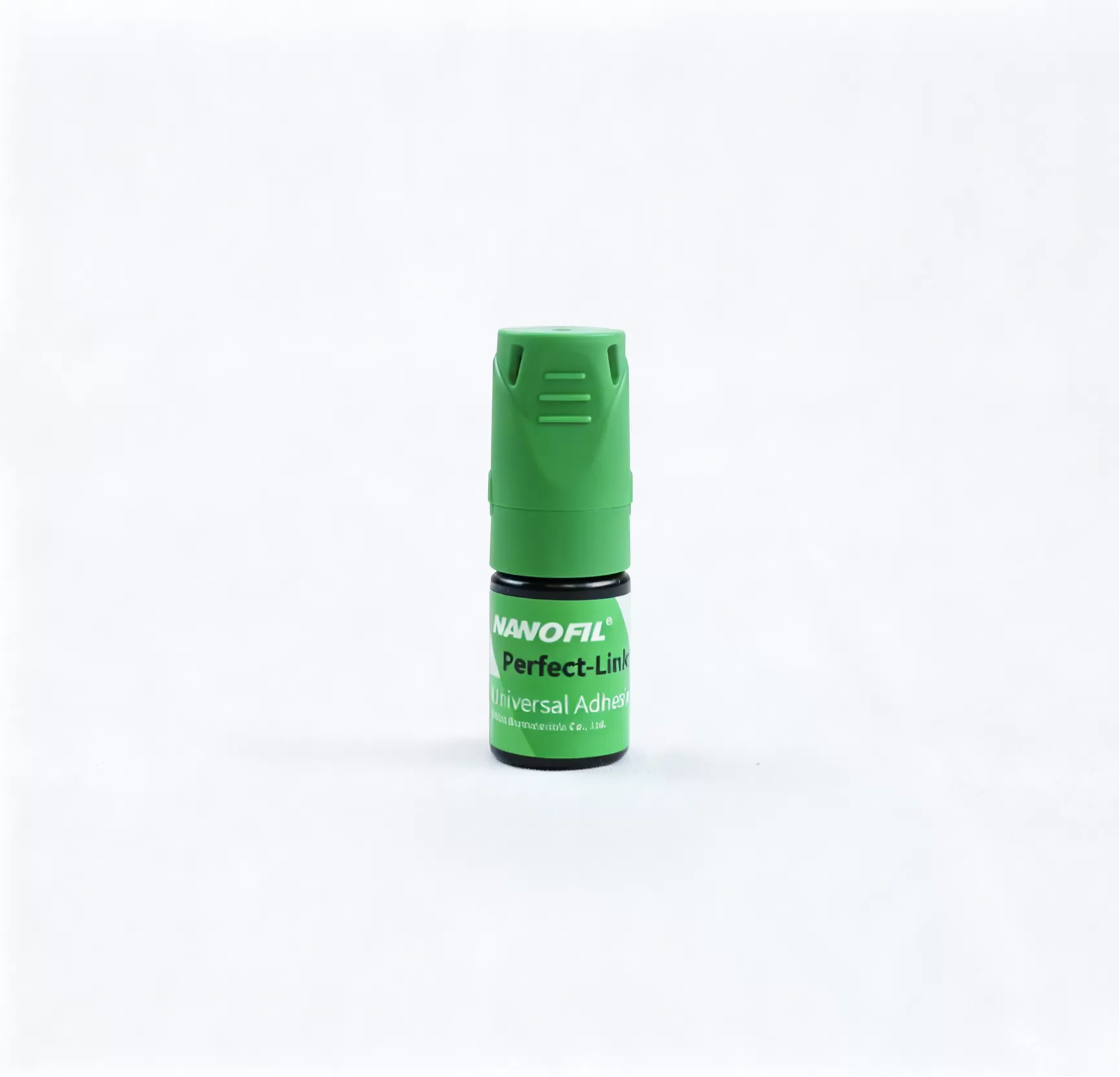
ATBIO lists NANOFIL® Perfect-Link Universal Adhesive for direct and indirect restorative applications with different etching strategies. Confirm the current instructions for the exact substrate and cement combination before use. A broad product-page description is not enough to establish an application time, omit a primer or guarantee reduced sensitivity.
06 — Select a Bonding Strategy by Case
| Clinical situation | Strategy to evaluate | Key verification |
|---|---|---|
| Enamel-dominant direct restoration or bevel | Etch-and-rinse or universal with enamel etching | Enamel coverage, etching time, isolation, and margin design |
| Mixed enamel and dentin margins | Selective enamel etch or validated etch-and-rinse protocol | Keep phosphoric acid placement controlled when dentin will remain in self-etch mode |
| Dentin-dominant cavity | Self-etch or product-specific universal mode | Dentin condition, active application, solvent removal, and instructions |
| Repair involving aged composite, metal, or ceramic | Substrate-specific repair protocol | Do not assume the adhesive replaces every silane, primer, or mechanical treatment |
| Indirect restoration with resin cement | Cement-system-designated adhesive sequence | Cure mode, restoration substrate, tooth substrate, and chemical compatibility |
For indirect cases, use the adhesive and cement as one validated system. The earlier dental resin cement guide explains how cure mode, restoration thickness, and intaglio treatment affect that selection.
07 — Application and Light-Curing Checks
Isolation: control saliva, blood, and crevicular fluid before surface treatment starts.
Acid placement: confine phosphoric acid to the substrates intended for etch-and-rinse or selective etching.
Active application: rub the adhesive for the full specified time; shortened application can reduce dentin bond strength.
Solvent evaporation: use the stated air pressure and time until the film reaches the required condition.
Film control: prevent pooling while avoiding excessive air thinning beyond the product protocol.
Light curing: use a compatible wavelength, clean light guide, verified output, correct distance and angulation, and the stated exposure. Cure the adhesive separately before composite placement when instructed; a later composite or bulk-fill exposure is not a substitute.
Dual-cure compatibility: check whether an activator or a particular adhesive sequence is required with self- or dual-cure materials.
Documentation: record adhesive, mode, lot, curing device, and exposure when traceability is important.
Contamination, shortened application, poor evaporation, and inadequate curing are among the preventable workflow problems discussed in why composite bonding fails.
08 — What Clinics and Distributors Should Verify
Which etching modes are explicitly included in the instructions for use?
What are the application, air-thinning, and curing times?
Which direct and indirect substrates are covered, and which need separate primers?
Is the adhesive compatible with the clinic's light-, dual-, and self-cure materials?
Is an activator required for particular cementation workflows?
What storage temperature, shelf life, dispensing control, and light protection are specified?
Are current IFU, safety data, CE documentation, and traceability support available for the target market?
Can the supplier support training, samples, and consistent replenishment without encouraging off-label protocol mixing?
The ATBIO dental adhesives portfolio provides product-level options for professional evaluation. Selection should be based on the intended procedures and current documentation, not on the number of claimed indications alone.
09 — Frequently Asked Questions
1. Is total-etch the same as etch-and-rinse?
In common dental usage, yes. Etch-and-rinse is the more descriptive term because phosphoric acid is applied and then rinsed before the adhesive sequence continues.
2. Is a universal adhesive always better than a conventional adhesive?
No. Universal adhesives offer mode flexibility and inventory advantages, but performance depends on formulation, substrate, protocol, and operator execution. A well-used multi-step system may be preferable for some procedures.
3. Should enamel always be selectively etched before a universal adhesive?
Not as an unconditional rule. Selective enamel etching is supported for many restorations with important enamel margins, but evidence and product instructions vary by case and adhesive. Primary teeth, dentin-dominant cavities, and different margin designs may require different decisions.
4. Does self-etch prevent postoperative sensitivity?
No strategy guarantees that outcome. Evidence has not consistently shown adhesive strategy alone to determine postoperative sensitivity. Diagnosis, depth, contamination, technique, curing, and occlusion also matter.
5. Can one universal adhesive bond enamel, dentin, zirconia, metal, and glass ceramic without other primers?
No such assumption is justified by the word “universal.” Review each substrate indication: glass ceramic may need HF etching and silane, whereas zirconia must not be HF etched. Metals and aged composite need their own validated cleaning, roughening and primer sequence.
6. Can a light-cured universal adhesive be used with every dual-cure resin cement?
No. Chemical compatibility and cure mode are product-specific. Use the adhesive-cement combination and any required activator exactly as documented by the manufacturers.
10 — References
Hong X et al. Clinical effects of different etching modes for universal adhesives: a systematic review and meta-analysis. https://pubmed.ncbi.nlm.nih.gov/34107709/
Sofan E et al. Classification review of dental adhesive systems: from the IV generation to the universal type. https://pmc.ncbi.nlm.nih.gov/articles/PMC5507161/
Chen H et al. Comparison of bond strength of universal adhesives using different etching modes: A systematic review and meta-analysis. https://pubmed.ncbi.nlm.nih.gov/34471040/
Josic U et al. The influence of selective enamel etch and self-etch mode of universal adhesives' application on clinical behavior of composite restorations placed on non-carious cervical lesions: A systematic review and meta-analysis. https://pubmed.ncbi.nlm.nih.gov/35151466/
Ma KS, Wang LT, Blatz MB. Efficacy of adhesive strategies for restorative dentistry: A systematic review and network meta-analysis of double-blind randomized controlled trials over 12 months of follow-up. https://pubmed.ncbi.nlm.nih.gov/35691823/
Reis A et al. Does the adhesive strategy influence the post-operative sensitivity in adult patients with posterior resin composite restorations?: A systematic review and meta-analysis. https://pubmed.ncbi.nlm.nih.gov/26122377/
11 — About ATBIO
This article is published by ATBIO, the dental-materials brand of AT&M Biomaterials Co., Ltd.
ATBIO (AT&M Biomaterials Co., Ltd.) supplies composite resins, dental adhesives, cements, etchant gels and related professional materials. For OEM or distributor enquiries, request current product instructions and destination-specific documentation. CE documentation must apply to the exact product; ISO 13485 concerns quality management and does not establish clinical superiority or authorization in every market.
This article provides general educational information and does not replace diagnosis, case-specific treatment planning, professional clinical judgment, or the instructions for use of an individual product. This page does not claim unconditional sale authorization in every country.
12 — Related Products
NANOFIL® Perfect-Link Universal Adhesive — a universal adhesive for direct and indirect restorative applications according to current product documentation.
NANOFIL® Bonding Agent — a light-cured dental adhesive for compatible direct restorative procedures.
NANOFIL® Etchant Gel — phosphoric-acid etchant for enamel and dentin conditioning where indicated.
Standardize each bonding mode with a documented, compatible material system. Request a quote or contact ATBIO for current instructions, technical documents, samples, and distributor support.
Préférez-vous l’apprentissage en ligne ?
Webinaires en direct et conseils professionnels : apprenez quand, où et comment.
Accédez à nos possibilités d’apprentissage en ligne