Dental Resin Cement | Complete Guide | ATBIO
Dental resin cement fixes an indirect restoration to a prepared tooth or abutment. Choose it on two separate axes: how it polymerizes and how it bonds. Light-cure, dual-cure and self-cure describe polymerization; self-adhesive describes a bonding approach and can also be dual-cure. Restoration material, thickness, translucency, preparation retention, tooth substrate and light access determine which combination is appropriate.
This complete guide explains where resin cement is used, how the main types differ, how selection changes by restoration, how a generalized clinical workflow is organized and what clinics and distributors should verify before purchasing. It does not replace the instructions for use supplied with the cement, adhesive, primer or restorative material.
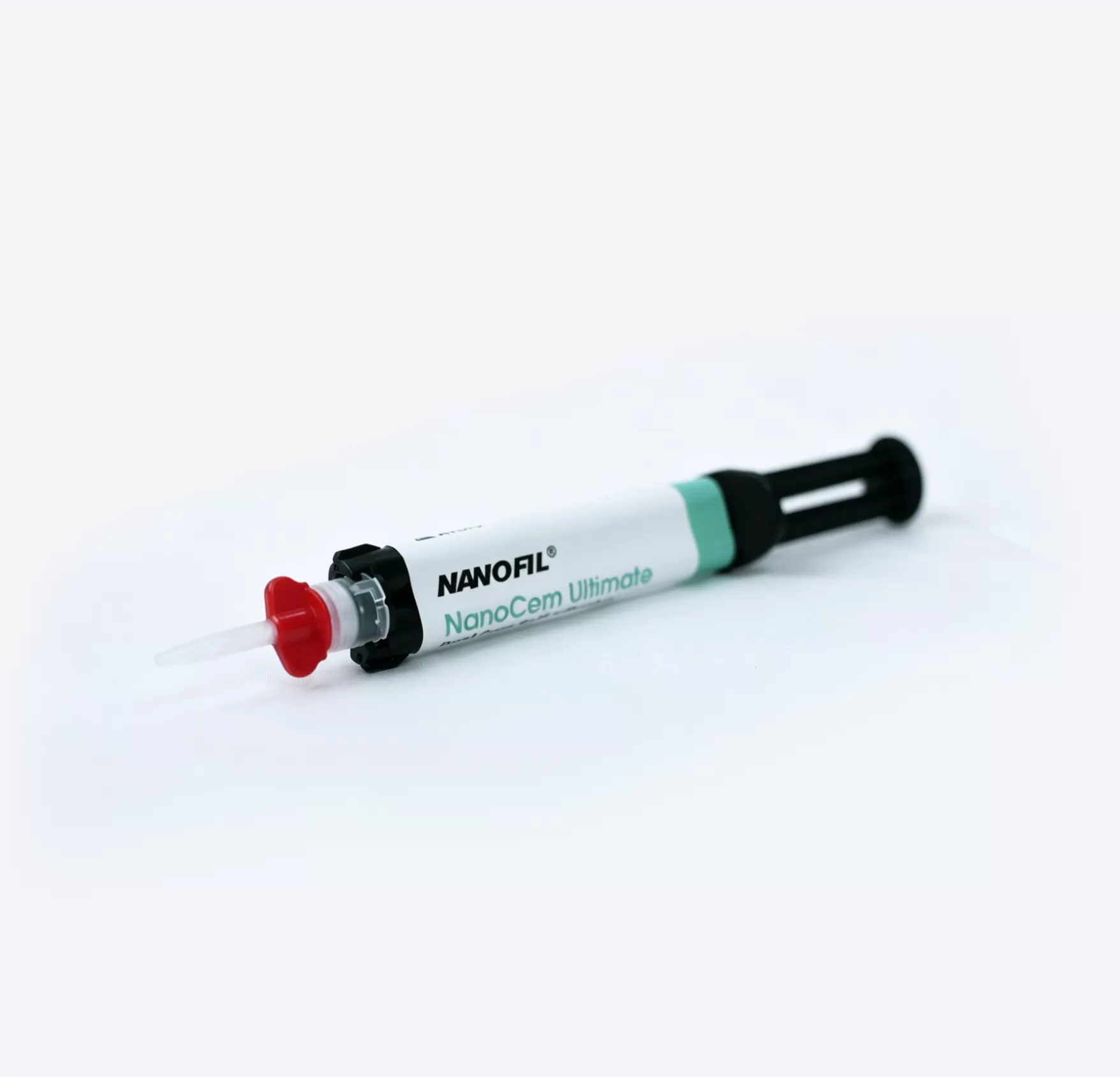
NANOFIL® NanoCem Ultimate dual-cure self-adhesive resin cement.
01 — What Dental Resin Cement Is Used For
Resin cements are polymer-based luting materials used between a prepared tooth or abutment and an indirect restoration. Depending on the system, bonding may involve micromechanical retention, an adhesive interface and functional monomers or primers selected for the tooth and restoration substrate.
Crowns and bridges: ceramic, metal and metal-ceramic restorations when resin cementation is indicated by the restorative design and manufacturer.
Veneers: thin ceramic or composite laminates where adhesive retention and cement shade can influence the outcome.
Inlays and onlays: partial-coverage restorations that rely on adhesive cementation and careful margin management.
Endodontic posts: especially fibre posts, where light access within the canal is limited and the system must be validated for intracanal use.
Selected implant and hybrid applications: only when the restorative design and product instructions specifically support the indication.
Resin cement is not automatically required for every crown. Preparation retention, restoration material, clinical conditions and the restorative manufacturer's guidance determine whether a resin cement, glass ionomer-based cement or another luting category is appropriate. The glass ionomer vs composite guide provides related background on material chemistry and selection.
02 — Resin Cement Cure Modes and Self-Adhesive Bonding
Dual-cure resin cement
Dual-cure systems combine light-activated and chemical polymerization mechanisms. Light exposure can support early strength and controlled margin curing, while the chemical component is intended to polymerize material in areas with limited light. Dual-cure cement is therefore commonly considered for crowns, bridges, deep inlays or onlays and posts. Performance remains product-specific: clinicians must not assume that the chemical component fully compensates for inadequate curing in every material or thickness.
Light-cure resin cement
Light-cure cement polymerizes when exposed to a compatible curing light. The absence of a chemical set gives more control over working time, but ambient light can still initiate polymerization. This can be useful for shade-sensitive, translucent restorations such as selected veneers. It is appropriate only when sufficient light can reach the complete cement layer through the restoration. Ceramic type, shade, opacity and thickness can all reduce light transmission.
Self-adhesive resin cement
Self-adhesive cement contains functional acidic monomers intended to interact with tooth structure without a separate tooth adhesive in the basic workflow. This is a bonding classification, not an alternative to dual curing: many self-adhesive cements are dual-cure. It can reduce clinical steps, but does not guarantee lower sensitivity or make surface preparation irrelevant: restoration-side treatment, cleaning and primer requirements still depend on the substrate and product instructions. For enamel-dependent or low-retention cases, a conventional adhesive resin cement may offer a more appropriate strategy.
03 — Resin Cement Compared with Other Luting Categories
| Decision factor | Resin cement | Glass ionomer or RMGI cement | Zinc phosphate cement |
|---|---|---|---|
| Retention approach | Adhesive and micromechanical mechanisms, system-dependent | Chemical interaction with tooth mineral plus preparation retention | Primarily preparation form and mechanical retention |
| Clinical complexity | Ranges from simplified self-adhesive to multi-step adhesive protocols | Generally simpler tooth-side workflow, product-dependent | Established conventional mixing and seating workflow |
| Restoration selection | Common for adhesive ceramics, partial coverage, veneers and posts | Selected retentive crowns and bridges according to indication | Selected conventionally retentive restorations |
| Moisture and isolation | Adhesive steps are sensitive to contamination | Early setting still requires moisture management | Requires controlled manipulation and seating conditions |
| Key limitation | Compatibility and surface-treatment errors can compromise bonding | Not the preferred solution for every adhesion-dependent restoration | Does not create an adhesive bond to tooth or restoration |
Compare properties without treating the categories as fixed rankings. Resin-cement strength and resistance to dissolution depend on formulation and adequate polymerization; glass ionomer and resin-modified glass ionomer (RMGI) are distinct materials, and zinc phosphate is brittle and depends on preparation retention. Glass ionomer-based cements release fluoride, but release alone does not prove prevention of recurrent caries; fluoride release from a resin cement must be documented for that product. Film thickness and flow affect complete seating, so request standardized test conditions rather than assume a universal thickness. Postoperative sensitivity also depends on the tooth and procedure, not just the cement class. Retention, margins, isolation and future removal needs remain part of selection.
04 — How to Choose Resin Cement by Restoration Type
| Restoration | Common cement direction | Questions to verify |
|---|---|---|
| Translucent veneer | Light-cure resin cement is often considered | Can light reach the complete interface? What intaglio treatment does the ceramic require? |
| Glass-ceramic crown, inlay or onlay | Light-cure only with adequate transmission; otherwise a validated dual- or self-cure system | Is the ceramic etchable, and what etching and silane sequence is specified? |
| Zirconia crown or bridge | A resin cement with validated chemical curing when indicated; separately select adhesive or self-adhesive bonding | What mechanical pretreatment and phosphate-monomer chemistry are validated? |
| Metal or metal-ceramic restoration | Resin cement with validated chemical curing, or a conventional luting cement if the design permits | Does the restoration rely on adhesion, and is a metal primer required? |
| Fibre post | Dual-cure cement validated for intracanal use | Are cement, adhesive, post treatment and canal workflow mutually compatible? |
Two questions narrow the choice: Can sufficient curing light reach the entire cement layer? If not, select a system validated for chemical curing in that indication; the words dual-cure alone are not a guarantee beneath opaque ceramic or metal. Does the restoration rely strongly on adhesion? If so, verify tooth and restoration pretreatment rather than default to a simplified self-adhesive protocol. Resin-bonded bridges and metal posts also need a design- and substrate-specific system, not an automatic extension of a crown or fibre-post protocol.
05 — Match the Cement to the Restoration Substrate
Glass ceramics and oxide ceramics require different surface treatments. For etchable glass ceramic, follow the specified hydrofluoric-acid (HF) and silane sequence, or an explicitly validated alternative. MDP does not replace HF etching and silane. Do not apply HF to zirconia: use its specified cleaning and mechanical pretreatment, with phosphate-monomer chemistry where required. HF can cause serious tissue injury; use only within the product's professional-use and protection instructions.
Metals vary in composition and oxide chemistry. Air abrasion and an appropriate metal primer may be required by the system. Indirect composite can require surface roughening, cleaning and a compatible primer or adhesive. In every category, the restoration manufacturer's and cement manufacturer's instructions must be reconciled.
Contamination after try-in can reduce bonding. Cleaning must be appropriate for the substrate because a cleaner suitable for one ceramic may not be suitable for another. A universal label on a bottle does not remove the need to identify the substrate.
06 — Generalized Step-by-Step Cementation Workflow
Confirm diagnosis, fit and occlusion. Complete try-in and adjustments before adhesive steps. Verify contacts, margins and shade where relevant.
Isolate the field. Control saliva, blood and crevicular fluid. Select an isolation method compatible with complete seating and margin access.
Clean the tooth and restoration. Remove provisional and try-in contamination without damaging the substrate.
Treat the restoration intaglio. Apply only the surface treatment specified for the ceramic, metal or composite substrate.
Prepare the tooth. For an adhesive resin cement, follow the specified etchant, primer and adhesive sequence, including any activator and whether the adhesive must be cured before seating. For a self-adhesive cement, follow its tooth-cleaning and application instructions without adding unvalidated steps.
Dispense and seat. Mix according to the delivery system, apply the cement, seat the restoration fully and maintain controlled pressure.
Manage excess. Follow the product's timing for gel-stage or tack-cure cleanup. Premature or aggressive removal can disturb the margin; delayed removal can make cleanup difficult.
Complete polymerization. Cure each accessible surface for the time and irradiance specified, accounting for attenuation through the restoration. Allow the chemical cure to proceed as instructed.
Finish and verify. Remove residual cement, finish margins, check proximal access and occlusion, and document the result.
This sequence is deliberately general. Product-specific working time, curing time, pretreatment and cleanup instructions take priority. Adhesive mismatch, contamination, incomplete seating and inadequate polymerization are avoidable causes of cementation failure.
07 — Common Cementation Errors and How to Prevent Them
Choosing by restoration name alone: two zirconia crowns can differ in preparation retention, opacity and margin depth. Evaluate the complete case.
Using the wrong intaglio protocol: glass ceramic and zirconia require different surface strategies. Identify the substrate before treatment.
Assuming dual-cure means light is irrelevant: use accessible light activation exactly as instructed and do not rely on chemical cure beyond the product's validated performance.
Combining incompatible adhesive and cement: select a documented system or use the specified activator when required.
Losing isolation at the margin: contamination during seating can undermine the interface created by earlier steps.
Incorrect excess cleanup: uncontrolled tack curing can lock interproximal excess or disturb uncured marginal cement.
Ignoring occlusion: a well-bonded restoration can still fail if contacts and excursions overload the restoration or interface.
Problems at the adhesive interface are related to the broader principles discussed in why composite bonding fails, although indirect cementation adds restoration-side treatment and seating variables.
08 — What Clinics and Distributors Should Verify Before Buying
Indications and contraindications: confirm the restoration and substrate categories listed in the instructions for use.
Cure mode: identify whether the product is light-cure, dual-cure or self-cure and how performance changes when light is attenuated.
Adhesive compatibility: verify whether a separate adhesive, primer or activator is required.
Restoration-side protocol: confirm compatibility with glass ceramic, zirconia, metal, indirect composite and posts as relevant.
Delivery and mixing: evaluate automix, hand-mix or unit-dose formats, waste, tip supply and consistency.
Working and cleanup behaviour: assess seating time, tack-cure guidance and excess-removal window.
Shade and try-in support: important for thin, translucent and aesthetically sensitive restorations.
Radiographic visibility: review product documentation where detection of residual cement or intracanal material matters.
Documentation and supply: check product-specific CE documents where applicable, quality-system documentation, current instructions, lot traceability, storage, shelf life and destination registration requirements.
ATBIO lists NANOFIL® NanoCem Ultimate Dual-Cure Self-Adhesive Resin Cement as a dual-cure, self-adhesive material. Buyers should consult its current instructions and market documentation for exact indications and use conditions. The wider ATBIO cements category provides additional portfolio context.
09 — FAQ
1. When is dual-cure resin cement considered?
It is commonly considered when light may not reach the complete interface, such as under opaque or thicker restorations, at deep margins or in post spaces. The selected product must be validated for the indication, and accessible surfaces should still be light-cured as instructed.
2. Can light-cure resin cement be used under every veneer?
No. Suitability depends on the veneer's material, thickness, shade and translucency and on the curing light. If adequate energy cannot reach the complete cement layer, a different validated cure strategy is required.
3. Does self-adhesive resin cement eliminate every pretreatment step?
No. It may eliminate a separate tooth adhesive in its basic protocol, but the tooth still requires appropriate cleaning and the restoration intaglio may require mechanical or chemical pretreatment. Follow the instructions for both cement and restoration.
4. Which primer is used for zirconia?
Zirconia bonding protocols commonly use phosphate-monomer chemistry such as MDP together with a validated mechanical surface treatment. Exact products and steps are system-specific. Do not HF-etch zirconia; conversely, MDP alone does not replace the specified HF and silane treatment of an etchable glass ceramic.
5. Why can dual-cure cement still benefit from light activation?
Light activation can support polymerization and early properties in accessible areas. The chemical component's ability to compensate under limited light varies by product, so the specified light exposure remains important.
6. Is resin cement always better than glass ionomer cement for crowns?
No. A retentive crown preparation may be compatible with a glass ionomer-based cement, while an adhesion-dependent restoration may require resin cementation. Restoration material, preparation, moisture control and manufacturer instructions determine the appropriate category.
10 — References
Ghodsi S et al. Resin cement selection for different types of fixed partial coverage restorations: A narrative systematic review. https://pubmed.ncbi.nlm.nih.gov/37427500/
Comino-Garayoa R et al. Adhesion to Zirconia: A Systematic Review of Surface Pretreatments and Resin Cements. https://pubmed.ncbi.nlm.nih.gov/34067501/
Borouziniat A et al. Comparison of bond strength of self-adhesive and self-etch or total-etch resin cement to zirconia: A systematic review and meta-analysis. https://pubmed.ncbi.nlm.nih.gov/38463466/
Blatz MB et al. The Effect of Resin Bonding on Long-Term Success of High-Strength Ceramics. https://pubmed.ncbi.nlm.nih.gov/28876966/
11 — About ATBIO
This article is published by ATBIO, the dental-materials brand of AT&M Biomaterials Co., Ltd.
ATBIO (AT&M Biomaterials Co., Ltd.) supplies composite resins, adhesives, cements, etchant gels and related dental materials. For distributor or OEM enquiries, request documents for the exact product and destination. Any CE documentation must cover the product concerned; ISO 13485 addresses quality management rather than clinical efficacy or universal market authorization. Laboratory findings for a cement category do not establish the performance of an individual ATBIO product.
This article provides general educational information and does not replace diagnosis, a case-specific treatment plan, professional clinical judgment or the instructions for use of an individual product. This page does not claim unconditional sale authorization in every country.
12 — Related Products
NANOFIL® NanoCem Ultimate Dual-Cure Self-Adhesive Resin Cement — a dual-cure, self-adhesive resin cement for professional evaluation according to its current documentation.
Perfect-Link Universal Dental Adhesive — an adhesive to evaluate against the chosen cement's instructions, not an automatically required companion to a self-adhesive cement.
NANOFIL® Etchant Gel — phosphoric-acid etchant for enamel and dentin conditioning where indicated by the selected protocol.
Select cement as part of a validated tooth-to-restoration system. Request a quote or contact ATBIO for current instructions, technical documentation, samples and distributor support.
Do you prefer online learning?
Live webinars and professional tips — learn when, where and how.
Access our online learning opportunities