Bulk-Fill Composite | Buying Guide | ATBIO
01 — Why compare bulk-fill composite before stocking
Bulk-fill composites occupy a specific, commercially important position in restoratives: they can save clinically meaningful chair time in posterior dentistry, they require careful positioning alongside conventional packable composites, and they are unforgiving of poor procurement decisions because their headline claim of curing deep increments depends on formulation details that a catalog page alone cannot fully explain.
For distributors and clinic buyers, that makes evaluation more important than usual. This guide explains what bulk-fill technology is, when it is most suitable, and which parameters to compare across suppliers before committing shelf space.
To keep broader restorative selection context aligned, see teeth-filling-types-compared and glass-ionomer-vs-composite.
02 — What “Bulk-Fill” Means
Conventional packable composites are placed and cured in increments of about 2 mm or less. The limit is linked to light attenuation: deeper layers receive lower irradiance, and under-cured resin at the base can weaken mechanical properties, increase elutable monomer risk, and compromise the bond at the cavity floor.
Bulk-fill composites are formulated to address this with two main design levers:
Increased light transmission using translucent resin matrices and modified opacifier or shade systems to enable deeper light penetration and support cure targets around 4 mm per increment.
Stress management through pre-polymerized fillers, modified monomer chemistry, and flexible matrix components to reduce polymerization stress in large increments.
For many deep posterior cases, this reduces placement steps and can recover minutes of chair time per restoration when technique requirements are followed. For the step-by-step context, see our posterior composite filling workflow.
03 — When bulk-fill makes sense
Bulk-fill is best viewed as a complement, not a universal replacement.
Strong fit:
Deep boxes and class II bodies where conventional incremental layering would otherwise require many placements.
High-volume posterior clinics where cumulative time savings are meaningful.
Deep class I cavities where a bulk-fill base is used below a final conventional occlusal layer.
Core build-ups under indirect restorations where curing reliability in larger volumes is important.
Weak fit:
Shallow cavities where a 2 mm workflow is already efficient.
Highly esthetic anterior restorations where shading and layering control are the priority.
Final occlusal surfaces in high-wear cases where many clinicians still prefer a thin conventional final layer for anatomy and wear resistance.
The most defensible strategy is often a hybrid one: conventional posterior or universal composites as the core workflow, with one bulk-fill SKU for deep-cavity efficiency when clinically justified.
04 — Procurement parameters to compare
Cross-brand comparison should be based on measurable procurement criteria rather than brochure language.
| Parameter | What to verify | Procurement impact |
|---|---|---|
| Depth of cure | Certified per shade, exposure time, and irradiance conditions. | Directly affects restoration reliability and reduces clinical callbacks. |
| Viscosity | Flowable bulk-fill behavior versus high-viscosity sculptable behavior. | Influences adoption, ease of handling, and inventory mix. |
| Shade and range | Depth-capable shades and availability of enamel/body layers. | Affects inventory complexity and clinician confidence. |
| Packaging format | Syringe versus unidose units, plunger strength, ergonomics. | Impacts waste, contamination risk, and repeat-purchase behavior. |
| Curing-light compatibility | Photoinitiator type and documented response to common LED profiles. | Defines fit for market lights and reduces clinical misuse. |
| Documentation and compliance | CE marking, IFU completeness, shelf life, batch traceability, and compliance records. | Critical for hospital procurement and distributor compliance checks. |
1. Depth of cure data
Validate the certified curing depth per increment, usually stated around 4 mm, and the exposure time required to achieve it.
Check whether each shade is covered. Depth of cure often changes across shades, and some products certify 4 mm only for selected shades.
Also confirm the irradiance used for the test data. A claim generated under very high-output conditions may not translate to all clinic lights. Cross-check against your dominant clinical lights and practical workflows using the best dental curing light buying guide.
2. Viscosity and handling
Flowable bulk-fill adapts well to deep boxes but is often capped with a conventional occlusal layer. High-viscosity bulk-fill can act more like a direct packable restorative and may support sculpting in simpler cases.
Ask about handling consistency across temperature conditions from warehouse to clinic, because shipping and storage variation can alter extrusion force and placement feel.
3. Shade range
Compare the number of shades and the availability of enamel and dentin/body shades. A broader shade selection may increase inventory complexity. A tighter, clinically relevant range may support simpler stocking while still meeting day-to-day restorative needs.
Verify blending behavior clinically rather than relying only on shade guide comparison.
4. Packaging and syringe format
Evaluate compules versus syringes for your market:
Unidose compules: single-use delivery that can reduce cross-contamination concerns and simplify dose control.
Syringes: multi-use delivery often preferred for repeated placement and inventory efficiency.
Ergonomics and plunger strength are practical adoption drivers, especially for viscous materials. Kit formats with complete accessories can speed onboarding.
5. Curing-light compatibility
Most bulk-fill products use common camphorquinone systems and work with standard LED outputs. Some formulations are tuned to broader photoinitiator profiles and benefit from polywave sources.
For procurement, prioritize products that publish reproducible performance with common light types in the intended market.
6. Documentation and compliance
Require complete and verifiable documentation for medical device procurement, including CE marking for the exact commercial item, clear IFU, shelf-life, and traceability. Missing items should disqualify a supplier regardless of technical performance.
For a wider market overview, the minamata-phase-down-distributors-guide is also useful context for responsible sourcing conversations.
05 — How to evaluate samples before stocking
Use a structured program before broad rollout:
Test depth of cure yourself. Cure 4 mm test increments using representative clinical lights and check base hardness after scrubbing. Repeat with an older or light-duty unit to estimate real-world tolerance.
Assess handling clinically. Place material in a deep class II typodont scenario and record adaptation, stickiness, slumping, and syringe response.
Compare polish and anatomy retention against your current conventional workflow layer.
Check radiopacity on a radiograph so the bulk body is distinguishable from tooth structure and neighboring restorative layers.
Verify shade coverage against the most common patient shades and note shade-specific depth/ curing-time behavior.
Run a small pilot. One or two chairside users, a defined number of restorations, and structured feedback on time, handling, and complaints.
Evaluate operational impact. Compare realistic material consumption, chair-time changes, and training requirements against the existing workflow.
If the material is adopted, define a post-launch refresh review using operator feedback and clinical outcomes.
06 — FAQ
Can bulk-fill composite be used for the entire restoration?
It can be suitable for body and sometimes full occlusal build-up depending on product certification and clinician preference. In many workflows, the final 1–2 mm is still completed with conventional composite for anatomy and wear resistance. Always follow the product’s IFU.
Is bulk-fill composite as strong as conventional composite?
Contemporary bulk-fill systems are designed to match posterior composite performance in indicated uses. The practical determinants are verified curing depth under actual lights and strict adherence to recommended exposure protocols.
What curing light is needed for bulk-fill composite?
Most products perform with standard LED units when irradiance is within the stated range. Some modern systems favor polywave compatibility, so buyers should confirm the photoinitiator and light matrix in advance, then validate with radiometer checks.
How should distributors judge whether bulk-fill is right for their market?
Look at case profile, clinic volume, and operator skill. Deep posterior programs with high throughput benefit most. Clinics focused on highly esthetic anterior work often keep bulk-fill as a secondary option only.
How do I reduce procurement risk in the first 90 days?
Start with a controlled trial, compare measured outcomes against declared specifications, and align reorder cycles with pilot performance. Use return and escalation criteria before expanding from sample to full stock.
07 — References
08 — About ATBIO
ATBIO supports restorative dentistry with a portfolio that includes the composite families under brands such as NANOFIL®, NANOFIL Nova®, GK®, and ONELUX®. Products are offered under CE certified frameworks with EN ISO 13485-compliant quality management, and ATBIO serves clinical and distributor networks across 100+ countries.
View ATBIO’s restorative collection at /dental-composite-resins/.
09 — Related Products
NANOFIL® Z250 Universal Restorative — conventional nanohybrid universal restorative composite for incremental and occlusal finishing layers.
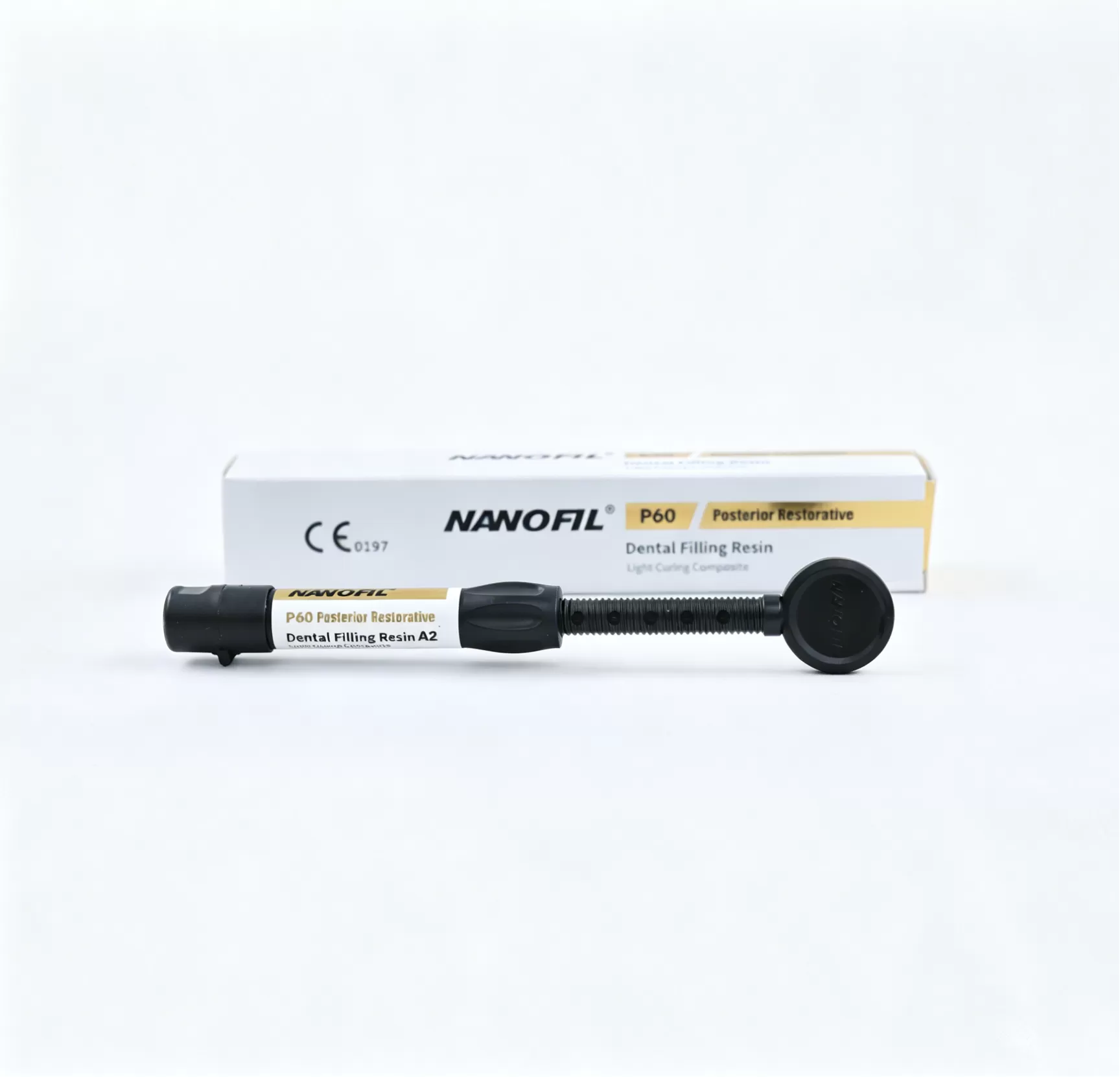
NANOFIL® P60 Posterior Restorative — conventional posterior workhorse for load-bearing class I and class II restorations.
NANOFIL® Flowable Composite — low-viscosity flowable material for liners and adaptation layers in conservative workflows.
ATBIO supports evidence-based procurement decisions through material benchmarking and practical portfolio discussion. For structured follow-up, you can request a quote and review distributor collaboration options.
This page does not claim unconditional sale authorization in every country.
Do you prefer online learning?
Live webinars and professional tips — learn when, where and how.
Access our online learning opportunities