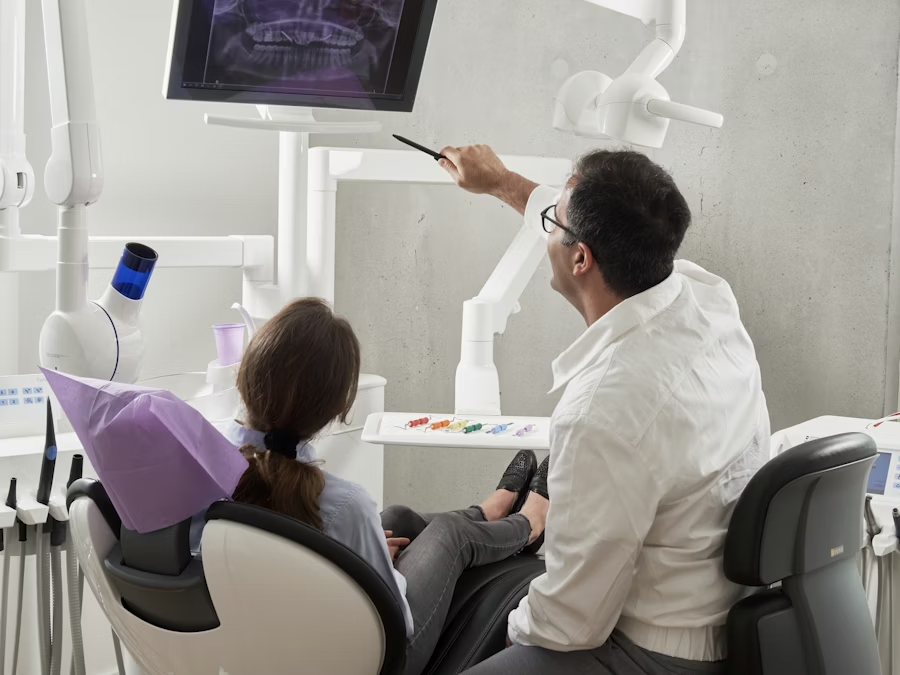
Pit and Fissure Sealant: Benefits & Placement Guide
Deep grooves on the chewing surfaces of molars are among the most cavity-prone areas of the mouth — and often the hardest to clean. A pit and fissure sealant closes those grooves with a thin protective resin coating, physically blocking the food, plaque, and bacteria that drive caries. For decades, dental sealants have been a cornerstone of preventive dentistry for children, and they are increasingly used in adult preventive programs. ATBIO has manufactured dental materials for 38 years, and this article explains what a pit and fissure sealant is, the main fissure sealant benefits, how a dental sealant prevents cavities, and what to look for in a sealant for your clinic or product line.
01 — What Is a Pit and Fissure Sealant?
Pits and fissures are the natural grooves and valleys on the occlusal (chewing) surfaces of molars and premolars. They are deeper and narrower than a toothbrush bristle, so plaque accumulates at their base while brushing cannot reach it. A pit and fissure sealant is a fluid resin placed into those grooves and hardened — usually with a curing light — to form a smooth, protective surface that no longer traps food.
Anatomy of Pits and Fissures: Why Caries Starts There
Occlusal caries accounts for approximately 90% of all dental caries in permanent molars of children and adolescents, and the reason is anatomical. Fissure morphology ranges from shallow U-shaped grooves that are relatively self-cleansing to deep, narrow, branching V-shaped and I-shaped invaginations with widths less than 100 µm at their orifice. Toothbrush bristles are 200–300 µm in diameter and cannot reach the base of these narrow fissures, so mutans streptococci and lactobacilli biofilms accumulate in a protected, nutrient-rich microenvironment. The ADA and AAPD clinical practice guideline on pit and fissure sealants confirms that sealing these non-cavitated or incipient carious lesions is more effective than observation alone in preventing lesion progression (Beauchamp 2009, PMID 19215748).
Sealant Material Types: Resin-Based vs Glass-Ionomer-Based
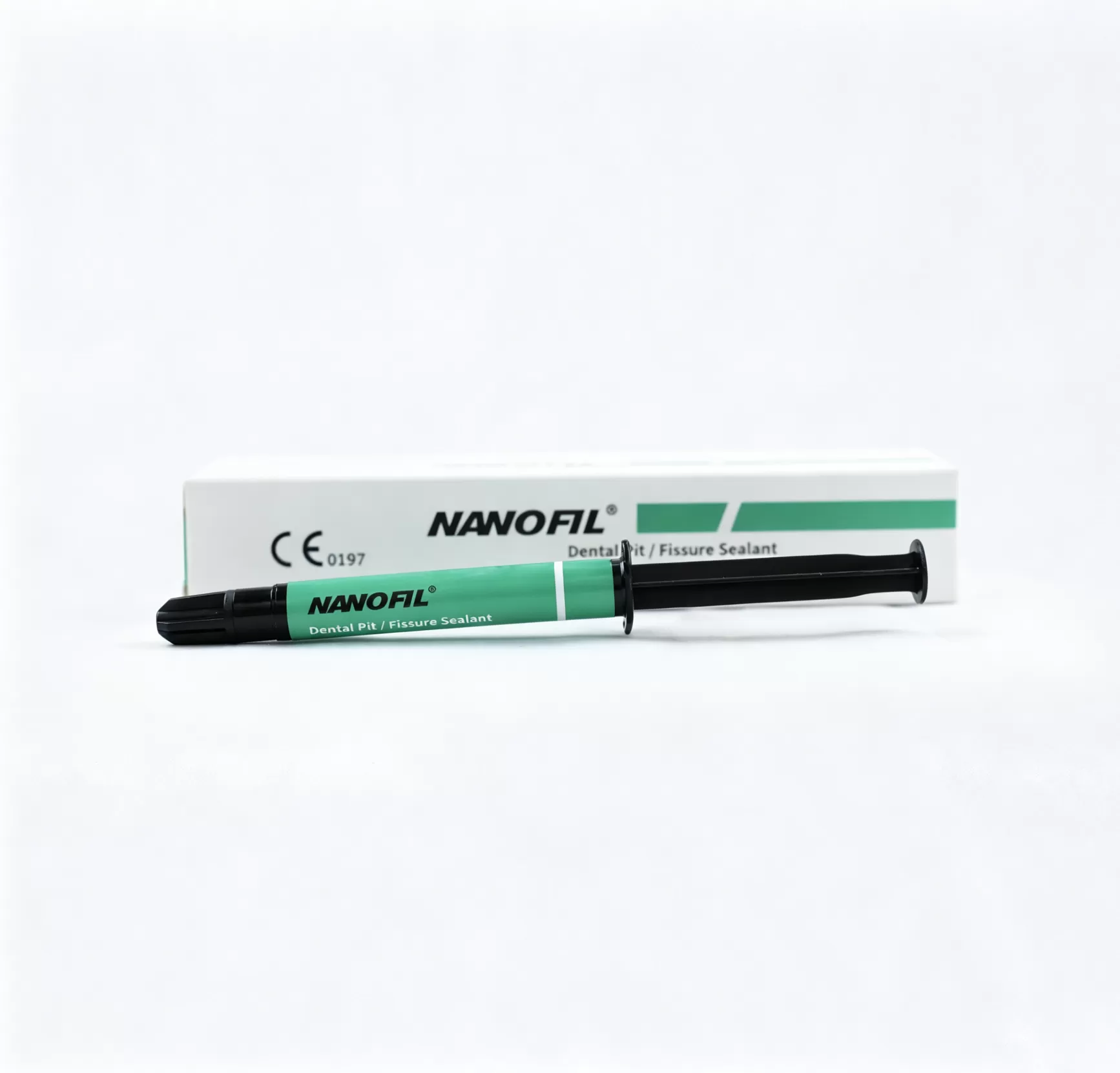
Resin-based sealants (Bis-GMA, UDMA, or TEGDMA matrix filled with inorganic particles) are the most common and are light-cured. They provide the best sealant retention on enamel, with 60–80% of sealants remaining fully intact after 4–5 years of clinical service. The NANOFIL® Pit and Fissure Sealant is a white, light-cured resin-based sealant designed for preventive care.
Glass-ionomer-based sealants (resin-modified or conventional GIC) are used in moisture-prone clinical situations where isolation is difficult, such as partially erupted first permanent molars in young children. Their fluoride release provides an additional anticariogenic benefit at the sealant–tooth interface, though their retention rates on occlusal surfaces are generally lower than resin-based materials.
ISO 6877:2015 Dentistry — Pit and fissure sealants defines minimum performance requirements for both categories, including film thickness, working/setting times, bond strength to enamel, fluoride release (where claimed), and biocompatibility testing.
02 — Fissure Sealant Benefits: Why Sealants Work
Caries Prevention Efficacy: The Evidence Base
Caries prevention. Sealing the grooves removes the ecological niche where cavity-causing bacteria accumulate. The 2016 Cochrane systematic review on sealants for preventing occlusal caries in permanent molars included 38 trials (N = 9,670 children followed 2–9 years) and found that resin-based sealants reduced the incidence of new occlusal dentinal caries by approximately 30% relative to no sealant or fluoride varnish alone: relative risk (RR) = 0.70 (95% CI 0.60–0.82) at 48–60 months for first permanent molars (Ahovuo-Saloranta 2016, PMID 26780162).
Non-invasive. No drilling and no anaesthesia are needed; placement takes only minutes per tooth and is painless, making it well tolerated by anxious pediatric patients.
Fast placement. A single appointment covers multiple teeth with minimal patient stress — important for school-based and public-health preventive programs.
Non-Invasive Workflow and Cost-Effectiveness
A natural fit for preventive programs. Sealants combine with fluoride treatments and oral hygiene education. In organized population-health settings, school-based sealant delivery programs targeting 6–8-year-olds at first permanent molar eruption and 11–13-year-olds at second molar eruption have been shown to reduce occlusal caries by 60% over 5 years when combined with semi-annual professional fluoride application.
Cost-effective. Preventing a cavity is simpler and less expensive than restoring one. A single sealant costs a fraction of a direct composite restoration, and it avoids the cycle of re-restoration that occurs when repaired fillings are progressively enlarged over a patient's lifetime.
03 — How a Dental Sealant Prevents Cavities
A dental sealant works as a physical barrier. By filling pits and fissures, it prevents food particles and plaque biofilm from accumulating in the grooves, so cariogenic bacteria lose their protected reservoir. This is why sealants are regarded as one of the most effective measures against occlusal caries, particularly in children after their first permanent molars erupt.
Physical Barrier Mechanism
The mechanism of action is straightforward but elegant. Before sealant application, the enamel surface of the fissure is etched with a 35–37% phosphoric acid gel. Etching dissolves the interprismatic enamel surface layer and creates a microporous, high-surface-energy topography with 5–20 µm deep etch pits. When the low-viscosity sealant resin is flowed over the etched surface, capillary action draws it deep into the micro-porosities of both the main fissure lumen and the etched enamel prism ends. After light activation, the cured resin forms thousands of resin "tags" that mechanically interlock with the enamel, creating a bonded, impermeable barrier (Simonsen 2002, PMID 12412954).
Key Material Properties: Fluidity and Bonding
Fluidity — the ability to flow into narrow, deep grooves before curing. Excessively high viscosity sealants bridge across fissure orifices rather than filling them, leaving hidden voids that can accumulate bacteria. The NANOFIL® Pit and Fissure Sealant is formulated for low viscosity and excellent thixotropic flow.
Bonding — keeping the sealant attached to enamel through years of chewing forces. Retention depends on adequate enamel etching, thorough drying without moisture contamination, and the material's own cohesive strength. Clinical practice guidelines report 70–80% full retention at 4 years and 50–60% retention at 7 years (Simonsen 2002, PMID 12412954). Partially lost sealants are easily repaired by re-etching and re-applying a new layer.
04 — Placement: A Light-Cured White Sealant in Practice
Clinical Placement Protocol Step-by-Step
Clean and isolate. Clean the occlusal surface with a non-fluoridated pumice paste, then isolate the tooth or quadrant. Rubber dam is the gold standard; cotton rolls with saliva ejector are acceptable alternatives in cooperative children.
Etch the enamel. Apply a 35–37% phosphoric acid etching gel to the pits, fissures, and a 1 mm peripheral zone of surrounding enamel for 20 seconds (30 seconds if the surface is prismless or fluorosed). Etching improves retention 2–3 fold compared to non-etched placement (Beauchamp 2009, PMID 19215748).
Rinse and dry thoroughly. Rinse for a full 20 seconds, then dry the etched enamel to a chalky, frosted white appearance. Do not allow the patient to rinse or spit after drying, and do not let moisture touch the etched surface.
Apply the sealant. Dispense the NANOFIL® Pit and Fissure Sealant directly from the 3 g syringe into the base of each fissure, starting from the most distal groove and working mesially. Do not overfill or extend the sealant more than 1 mm onto the smooth occlusal enamel.
Light-cure, check, and adjust. Use a dental curing light (minimum output ≥ 600 mW/cm²) for 20–30 seconds per segment. After curing, check visually and with an explorer for voids, bubbles, and marginal deficiencies; add sealant to any voids by re-etching for 10 seconds and reapplying.
Etching, Curing, and Post-Placement Quality Checks
The NANOFIL® Pit and Fissure Sealant is supplied white, so the cured sealant is easy to check visually against natural enamel — defects, voids, and incomplete fissure coverage are immediately visible — and is delivered in a 3 g syringe for direct, no-mess application. Because it is light-cured, working time stays fully under the clinician's control; the material does not set until the curing light is applied, allowing unhurried placement across multiple teeth before batch curing.
05 — NANOFIL® Pit and Fissure Sealant at a Glance
Product Specifications
| Parameter | NANOFIL® Pit and Fissure Sealant |
|---|---|
| Type | White, light-cured resin sealant (Bis-GMA / UDMA based) |
| Fluidity (ISO 6877) | Excellent fluidity for deep fissure penetration |
| Bonding | Strong mechanical bonding to etched enamel |
| Retention profile | Low shedding; 70–80% full retention at 4 years |
| Curing mode | Light-cured (20–30 s at ≥ 600 mW/cm²) |
| Delivery | 3 g/syringe |
| Standard compliance | Conforms to ISO 6877:2015 requirements |
Clinical Comparison: Sealant vs Fluoride Varnish for Occlusal Caries Prevention
| Outcome (48–60 months, 1st permanent molars) | Resin-based pit & fissure sealant | 5% NaF fluoride varnish (2×/yr) |
|---|---|---|
| New occlusal dentinal caries incidence | 11.3% | 16.1% |
| Relative risk vs no preventive intervention | 0.70 (95% CI 0.60–0.82) | 0.83 (95% CI 0.72–0.95) |
| Number needed to treat (NNT) to prevent 1 cavity | 11 children | 18 children |
| Requires anaesthesia / drilling | No | No |
| Retention / reapplication interval | Check every 6 mo; repair as needed | Reapply every 6 mo |
Relative risk (RR) = 0.70 indicates that children who received sealants had 30% lower risk of developing new occlusal dentinal caries on first permanent molars at 48–60 months compared with the control group. Source: Cochrane Database of Systematic Reviews 2016, 38 RCTs, N = 9,670 (Ahovuo-Saloranta 2016, PMID 26780162 / DOI 10.1002/14651858.CD003067.pub4).
The NANOFIL® Pit and Fissure Sealant is part of the ATBIO Prophylaxis System, which also covers etching gels and fluoride-based preventive products.
Interested in sealant and preventive products for your practice or distributorship? Request product information →
06 — Building a Preventive Program: Sealants Plus Fluoride
Complementary Prevention Strategies
Sealants and fluoride are complementary, not competing. A sealant blocks the physical niche where caries starts — the deep, stagnant pits and fissures — while fluoride supports remineralization and strengthens enamel against acid attack on all tooth surfaces, including smooth and interproximal surfaces that sealants do not cover. Many preventive programs pair fissure sealing with professional fluoride application at the same or alternating recall visits.
Clinical Decision Making: Who, What, When, How
Who (patient selection): All children and adolescents should be evaluated for sealant placement. High-caries-risk individuals are the highest priority; adults with deep fissures, incipient occlusal lesions, or recurrent caries history also benefit.
What (tooth selection): All newly erupted permanent first molars (ages 6–7) and second molars (ages 11–13) with deep fissure anatomy or incipient caries. Primary molars in children < 6 years with deep fissures or a history of early childhood caries.
When (timing): Seal as soon as the molar has erupted sufficiently that the occlusal surface is accessible — usually within 6–12 months of clinical eruption.
How (technique): Etch + dry + seal + cure protocol per section 04, with 6-month recall to check retention and repair as needed. A partially lost sealant repaired within 6 months retains 90%+ of the efficacy of a continuously intact sealant.
07 — FAQ: Pit and Fissure Sealant Questions
What are pit and fissure sealants made of?
Most are resin-based materials, similar to flowable composites in chemistry but lower in filler loading and optimized for low viscosity. Resin sealants use a Bis-GMA, UDMA, or TEGDMA polymer matrix with 20–50 wt% inorganic filler particles and a visible-light photoinitiator. Glass-ionomer-based sealants are an alternative based on GIC chemistry, used primarily for partially erupted molars and moisture-challenged isolation.
How long do dental sealants last?
A landmark 2002 clinical review reported 70–80% of resin sealants fully intact at 4 years post-placement, and 50–60% fully retained at 7–9 years in children whose first permanent molars were sealed at age 6–7 (Simonsen 2002, PMID 12412954). Sealants are checked at every 6-month recall; partial loss is repaired by re-etching and applying a fresh layer.
Does placing a dental sealant hurt?
No. Sealant placement is entirely non-invasive — there is no drilling and no local anaesthesia. The only mild sensations are the slightly sour taste of the etching gel (quickly rinsed away), the pressure of a cotton roll, and the warmth of the curing light.
Can sealants be placed on adult teeth?
Yes. Adults with deep fissure anatomy, a documented history of occlusal caries, incipient non-cavitated lesions, or xerostomia can also benefit. A 2017 ADA clinical practice update explicitly recommended sealants for adults with at-risk occlusal surfaces.
Do sealants require etching gel?
Resin-based sealants follow the same conditioning logic as all adhesive dentistry: the enamel is etched with a 35–37% phosphoric acid etching gel, rinsed, and thoroughly dried before application. The ADA/AAPD guideline confirms that omitting the etch step reduces bond strength and long-term retention by 60–70% (Beauchamp 2009, PMID 19215748).
Are sealants more effective than fluoride varnish alone?
Both are evidence-based preventive interventions addressing different caries pathways. The 2016 Cochrane review found resin-based sealants reduced new occlusal dentinal caries by approximately 30% relative to fluoride varnish alone at 48–60 months (RR = 0.70 for sealants vs RR = 0.83 for varnish), and the NNT to prevent one occlusal cavity was 11 for sealants vs 18 for varnish (PMID 26780162). In practice, the best preventive programs use both modalities together.
What is the difference between a dental sealant and a filling?
A filling repairs a tooth that already has a cavity. A sealant is applied to a sound (non-cavitated) tooth purely to prevent a cavity from starting. Every successfully placed sealant that prevents a cavity is one less filling a patient will need over their lifetime.
08 — References
Beauchamp J, et al. Evidence-based clinical recommendations for the use of pit-and-fissure sealants: a report of the American Dental Association Council on Scientific Affairs and the American Academy of Pediatric Dentistry. Dent Clin North Am. 2009;53(1):131-147. pubmed.ncbi.nlm.nih.gov/19215748
Ahovuo-Saloranta A, et al. Pit and fissure sealants versus fluoride varnishes for preventing dental decay in the permanent teeth of children and adolescents. Cochrane Database Syst Rev. 2016;1:CD003067. pubmed.ncbi.nlm.nih.gov/26780162 / doi.org/10.1002/14651858.CD003067.pub4
Simonsen RJ. Pit and fissure sealant: review of the literature. Pediatric Dentistry. 2002;24(5):393-414. pubmed.ncbi.nlm.nih.gov/12412954
ISO 6877:2015. Dentistry — Pit and fissure sealants. International Organization for Standardization. iso.org/standard/59110
ATBIO. NANOFIL® Pit and Fissure Sealant (Light-Cured) — Product page.
ATBIO. ATBIO Prophylaxis System — Full preventive catalog.
About the Manufacturer
ATBIO (AT&M Biomaterials Co., Ltd., Beijing) has manufactured dental materials for 38 years. The company's products carry CE marking under MDR 2017/745, are produced under EN ISO 13485 quality management, and are exported to more than 100 countries. For partnership or product inquiries, contact info@atmbio.com or +86-10-69778208. This page does not claim unconditional sale authorization in every country.
Related Products
Do you prefer online learning?
Live webinars and professional tips — learn when, where and how.
Access our online learning opportunities