Dental Etching Gel Guide: 37% Phosphoric Acid | ATBIO
Few materials in adhesive dentistry do as much work with as little chairside attention as a dental etching gel. Applied before bonding agents, composite restorations, pit and fissure sealants, and orthodontic brackets, this phosphoric acid etchant conditions the tooth surface so resin can form a strong, durable bond. This guide explains what acid etching in dentistry is, the types of etching materials available, a step-by-step enamel etching protocol, and the factors that determine etching success rate. ATBIO has manufactured dental materials for 38 years under EN ISO 13485 quality management and CE (MDR 2017/745) certification.
Quick answer: Acid etching in dentistry means applying 35–37% phosphoric acid gel to enamel for 15–20 seconds, which dissolves a microscopic surface layer and creates a rough, porous etch pattern. Resin monomers flow into these micropores and, once light-cured, form micromechanical tags that lock the restoration or sealant to the tooth. Without this conditioning step, bond strengths fall sharply and marginal leakage becomes much more likely.
01 — What Is Acid Etching in Dentistry?
The acid etch technique, pioneered in the 1950s, transformed restorative dentistry by making resin-tooth adhesion predictable. When etching dental enamel, the acid selectively dissolves a thin surface layer and creates a microscopically rough pattern of porosity. Resin monomers penetrate these pores and, once polymerized, form resin tags that anchor the restoration to the tooth. Decades of clinical use document the safety and reliability of this conditioning step [PMID 13271655].
The Science: Enamel Micro-Porosity & Resin Tags
The bond between resin and tooth begins with the surface the etchant creates: etch too little and the bond weakens; etch correctly and the entire restorative chain — adhesive, composite, sealant — performs predictably. The evidence ties the optimal concentration to an ideal etch pattern: 35–37% phosphoric acid applied for 15–20 seconds produces the typical 5–10 µm prism-level etch associated with the strongest bonds (Van Meerbeek et al. 2003, PMID 12760693).
The "Frosty White" Appearance — The Visual Endpoint
Properly etched enamel appears frosty or chalky — the clinical signal that sufficient porosity has been created. If the surface does not look frosted, either the etch time was too short or the concentration too low, and the bonding agent should not be applied until the etch is corrected.
Why 37% Phosphoric Acid?
Most phosphoric acid etchants used in dentistry are supplied at 35% or 37% concentration. The 37% strength is widely regarded as the reference standard for enamel conditioning. Lower concentrations may not create enough porosity for strong resin tags; higher concentrations add no clinical benefit while increasing the risk of over-etching. Both 35% and 37% gels are common in practice — the key factors are consistent concentration and a correctly executed protocol [PMID 12760693].
02 — Types of Etching Materials in Dentistry
Understanding the types of etching gels and etchants helps clinicians and buyers select the right product for each procedure:
Phosphoric acid gels (35% and 37%) — the clinical gold standard for enamel conditioning and total-etch dentin preparation, used in the vast majority of adhesive restorations.
Self-etch primers — mild-acid primers that condition and prime enamel and dentin in a single step within specific adhesive systems; lower etching aggressiveness than phosphoric acid.
Polyacrylic acid conditioners — prepare the tooth surface for glass ionomer placement without the deeper etch of phosphoric acid.
Hydrofluoric acid — used intraorally only for conditioning ceramic surfaces before silane application, never on tooth structure.
Gel, liquid, and foam formats exist; gel formulations are preferred in restorative work because their viscosity keeps the acid exactly where it is placed.
03 — The Enamel Etching Protocol: Step by Step
A reliable enamel etching protocol protects treatment success:
Step 1 — Isolation & Cleaning
Clean the tooth surface with prophylaxis paste and rinse. Isolate the tooth with a rubber dam or cotton rolls. Contamination control from this moment onward is the silent determinant of success.
Step 2 — Applying the Etchant Gel
Apply the etching gel to enamel for the time specified by the manufacturer. Use a fine-tip syringe for precise, single-handed application; a tinted gel lets you see exactly where the acid has been applied and where it must be rinsed away.
Step 3 — Etching Time
Enamel: 15–20 seconds for 35–37% phosphoric acid — the evidence-based sweet spot that creates the 5–10 µm prism-level etch pattern [PMID 12760693].
Dentin (total-etch): shorter than enamel, per the manufacturer's instructions, to avoid over-etching and collagen collapse.
Step 4 — Rinsing
Rinse for at least 15 seconds with a water spray to remove all acid and dissolved debris. Incomplete rinsing leaves residue that weakens the bond; rinse longer than feels necessary (Van Meerbeek et al. 2003, PMID 12760693).
Step 5 — Drying
Dry gently with oil-free air. Properly etched enamel appears frosty or chalky. For dentin, avoid over-drying — a slightly moist surface is correct for most total-etch adhesives.
Step 6 — Bonding Agent Application
Apply the bonding agent immediately, keeping the etched surface free of contamination. Then continue with the restorative protocol. ATBIO's adhesive range complements the etching step in a complete bonding workflow.
04 — Total-Etch vs Selective-Etch vs Self-Etch
When to Use Each Approach
Total-etch: etch enamel and dentin with phosphoric acid, then apply a separate bonding agent. Maximum bond strength, more technique-sensitive.
Selective-etch: etch only enamel, keep dentin un-etched, then apply a self-etch adhesive. A pragmatic compromise for class V and cervical restorations.
Self-etch: the primer conditions and primes in one step; lower technique sensitivity, adequate for many routine cases.
Clinical Scenarios
Direct resin restorations, veneer cementation, sealants, and orthodontic brackets all rely on the same principle: a conditioned surface that resin can wet and interlock with. Research on adhesive interfaces stresses continuous isolation from etching through light-curing [PMID 12760693]. Bonding to caries-affected dentin is a distinct challenge that has been studied separately (Erhardt et al. 2008, PMID 18023859).
05 — Common Etching Mistakes & How to Avoid Them
Over-Etching Dentin
Over-etching dentin exposes and collapses the collagen network, causing bond failure. Follow the manufacturer's dentin etch time — always shorter than enamel.
Saliva / Blood Contamination
Even a perfect etch is lost if saliva touches the surface before bonding. Maintain isolation from etching through light-curing; if contamination occurs, rinse and re-etch.
Over-Drying Dentin
Drying dentin excessively collapses collagen fibrils. Use gentle air; a slightly moist dentin surface is correct for most total-etch adhesives.
Uneven Etching Pattern & Incomplete Rinsing
Skipping isolation or short-cutting the rinse are among the most common reasons a bond fails clinically. Use a tinted gel to verify full coverage, and rinse with a water spray for at least 15 seconds.
06 — Evidence-Based Etching Parameters
| Parameter | Evidence-based reference | Clinical implication |
|---|---|---|
| Phosphoric acid concentration | 35–37% H₃PO₄ | Optimal etch pattern with minimal tissue risk |
| Enamel etch time | 15–20 seconds | Typical 5–10 µm prism-level etch pattern* |
| Rinse duration | ≥15 seconds with water spray | Complete removal of acid and dissolved debris |
| Etch depth | 5–10 µm of enamel | Sufficient microporosity for resin tags |
| Dentin etch time (total-etch) | Shorter than enamel, per instructions | Avoid over-etching dentin |
*35–37% H₃PO₄ etching for 15–20 s produces the typical 5–10 µm prism-level etch pattern associated with optimal bond strength (Van Meerbeek et al. 2003, PMID 12760693).
07 — ATBIO Acid Etching Gels
ATBIO manufactures two phosphoric acid etchants, giving practices and distribution partners a choice of handling characteristics:
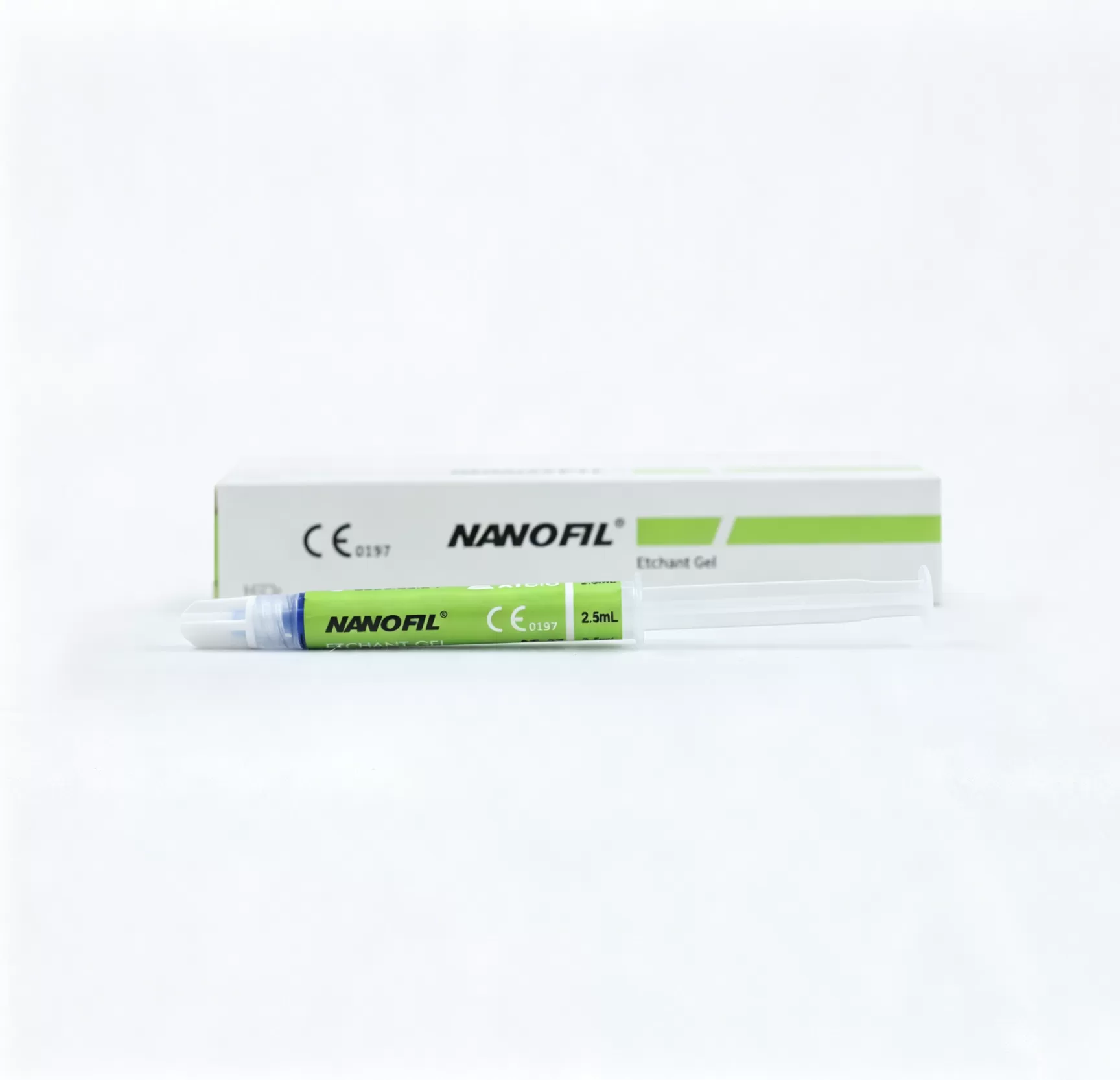
| Parameter | NANOFIL® Dental Etchant Gel | NANOFIL Nova® Etchant Gel |
|---|---|---|
| Phosphoric acid concentration | 35% / 37% | 35% / 37% |
| Visual appearance | Dark blue | Semi-gel, blue |
| Consistency | Gel-like, easy to rinse | High viscosity |
| Rinsing | Easy rinse | Swift, residue-free rinsing |
| Technique & scope | Enamel/dentin etching (total-etch technique); also conditions metal, ceramic & other prosthesis surfaces | Selective-etch primarily; total-etch on demand; cleaner for indirect restorations (not for zirconia) |
| Bonding performance | Removes contaminated layer & improves surface properties for bonding | Supreme adhesion for enamel & dentin bonding |
| Antimicrobial (BAC) | — | Optional BAC (0.1%) formula |
| Packaging | 2.5 ml & 5 ml syringes; single or ×2 kits | 5 ml syringe; 20 × 25-gauge fine-tip applicators included |
The classic NANOFIL Etchant Gel is a dependable workhorse for daily bonding procedures, while the NANOFIL Nova Etchant Gel is formulated for clinicians who want maximum placement control with high-viscosity handling and residue-free rinsing. Both are part of the ATBIO etching gel range.
Interested in evaluating ATBIO etching gel and adhesive solutions for your practice or distributorship? Request product information →
Unboxing Video
See what comes in the box: ATBIO dental etching gel packaging, syringes, and fine-tip applicators.
08 — FAQ: Dental Etching Gel Questions
What is acid etching in dentistry?
Acid etching in dentistry is the conditioning of tooth enamel — and dentin in total-etch procedures — with phosphoric acid before applying bonding agents, composites, sealants, or orthodontic brackets. It creates the micro-rough surface that resin needs to bond, and it is the established first step in adhesive dentistry [PMID 13271655].
How long should 37% phosphoric acid gel stay on enamel?
The manufacturer's instructions should always be followed. As a clinical reference, the evidence-based sweet spot for 35–37% phosphoric acid is 15–20 seconds, which produces the 5–10 µm prism-level etch pattern associated with optimal bond strength (Van Meerbeek et al. 2003, PMID 12760693).
What are the types of etching gels used in dentistry?
The main types are phosphoric acid gels (35%/37%), mild-acid etchants used in specific adhesive systems, and polyacrylic acid conditioners for glass ionomers. Gel, liquid, and foam formats exist; gel is the most common for adhesive restorations.
What is the difference between a gel etchant and a liquid etchant?
A gel has higher viscosity and stays where it is applied, which gives the clinician more control and reduces the risk of acid running onto soft tissue. Liquids flow more readily and are harder to confine.
Can a tooth etching gel be used on dentin?
In total-etch adhesive systems, phosphoric acid is applied to dentin for a shorter time than enamel and then thoroughly rinsed. Selective-etch and self-etch approaches are alternatives, depending on the adhesive system used [PMID 18023859].
Can a tooth etching gel be used before pit and fissure sealants?
Yes. Etching the fissure enamel before sealant placement is a standard part of resin-based sealant procedures and improves sealant retention — the mechanism is the same one bonding agents rely on [PMID 12760693].
Is etching dental enamel safe?
Phosphoric acid etching is an established, widely used step in adhesive dentistry. It removes only a microscopic layer of enamel, and the surface forms a stable interface once the restoration or sealant is bonded. Decades of clinical use document this safety record [PMID 13271655]. Adhering to the manufacturer's instructions and maintaining isolation are essential.
09 — References
Buonocore MG. A simple method of increasing the adhesion of acrylic filling materials to enamel surfaces. Journal of Dental Research. 1955;34(6):849-853. pubmed.ncbi.nlm.nih.gov/13271655
Van Meerbeek B, De Munck J, Yoshida Y, et al. Buonocore memorial lecture. Adhesion to enamel and dentin: current status and future challenges. Operative Dentistry. 2003;28(3):215-235. pubmed.ncbi.nlm.nih.gov/12760693
Erhardt MC, Toledano M, Osorio R, Pimenta LA. Histomorphologic characterization and bond strength evaluation of caries-affected dentin/resin interfaces: effects of long-term water exposure. Dental Materials. 2008;24(6):786-798. pubmed.ncbi.nlm.nih.gov/18023859
ATBIO. Etching Gel Product Range — Overview.
ATBIO. Contact and partnership.
About the Manufacturer
ATBIO (AT&M Biomaterials Co., Ltd., Beijing) has manufactured dental materials for 38 years. The company's products carry CE marking under MDR 2017/745, are produced under EN ISO 13485 quality management, and are exported to more than 100 countries. For partnership or product inquiries, contact info@atmbio.com or +86-10-69778208.
Related Products
Do you prefer online learning?
Live webinars and professional tips — learn when, where and how.
Access our online learning opportunities